Wrapped Tokens: What They Are and How They Work
Wrapped tokens let a coin from one blockchain be used on another. This guide explains wrapping, why it exists and the risks to check first.
On this page
Short answer
A wrapped token is a token on one blockchain that represents a coin from another blockchain, backed one-to-one by the original coin held in reserve. Wrapping exists because blockchains cannot read each other directly, so a wrapped version lets a coin be used in apps and exchanges on a chain it was not built for.
What is a wrapped token?
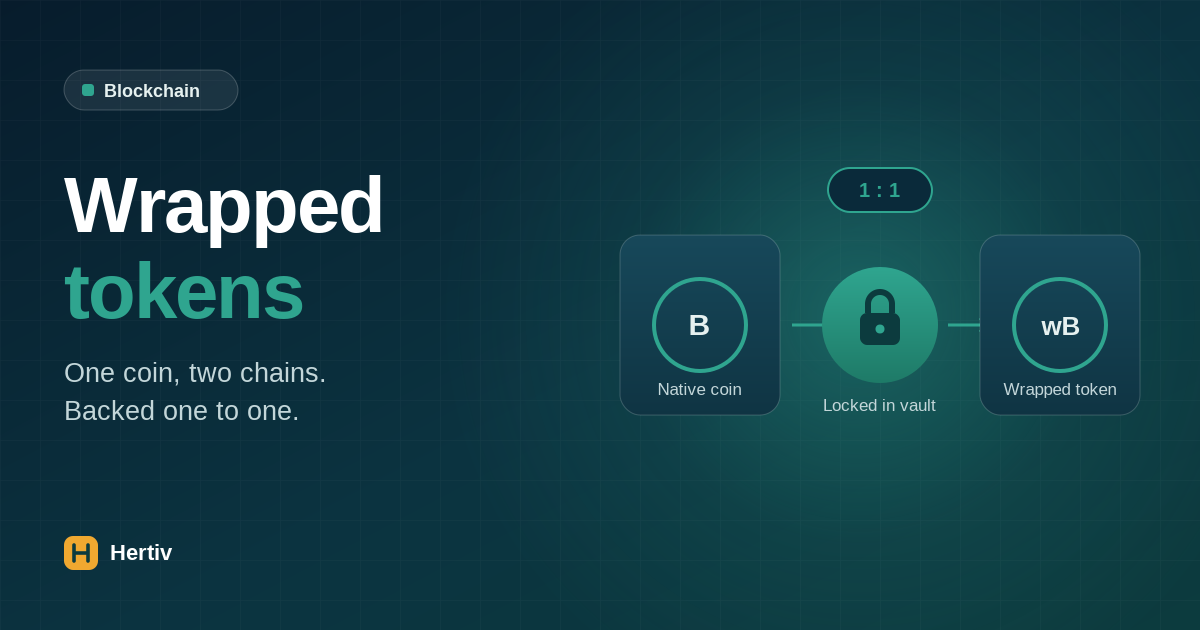
A wrapped token is a token issued on one blockchain that stands in for a coin from a different blockchain. The original coin is locked in a reserve, and an equal amount of wrapped tokens is issued on the target chain. One wrapped bitcoin, for example, is backed by one bitcoin held in reserve.
The wrapped token behaves like any other token on its chain: it can be traded, lent, staked or used in decentralised apps. When the holder wants the original coin back, they return the wrapped token and the reserve releases the original coin. That two-way path is what makes the peg hold.
Wrapping is a bridge between chains. Blockchains are separate systems that cannot read each other's state, so a coin cannot simply move from one to the other. Wrapping creates a representation of it instead. For the basics of the chains involved, see what blockchain is.
How does wrapping work?
Wrapping works in four steps, and each step is handled by a custodian or a smart contract, depending on the design.
- Lock. The user sends the original coin to a custodian or a locking contract.
- Mint. An equal amount of wrapped tokens is issued on the target chain and sent to the user.
- Use. The wrapped tokens move freely on the target chain, in trading, lending or apps.
- Redeem. The user returns the wrapped tokens, they are burned, and the original coin is released.
The peg depends on the reserve always matching the wrapped supply. If 1,000 wrapped tokens exist, the reserve must hold 1,000 original coins. Audits and public proof of reserves exist to let holders check that, though not every wrapped token publishes them.
Wrapped vs native: what changes?
A wrapped token and the native coin it represents are equal in value but different in where they can be used and who you must trust.
| Area | Native coin | Wrapped token |
|---|---|---|
| Chain | Its own blockchain | A different blockchain |
| Use in apps | Only on its own chain | On the target chain's apps |
| Backing | None needed | One-to-one reserve |
| Trust needed | The chain itself | Custodian or bridge contract |
| Risks | Chain and price risk | Plus custodian and bridge risk |
| Redeem | Not needed | Return token, release coin |
The most widely used example is Wrapped Bitcoin (WBTC), which lets bitcoin be used in Ethereum apps. Similar wrapped versions exist for other coins and other chains.
Why wrap a token at all?
Teams wrap tokens for three practical reasons: to use a coin in apps on another chain, to trade it where it is not listed, and to earn yield on it.
The first reason is the biggest. A bitcoin holder who wants to lend on an Ethereum app cannot send bitcoin there directly, but wrapped bitcoin works in that app like any Ethereum token. The second reason is access: a coin may be listed on exchanges on one chain but not on another. The third is yield: lending and liquidity pools on the target chain can pay a return on the wrapped token.
None of these reasons changes the coin itself. Wrapping is packaging, not a new asset, and the wrapped token is only as sound as the reserve and the bridge behind it. Stablecoins face a similar question of backing — see what a stablecoin is for how backing and reserves work there.
Example (hypothetical): wrapping bitcoin for a lending app
Example (hypothetical): a holder has 2 bitcoin and wants to lend them on an Ethereum lending app that only accepts Ethereum tokens. She sends the 2 bitcoin to the wrapping service, which locks them in reserve and mints 2 wrapped bitcoin on Ethereum.
She deposits the 2 wrapped bitcoin in the lending app. The app lends them out and pays her a return — the numbers here are made up for the example, so say the app pays 3% a year, which is 0.06 wrapped bitcoin over a year on 2 tokens. When she wants her bitcoin back, she withdraws the wrapped tokens, returns them to the wrapping service, the service burns them and releases her 2 bitcoin.
The arithmetic she checks is simple: 2 wrapped tokens in, 2 bitcoin out, plus whatever the lending app paid. If the reserve held only 1.5 bitcoin for 2 wrapped tokens, the peg would be broken — which is why she checks the published proof of reserves before wrapping.
What are the risks of wrapped tokens?
Wrapped tokens add risks on top of the coin's own price risk. The main ones are custodian risk, smart contract risk and depegging.
- Custodian risk. If a central custodian holds the reserve, holders trust that custodian to keep it safe and to redeem on demand.
- Smart contract risk. If a bridge contract holds the reserve, a bug in that contract can put the reserve at risk.
- Depegging. If the market doubts the reserve, the wrapped token can trade below the value of the coin it represents.
- Redemption friction. Some wrapped tokens are hard to redeem in a crisis, when many holders try at once.
- Regulatory risk. Custodians and issuers face rules that differ by country, and those rules can change.
Before using a wrapped token, check who holds the reserve, whether proof of reserves is published, how redemption works and whether the contract has been audited. If those answers are not public, treat the token with caution. For wallet setup and custody choices, see crypto wallet development.
What are the common mistakes?
The most common mistakes with wrapped tokens are treating them as the same as the original coin, ignoring the bridge and assuming the peg cannot break.
- Assuming one-to-one is guaranteed. The peg holds only while the reserve matches the supply and redemptions work.
- Ignoring who holds the reserve. A wrapped token is a claim on a custodian or a contract, not on the chain itself.
- Using wrapped tokens in long-term storage. For holding, the native coin in your own wallet is usually the safer choice.
- Skipping the audit check. If the bridge contract has no public audit, that is a warning sign.
- Forgetting the fees. Wrapping, unwrapping and moving between chains each cost fees, which add up on small amounts.
Key takeaways
- A wrapped token represents a coin from another chain, backed one-to-one by a reserve
- Wrapping exists because blockchains cannot read each other directly
- Wrapped tokens add custodian and bridge risk on top of the coin's own risk
- Check the reserve, the proof of reserves and the redemption path before wrapping
- For long-term holding, the native coin in your own wallet is usually the safer choice
Frequently asked questions
What is the most common wrapped token?
Wrapped Bitcoin (WBTC) is the most widely used. It represents bitcoin on Ethereum, backed one-to-one by bitcoin held in reserve, and it lets bitcoin be used in Ethereum lending and trading apps.
Is a wrapped token the same as a stablecoin?
No. A stablecoin is pegged to a fiat currency such as the dollar, while a wrapped token is pegged to another cryptocurrency. Both rely on reserves, but they track different things.
Can a wrapped token lose its peg?
Yes. If the market doubts the reserve, or redemptions stop working, the wrapped token can trade below the value of the coin it represents. That is called depegging, and it has happened to wrapped tokens before.
Who holds the reserve for a wrapped token?
It depends on the design. Some wrapped tokens use a central custodian that holds the coins, while others use a smart contract or a decentralised bridge. Check the specific token's documentation before using it.
How do I unwrap a token?
You return the wrapped tokens to the wrapping service or bridge, they are burned, and the original coin is released to your wallet. Fees apply, and redemption can be slow during periods of heavy demand.
Should I hold wrapped tokens long term?
For long-term holding, the native coin in a wallet you control is usually safer, because it carries no custodian or bridge risk. Wrapped tokens are best for short-term use inside apps on another chain.


