Why Develop a DeFi App? The Business Case
DeFi apps let users lend, borrow and trade without a bank in the middle. Here is why businesses build them, what they earn and what the risks are.
On this page
Short answer
A DeFi app is software that lets users lend, borrow, trade and earn yield on digital assets through smart contracts instead of through a bank or broker. Businesses develop DeFi apps to earn fees from those services, reach users banks do not serve, and build products that run around the clock without manual processing.
What is a DeFi app?
A DeFi app, short for decentralised finance app, is software that offers financial services through smart contracts on a blockchain. Users connect a wallet, deposit assets and use services such as lending, borrowing, swapping tokens or earning yield, with the contract enforcing the rules instead of a bank clerk or a broker.
The app itself is the interface: screens, accounts and support wrapped around contracts that hold the funds and run the logic. The contracts decide who can borrow, at what rate and with what collateral, and they settle trades and liquidate loans automatically when conditions are met.
DeFi apps differ from a crypto exchange in scope. An exchange mainly buys and sells assets. A DeFi app can also lend, stake, insure and build structured products, and it can combine those services so one deposit earns yield in several ways at once.
The key idea is that the rules are public and the settlement is automatic. Anyone can read the contract, and no single company can change the terms after users have deposited. That transparency is the main selling point, and also the main risk, since a bug in the contract is public too.
Why do businesses develop DeFi apps?
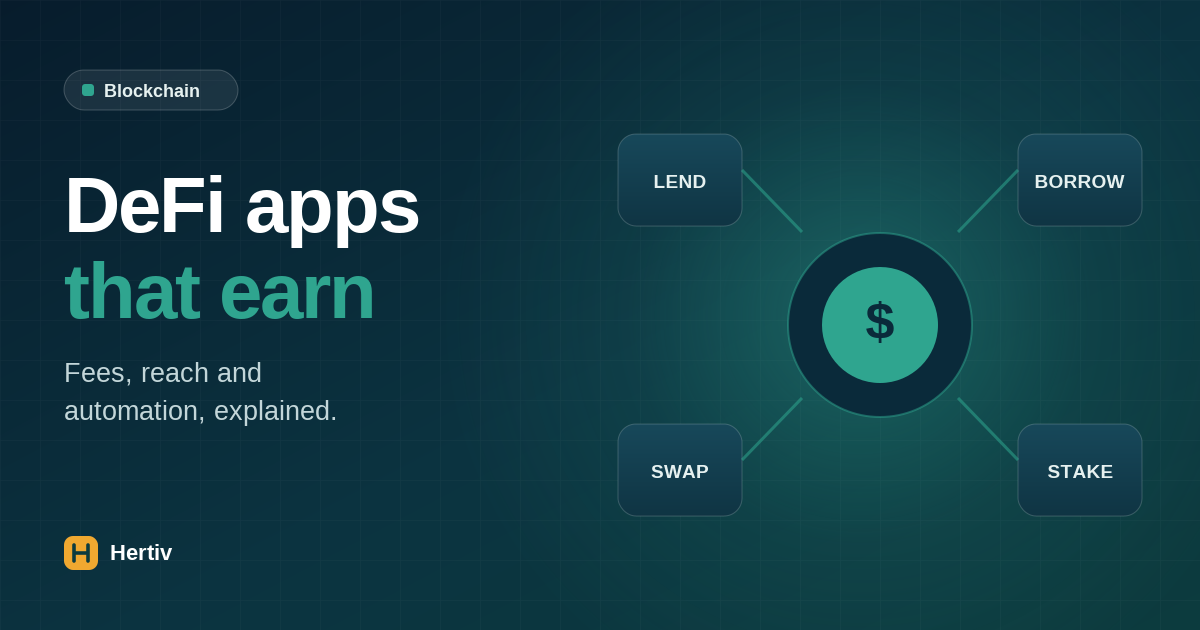
Businesses develop DeFi apps for three reasons: fees, reach and automation. Fees come from lending spreads, trading, staking and liquidations. Reach comes from serving users in places where banks are slow or absent. Automation comes from contracts that settle trades and manage collateral without staff.
Fees are the most direct reason. A lending app earns the spread between what borrowers pay and what lenders receive. A trading app earns a fee on each swap. A staking app earns a share of the yield it routes to users. Each stream is small per transaction, but volume makes it add up.
Reach matters because a DeFi app needs only an internet connection and a wallet. That opens markets where opening a bank account is hard, and it lets a small team serve users in many countries without opening offices. The trade-off is that the team must handle rules that differ by region.
Automation is the third reason. A contract can liquidate an under-collateralised loan in seconds, at any hour, without a risk team working nights. That lowers operating cost, but it also means the team must get the contract right, since there is no human to catch a mistake in time.
How do DeFi apps make money?
DeFi apps make money from fees on the services they offer, and the table below shows the main revenue streams and how each one works.
| Revenue stream | How it works | Typical range |
|---|---|---|
| Lending spread | Borrowers pay more than lenders receive | A few points of the loan rate |
| Trading fees | A fee on each swap or trade | A fraction of a percent per trade |
| Staking share | A share of the yield routed to users | A share of the staking reward |
| Liquidation fees | A fee when a loan is closed out | A share of the collateral sold |
| Token fees | Fees for minting or managing tokens | Set per transaction |
The ranges above are planning figures, not quotes, since rates move with the market and differ by chain and asset. The point is that no single stream is large; the business works when volume is high and costs stay low.
Some apps also issue a governance token, which can raise funds and reward users, but a token is not revenue. It is a liability to manage, with holders who expect a say in the rules. Teams that treat a token as free money usually regret it.
For a cost view of the build itself, see DeFi development cost breakdown.
For the wider case, popular DeFi use cases shows which services attract users.
What does a DeFi app need to work?
A DeFi app needs four things to work: audited contracts, reliable price data, liquidity and a usable interface. Each one is a project in itself, and a weak link in any of them can sink the app.
Audited contracts are first. The contracts hold user funds, so they need an independent audit before launch and a bug bounty after it. A contract that has not been audited is a risk no marketing can offset.
Reliable price data is second. Lending and liquidation depend on knowing the price of the collateral, so the app needs a price feed it can trust, with a fallback if the feed fails. A wrong price can liquidate loans that should be safe.
Liquidity is third. A lending app needs lenders, a trading app needs traders, and both need enough volume for prices to be fair. Teams usually seed liquidity with their own funds or incentives, and plan for the cost before launch.
The interface is fourth. Users need to understand what they are doing, what it costs and what can go wrong. A confusing interface in a financial app is not a design flaw; it is a safety problem. For help scoping the build, DeFi development covers the process.
What are the risks of developing a DeFi app?
The risks of developing a DeFi app fall into four groups: smart contract risk, market risk, legal risk and operational risk. Each needs a different answer, and none of them goes away after launch.
Smart contract risk is the risk of a bug or an exploit in the code. Even audited contracts have been drained, so teams use audits, bug bounties, limits on how much can be withdrawn at once, and a pause function controlled by more than one person.
Market risk is the risk that prices move faster than the app can react. A sharp fall can trigger liquidations that cascade, and a thin market can make prices easy to push around. Limits on loan size, collateral rules and circuit breakers are the standard defences.
Legal risk is the risk that the app's services are regulated in a region it serves. Lending, securities and payments rules differ by place, and a team that ignores them can face fines or a forced shutdown. Get legal advice for each region before launch, and design the app so it can block regions it cannot serve.
Operational risk covers the rest: a broken price feed, a compromised admin key, a support failure during an outage. Multi-signature controls, tested incident plans and honest status updates are the boring defences that matter most when something goes wrong.
Example: a small lending app and its first year
Example (hypothetical): a team of 5 builds a lending app on one chain. Users deposit a stablecoin and earn interest, while borrowers deposit crypto as collateral and borrow the stablecoin. The app takes a spread of 2 points: lenders earn 4 percent a year, borrowers pay 6 percent.
In the first year the app holds 2,000,000 dollars in deposits on average. Lenders earn 4 percent, which is 80,000 dollars a year, and borrowers pay 6 percent, which is 120,000 dollars a year. The spread is 40,000 dollars, which is the app's revenue from lending before costs.
The costs are 60,000 dollars for the audit, 30,000 dollars for the price feed and infrastructure, and 20,000 dollars for liquidity incentives, a total of 110,000 dollars in the first year. The app loses 70,000 dollars in year one, which the team had budgeted for, and breaks even in year two if deposits grow to 5,000,000 dollars, where the spread becomes 100,000 dollars.
The lesson is that a DeFi app is a volume business. A small app with honest rates loses money in its first year, and the team must have the funds to reach the volume where the spread covers the costs.
What are the common mistakes?
The most common mistakes in developing DeFi apps come from underestimating the audit, the liquidity and the legal work, and from treating a token launch as the business.
- Skipping the audit. An unaudited contract holding user funds is a risk no launch date can justify.
- Launching with no liquidity. A lending app with no lenders has no loans, and a trading app with no traders has no prices.
- Ignoring legal review. Rules differ by region, and a shutdown costs more than the advice would have.
- Treating a token as revenue. A governance token is a liability to manage, not free money.
- No pause or limits. A contract with no way to stop a drain leaves the team helpless during an attack.
- Confusing interfaces. Users who do not understand the risks will lose money and blame the app.
Build the case on fees and volume, audit the contracts, seed the liquidity, get the legal advice, and launch small enough to survive the first year.
Key takeaways
- A DeFi app offers lending, borrowing and trading through smart contracts
- Revenue comes from spreads, trading fees and staking shares, not tokens
- Audited contracts, price feeds, liquidity and a clear interface are all required
- Smart contract, market, legal and operational risks each need a plan
- A DeFi app is a volume business that usually loses money in year one
Frequently asked questions
What is a DeFi app?
A DeFi app is software that offers financial services such as lending, borrowing, trading and staking through smart contracts on a blockchain. Users connect a wallet and use the services directly, with the contract enforcing the rules instead of a bank or broker.
Why would a business build a DeFi app instead of a fintech app?
A DeFi app can serve users in many countries without offices, run around the clock, and settle trades automatically. The trade-off is more risk: smart contract bugs, price swings and rules that differ by region. A fintech app is simpler to run but needs banking partners and licences.
How much does it cost to develop a DeFi app?
Cost depends on scope, chain and audit needs. A small lending or staking app is a five-figure build plus an audit, while a larger platform with several services costs far more. Plan for the audit, price feeds, liquidity incentives and a year of maintenance on top of the build.
Is a DeFi app legal?
It depends on the region and the services offered. Lending, securities and payments rules differ by place, and some services need a licence. Get legal advice for each region you plan to serve, and design the app so it can block regions it cannot serve.
Do DeFi apps need a token?
No. Many DeFi apps work without a token, earning fees from lending, trading and staking. A token can raise funds and reward users, but it is a liability to manage, with holders who expect a say in the rules. Do not launch a token to fund the build.
What is the difference between a DeFi app and a DEX?
A DEX is one kind of DeFi app, focused on swapping tokens. A DeFi app can also lend, borrow, stake and insure, and it can combine those services. If you only need trading, a DEX is enough; if you need lending and yield too, build the wider app.


