Why Decentralized Custody Matters for Crypto Teams
Decentralized custody spreads control of crypto keys across people and rules, so no single failure can move funds, and this guide explains why teams choose it.
On this page
Short answer
Decentralized custody matters because it removes the single point of failure in holding crypto: no one person, device or company holds the full key, so a hack, a lost laptop or a rogue employee cannot move funds alone. Teams choose it when they hold enough value that one failure would be costly, and it works through key sharing, multi-signature rules or smart contract wallets that require several approvals.
What is decentralized custody?
Decentralized custody is a way of holding crypto assets in which control of the keys is spread across several people, devices or rules, so that no single party can move funds on its own. Instead of one private key held by one person or one company, the power to sign a transaction is split and shared.
The idea is simple: a single key is a single point of failure, and a single point of failure is what attackers look for. The table below compares the main custody models, and the rest of this article explains why teams choose the decentralized ones.
| Model | Who holds the key | Single failure? | Best for |
|---|---|---|---|
| Custodial | One company | Yes | Small holders |
| Single wallet | One person | Yes | Personal use |
| Multi-signature | Several key holders | No | Teams and funds |
| MPC | Key shares on devices | No | Businesses |
| Smart contract wallet | Rules on chain | No | DAOs and treasuries |
Decentralized custody is not one product. It is a design choice that can be built with multi-signature wallets, multi-party computation or smart contract rules, and the right build depends on who needs to approve a transaction and how fast it must happen.
Why teams move to decentralized custody
Teams move to decentralized custody for one reason above all: they hold enough value that a single failure would be expensive. A fund, a DAO treasury or a company payroll in crypto cannot accept that one lost laptop or one compromised employee empties the wallet.
The second reason is internal control. When three people must approve a payment, no one person can move funds alone, and every payment leaves a record of who approved it. That record matters for audits, for investors and for the team itself, because it turns trust in one person into a process anyone can check.
The third reason is resilience. A company that holds its keys in one place loses access when that place fails, whether the failure is a hack, a fire or a legal freeze. Spreading the keys across people and devices means the team can still operate when one part is down, as long as enough key holders remain.
How key sharing works in practice
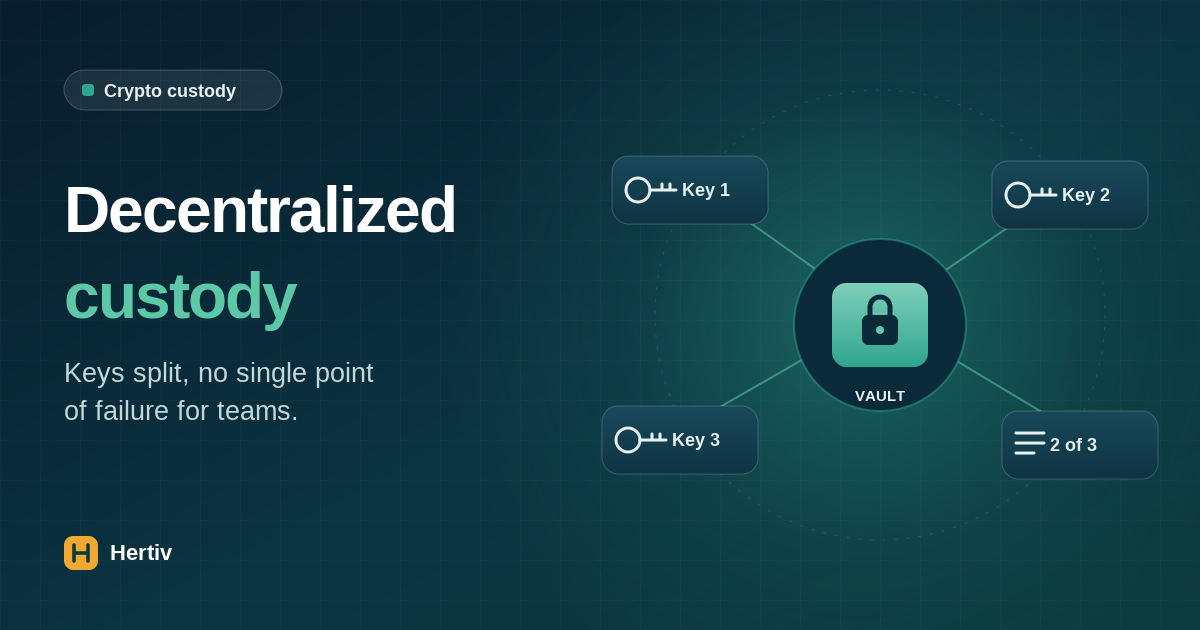
Key sharing works by splitting the power to sign a transaction so that several approvals are needed. In a multi-signature wallet, the rule is written as a threshold, such as two of three or three of five key holders must sign. A transaction with too few signatures simply does not move.
Multi-party computation, known as MPC, splits a single key into shares held on different devices. No device ever holds the full key, and the shares combine only at the moment of signing. The result looks like a normal wallet to the outside world, which makes MPC easy to use with existing systems.
Smart contract wallets put the rules on chain instead. The wallet is a contract that says who can approve, how many approvals are needed, and what limits apply, such as a daily spending cap. The rules are visible to everyone and cannot be changed by one person in secret.
For the key technology behind one of these models, what an MPC wallet is explains how key shares are created and used.
The risks that remain with decentralized custody
Decentralized custody removes one risk and adds others, and teams that ignore the new risks can lose funds just as surely. The most common is losing access: if enough key holders lose their keys or leave the team, the funds can become unreachable, because no one can gather the required approvals.
Smart contract wallets add code risk. A bug in the wallet contract can be exploited, and a contract that cannot be upgraded cannot be fixed quickly. Teams that use smart contract wallets should have the contract audited and keep a tested recovery path.
Coordination is the third risk. A payment that needs three approvals can stall when one approver is on holiday or unreachable, and a team that needs to move fast in a crisis can find its own rules in the way. The fix is to plan for absence, with backup approvers and clear rules for emergencies, before the crisis arrives.
How to choose a decentralized custody setup
Choose a setup by writing down who must approve, how fast money must move, and what happens when someone is away, then pick the model that fits those three answers.
- List the approvers. Name the people or roles that must approve a payment, and how many approvals each amount needs.
- Set the threshold. Pick a rule such as two of three for daily payments and three of five for large ones, and write it down.
- Plan for absence. Name backup approvers and a recovery path for lost keys, and test the recovery path before you need it.
- Check the audit trail. Confirm that every approval is recorded, so an auditor can see who approved what and when.
- Test with small amounts. Move a small amount through the full approval flow first, and only scale up when the process works smoothly.
Keep the setup as simple as the risk allows. A two-of-three rule that everyone understands beats a complex scheme nobody follows. MPC wallet development can help if you want a custody setup built for your team.
Example (hypothetical): a small fund splits its keys
Example (hypothetical): a small crypto fund holds $600,000 in a wallet and sets a two-of-three rule. Three partners each hold one key, and any two of them must sign a payment.
The fund moves $30,000 a month in expenses, in 6 payments of $5,000. Each payment needs two signatures, so the fund makes 12 signatures a month. If one partner is away for two weeks, the other two can still sign, and the payments continue.
One month, a partner's laptop is stolen. The thief has one key, but one key alone cannot move funds under a two-of-three rule, so the $600,000 stays safe. The fund replaces the stolen key with a new one, at the cost of a few hours of work, and the total loss is zero. That is the point of the split: a single failure costs time, not money.
Common mistakes with decentralized custody
The most common mistakes are setting a threshold nobody can meet, skipping the recovery test, and treating the setup as finished once it is built.
- Threshold too high. A four-of-five rule sounds safe until two approvers are away and nothing can move. Match the threshold to real availability.
- No recovery test. A recovery path that has never been tested is a guess. Test it with a small amount before you rely on it.
- Keys in one place. Three keys stored in the same office or the same cloud account are not decentralized. Spread them across people and places.
- No audit trail. Approvals that leave no record cannot be checked later. Record who approved what and when.
- Ignoring smart contract risk. A wallet contract with no audit is a risk of its own. Audit the contract and keep a recovery path.
- No emergency plan. A crisis payment that needs three approvals and two approvers are away will stall. Plan for absence in advance.
Key takeaways
- Decentralized custody spreads key control so no single failure can move funds
- Multi-signature, MPC and smart contract wallets are the three main ways to build it
- Teams choose it for resilience, internal control and a clear audit trail
- Lost keys and slow approvals are the main risks, so plan backups and recovery
- Set the threshold to match real availability, not maximum caution
- Test the recovery path with a small amount before you rely on it
Frequently asked questions
What is decentralized custody?
Decentralized custody is holding crypto so that no single person, device or company controls the keys alone. Control is split across several key holders, key shares or smart contract rules, and a transaction needs more than one approval to move.
How is decentralized custody different from a normal wallet?
A normal wallet has one private key held by one person or one company, so a single failure can lose or move the funds. Decentralized custody splits that power, so several approvals are needed and one failure costs time rather than money.
What is the difference between multi-signature and MPC custody?
Multi-signature wallets need several separate keys to sign, and the rule is visible on chain. MPC splits one key into shares on different devices, so no device holds the full key, and the wallet looks like a normal wallet to the outside world.
Is decentralized custody safer than custodial custody?
It removes the risk of one company failing or being hacked, but it adds the risk of lost keys and slow approvals. It suits teams that hold enough value to justify the extra process, and it needs a tested recovery path to be safe in practice.
What happens if a key holder loses their key?
It depends on the threshold. Under a two-of-three rule, the other two holders can still sign, and the team replaces the lost key. Under a three-of-three rule, a lost key can lock the funds, which is why thresholds should allow for one loss.
Who should use decentralized custody?
Funds, DAO treasuries, companies holding crypto payrolls and any team where one person's mistake or one hack could move a large sum. Small personal holders usually do not need it, because a single secure wallet with a backup is simpler.


