White Label Tokenization Launchpad: How to Run Token Sales
A tokenization launchpad lets you run token sales under your own brand. Learn what it includes, how a launch works, and what to check before you pick one.
On this page
Short answer
A white label tokenization launchpad is ready-made software that lets a business run token sales under its own brand. It covers token creation, investor onboarding, payment collection and distribution, while the business keeps its name, colours and domain. It suits teams that want to launch without building sale infrastructure from scratch.
What is a white label tokenization launchpad?
A white label tokenization launchpad is software that a business licenses and runs under its own brand to launch and sell tokens. The provider builds the sale pages, the investor dashboard, the token contracts and the payment flow, while the business keeps its name, logo and domain.
It differs from a public launchpad, where projects apply to list on someone else's platform. With a white label version, the business controls the brand, the sale terms and the investor list. The provider stays invisible to the investor.
The main parts are:
| Part | What it does | Who sees it |
|---|---|---|
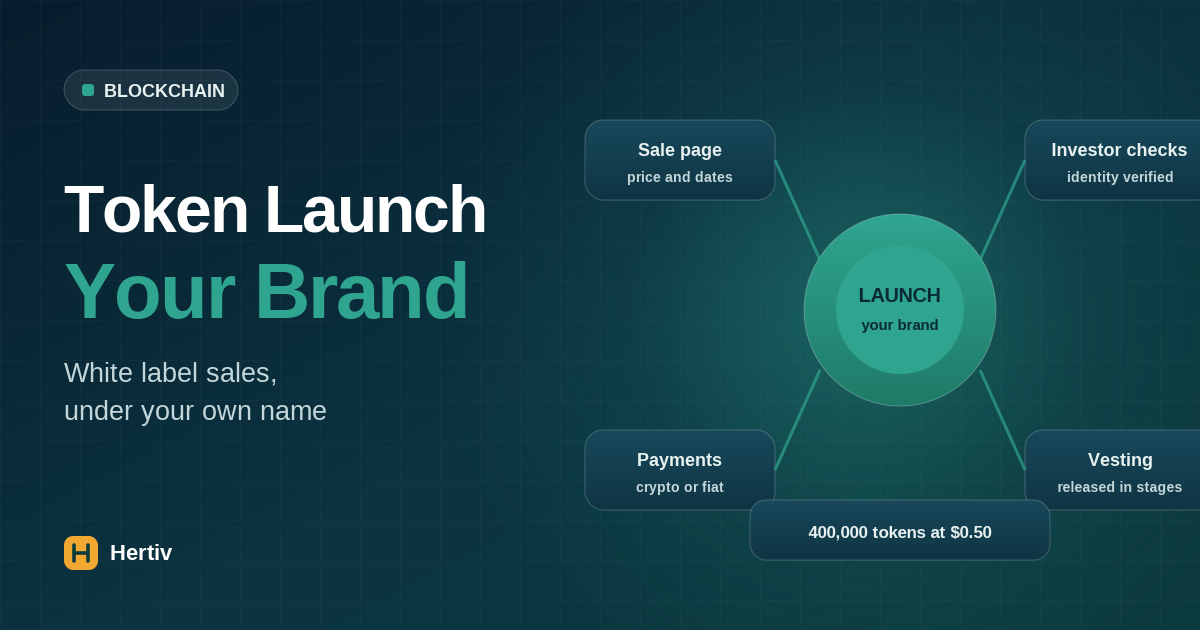
| Sale page | Shows the offer, price and timeline | Investors |
| Token contracts | Create and distribute the tokens | Nobody directly |
| Investor checks | Identity and eligibility checks | Investors and the team |
| Payments | Collects funds in crypto or fiat | Investors and the team |
| Dashboard | Tracks sales, investors and claims | The team |
Most buyers are funds, real estate firms and startups that want to tokenise an asset and raise money from it. If you are comparing tokenisation routes, real world asset tokenization explains the wider model this fits into.
How does a token launch work on a launchpad?
A token launch on a white label launchpad follows a fixed sequence: set up the sale, open it to checked investors, collect funds, then distribute tokens on the agreed schedule. Each step is handled by the platform, so the team focuses on the offer and the investors.
A typical sequence looks like this:
- Configure the sale. Set the token price, total supply, sale dates, minimum and maximum purchase, and the vesting schedule.
- Deploy the contracts. The platform deploys token and sale contracts, usually audited templates, on the chosen chain.
- Open investor onboarding. Investors create an account, pass identity checks and connect a wallet.
- Run the sale. Investors buy during the sale window. Funds are held in the sale contract or a custody account.
- Distribute and list. Tokens are released per the vesting schedule, and the team can list them on an exchange afterwards.
Vesting matters more than most teams expect. If all tokens release at once, early buyers can sell immediately and the price falls. A staged release spreads that pressure over months.
What features should you expect?
A launchpad worth using covers the whole sale, not just the payment page. The features that matter most are the ones that protect investors and keep the team in control of the process.
- Investor checks. Identity verification, sanction screening and eligibility by country, with records the team can audit.
- Flexible sale types. Fixed price, tiered pricing, whitelist rounds and public rounds, so the sale can match the plan.
- Vesting and claims. A schedule investors can see, with a claim page that releases tokens on time.
- Multi-chain support. The ability to launch on more than one chain without rebuilding the sale.
- Reporting. A clear record of who bought, how much, and when, for accounting and compliance.
- Admin controls. Pause, refund and close functions the team can use without calling the provider.
Ask the provider what happens if the sale fails to reach its target. A refund path should be part of the platform, not a manual process the team has to invent under pressure.
What does a white label launchpad cost?
A white label launchpad usually costs a setup fee plus a share of the funds raised, and the exact numbers depend on the provider, so check the vendor site for current pricing. Some providers charge a flat monthly fee instead, which suits teams that run several sales a year.
The cost drivers are:
| Cost item | What drives it |
|---|---|
| Setup and branding | Custom design, domain and integrations |
| Sale fee | Share of funds raised, often tiered |
| Contract audit | Whether audits are included or separate |
| Compliance checks | Identity checks per investor |
| Support | Hours, languages and response time |
Budget for legal advice separately. A launchpad handles the software, but the team still needs advice on whether the token is a security in each country where it is sold. That question decides the sale structure, and it is not something software can answer.
Example (hypothetical): a property fund launches a token sale
Example (hypothetical): a property fund wants to raise money for one building by selling tokens that represent a share of it. It licenses a white label launchpad, brands the sale page with its own name, and sets the token price at $0.50 with a total supply of 1,000,000 tokens.
The sale opens to 400 checked investors. In the first round, 40% of the tokens sell: 400,000 tokens at $0.50, which raises $200,000. The launchpad charges a 2% sale fee, which is $4,000, so the fund receives $196,000 before legal and audit costs.
The remaining tokens vest over 12 months, with a claim page releasing them in equal monthly parts. Investors can see the schedule before they buy, which avoids surprises. The fund keeps the investor list and the sale records for its own reporting.
The numbers are small on purpose. The point is the shape: a branded sale, checked investors, a visible vesting schedule, and a clear fee. If any of those four are missing, the launch is harder to run and harder to defend.
How do you choose a white label launchpad?
You choose a white label launchpad by testing the sale flow end to end and checking the parts that fail most often: contracts, investor checks and refunds. A demo on slides is not enough.
- Run a test sale. Buy a token as a test investor, pass the checks, claim a vested token and request a refund. Note every step that is slow or unclear.
- Read the contracts. Ask who audited the token and sale contracts, when, and what the audit covered.
- Check the compliance flow. Confirm which countries are supported and what records the platform keeps.
- Confirm the fee structure. Get the setup fee, the sale fee and the per-investor check cost in writing.
- Ask about support during a live sale. Find out who answers, how fast, and in which time zone, because sales do not wait for office hours.
For teams weighing a launch against other ways to raise money, how to launch a stablecoin is a useful contrast, since a stablecoin launch has different rules and a different audience.
What are the common mistakes?
The most common mistakes with a white label launchpad are skipping legal advice, promising returns, and launching before the investor checks are tested. Each one is easy to avoid and expensive to fix after the sale starts.
- No legal review. Selling a token without advice on securities rules in each target country is the biggest risk in any launch.
- Promising returns. Marketing that implies a token will rise in value attracts the wrong investors and the wrong attention.
- Untested checks. If identity checks fail during the sale, real investors are blocked and the team loses trust.
- No vesting plan. Releasing all tokens at once invites immediate selling and a sharp price drop.
- Ignoring refunds. A sale that misses its target needs a refund path that works without manual work.
- Weak support. Investors who cannot get help during a live sale will not come back for the next one.
If the token is a stable asset, what is a stablecoin explains the model and the rules that apply to it.
Key takeaways
- A white label tokenization launchpad is a branded sale platform, not a public listing
- It covers token creation, investor checks, payments and vesting under your own brand
- Vesting and refund paths matter as much as the sale page itself
- Legal advice and contract audits come before marketing, not after
- Test the full sale flow as an investor before you open it to the public
Frequently asked questions
What is the difference between a white label launchpad and a public launchpad?
A public launchpad lists projects on its own platform and brand, and investors come to it. A white label launchpad is software a business licenses and runs under its own brand, with its own sale page, domain and investor list. The business controls the terms; the provider supplies the technology.
Do I need a licence to run a token sale on a launchpad?
It depends on the token and the countries where it is sold. Some tokens are treated as securities and need a licence or an exemption, while others are not. Get legal advice for each target country before setting sale terms, because the launchpad cannot decide this for you.
How long does it take to set up a white label launchpad?
A standard setup with an existing template usually takes a few weeks, including branding, contract deployment and a test sale. Custom design, extra chains and deeper compliance integrations add time. Allow extra weeks for the contract audit and the legal review.
Can a launchpad handle fiat payments as well as crypto?
Many can, through a payment provider that converts fiat to crypto or holds it in custody. Check which currencies and payment methods are supported, what the conversion fees are, and how refunds work for fiat buyers before you promise it to investors.
What happens if the sale does not reach its target?
A well-run sale either refunds investors automatically or extends the sale under terms set before it opened. Confirm which one applies, who triggers it, and how long refunds take. Do not leave this to be decided after the sale closes.
Is a white label launchpad the same as a tokenization platform?
No. A tokenization platform turns assets into tokens and manages them over time. A launchpad is the sale layer: it runs the token sale, the investor checks and the distribution. Some providers offer both, but they solve different problems.


