White Label ICO Platform: How to Run a Token Sale
An ICO platform lets you run a token sale without building the sale software from scratch. Learn what it includes, how it works and what to check first.
On this page
Short answer
A white label ICO platform is ready-made software that runs an initial coin offering under your own brand, handling token creation, the sale page, payments, investor checks and token distribution. You buy or rent the platform, add your logo, token details and sale rules, and launch without building the sale system from zero.
What is a white label ICO platform?
A white label ICO platform is ready-made software for running an initial coin offering, rebranded as your own product. It provides the token sale page, the dashboard where investors buy tokens, the payment handling and the smart contract that issues the tokens, all under your name and logo.
The "white label" part means the platform provider stays invisible. Your investors see your brand, your domain and your design, not the company that built the software. This is different from building a sale from scratch, where your team writes the contracts, the sale page and the payment flow itself.
Teams use these platforms for public token sales, private rounds and community sales. The sale type changes the rules, such as who can buy and how much they can buy, but the core parts stay the same: a token, a price, a payment method and a way to send tokens to buyers after the sale. For the broader picture of launching a sale, see How to Launch an ICO: A Practical Guide
What does an ICO platform include?
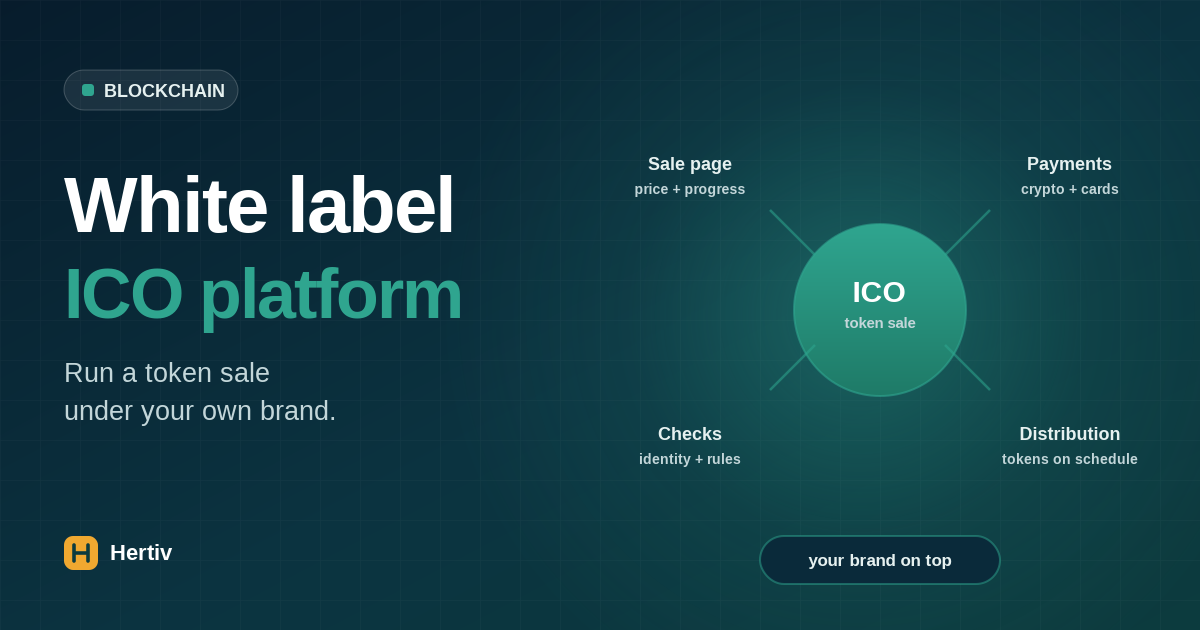
An ICO platform usually includes five parts, and each one matters before launch. Missing any of them means buying it separately or building it yourself, which removes much of the time saving.
| Part | What it does | Why it matters |
|---|---|---|
| Token creation | Makes the token and sets supply, decimals and rules | Errors here are hard to fix after launch |
| Sale page | Shows the offer, price, progress and countdown | This is what investors trust or walk away from |
| Payments | Takes crypto and, in some cases, card payments | More payment options usually means more buyers |
| Investor checks | Runs identity and eligibility checks on buyers | Needed in many places before a public sale |
| Distribution | Sends tokens to buyers, often on a vesting schedule | Late or wrong distribution damages trust fast |
Some platforms also add a referral programme, a dashboard for the sale team and support for several blockchains. Ask which parts are included in the price and which are paid extras, because the headline price rarely covers everything. A token sale also needs a clear legal position, so check the rules in each place where you plan to sell before choosing a platform.
How does an ICO sale work on the platform?
An ICO sale on a white label platform follows a set sequence. Each step is handled by the platform, but your team still owns the decisions behind it.
- Set the token and sale rules. Choose the token name, total supply, sale price, sale dates, minimum and maximum purchase, and how many tokens go to the team, the sale and future use.
- Deploy the smart contract. The platform creates the token contract and the sale contract, and your team reviews them before they go live.
- Open the sale page. Investors connect a wallet, pass the identity check if one is required, and send payment in an accepted currency.
- Record the purchase. The platform logs each buyer, the amount paid and the tokens owed, and shows live progress on the sale page.
- Distribute the tokens. At the end of the sale, tokens are sent to buyers at once or released over time on a vesting schedule.
Most sales run in rounds: a private round for early buyers, then a public round. The price often rises between rounds, which rewards early buyers but also means the team must be clear about the schedule from the start. Changing the price or the supply after buyers have paid is a fast way to lose trust.
What should you check before choosing a platform?
Choosing an ICO platform is a decision about trust as much as about features. Investors send money to a contract your team picked, so the platform's record matters.
- Contract audits. Ask whether the sale and token contracts have been checked by an independent auditor, and read the report rather than taking the claim at face value.
- Chains supported. Check that the platform runs on the chain your buyers already use, and ask what it costs to add another one later.
- Investor checks. Confirm the platform supports the identity checks your sale needs, and how long those checks take for a typical buyer.
- Payment options. Confirm which currencies are accepted and how card payments, if offered, are settled to your team.
- Support and uptime. A sale page that goes down during the first hour of a sale costs real money. Ask what support is included and how outages are handled.
Price is usually a setup fee plus a share of the sale or a monthly fee; check the vendor's own site for current pricing, or ask for a written quote, because published prices change often. The cheapest platform is rarely the best choice when the contract holds other people's money. Fees and terms are best confirmed directly; see the vendor site for the current numbers.
What does an ICO platform cost to run?
The cost of running an ICO platform has three parts: the platform fee, the sale costs and the running costs after launch. Teams that budget for only the first part are surprised by the other two.
The platform fee is usually a setup payment plus a percentage of funds raised, or a monthly subscription. Sale costs include the contract audit, legal advice, identity checks for buyers and marketing to reach investors. Running costs include hosting, support staff during the sale and the distribution of tokens, which can take weeks if vesting is involved.
A realistic budget also covers a contingency for delays. Contract fixes, audit findings and payment provider approvals all take longer than the first estimate. Treat the sale as a project with a team, not as a page you switch on. For the related question of what a token sale costs end to end, the guide on Cost of Launching an ICO: What to Budget For breaks down the same parts in more detail.
Example (hypothetical): a small team runs its first token sale
Example (hypothetical): a team of six builds a tool for small retailers and wants to raise funds through a token sale. It picks a white label ICO platform, sets a total supply of 10,000,000 tokens and a sale price of $0.50 per token, with 4,000,000 tokens offered in the sale.
The team sets a minimum purchase of $100 and a maximum of $10,000 per buyer. If 800 buyers each buy $500 of tokens, the sale raises 800 x 500 = $400,000. At $0.50 per token, those buyers receive 800,000 tokens between them, which is 800,000 x 0.50 = $400,000 of tokens, matching the amount raised.
The platform charges a 2 percent fee on funds raised, which is 2 percent of $400,000 = $8,000. The team also budgets $6,000 for the contract audit and $4,000 for identity checks. Total sale costs are $8,000 + $6,000 + $4,000 = $18,000, leaving $382,000 from the sale before any other costs.
Tokens are released over six months, with one sixth each month, so no buyer can sell everything on day one. The team publishes the schedule before the sale starts and sticks to it.
What are the common mistakes?
The most common mistake with a white label ICO platform is treating it as a shortcut around the hard parts of a token sale. The platform handles the software, but the token design, the legal position and the investor trust are still your team's job.
- Skipping the contract audit. An unaudited sale contract is a risk to every buyer, and a bug found after launch is far more expensive than an audit.
- Unclear token supply. If buyers cannot see the total supply and how tokens are split between the sale, the team and future use, many will not buy.
- No identity checks where needed. Selling to buyers in places where checks are required, without running them, can shut the sale down mid-way.
- Changing the rules mid-sale. Moving the price, the supply or the vesting schedule after buyers have paid breaks trust and is hard to undo.
- No plan for distribution. A sale that ends with buyers waiting weeks for tokens, with no updates, damages the project before it starts.
Key takeaways
- A white label ICO platform runs a token sale under your brand, from token creation to distribution
- The five core parts are token creation, the sale page, payments, investor checks and distribution
- Sales usually run in rounds, with the price often rising between private and public rounds
- Check the contract audit, supported chains, identity checks and support before choosing
- Budget for the platform fee, the audit, legal advice and running costs, not just the setup fee
- Publish the token supply, price and vesting schedule before the sale and do not change them mid-sale
Frequently asked questions
What is the difference between a white label ICO platform and building your own?
A white label platform gives you ready-made sale software under your brand, so you launch in weeks instead of months. Building your own means writing the token contract, sale page, payments and distribution yourself, which gives full control but takes far longer and needs a team that can audit the contracts.
Do I need a smart contract audit for an ICO platform?
Yes, if the platform's contracts will hold buyer funds. An independent audit checks for bugs that could lose money or lock tokens. Ask the platform provider for the audit report and check what was found and fixed, rather than accepting that an audit happened.
Can a white label ICO platform accept card payments?
Some can, through a payment provider that converts card payments into crypto for the sale. Others accept crypto only. Card payments add buyer convenience but also add provider fees and settlement delays, so confirm the terms and the currencies supported before launch.
What is token vesting in an ICO?
Vesting means tokens are released to buyers over time instead of all at once, for example one sixth each month for six months. It stops early buyers from selling everything on the first day and signals that the team expects the project to last. The schedule should be published before the sale.
Which blockchain should an ICO run on?
Choose the chain your likely buyers already use, because asking them to move to a new chain adds friction. The most common choices are the large smart contract chains with established wallets and exchanges. Check that the platform supports your chosen chain and that its contracts have been audited on it.
What happens if an ICO does not reach its target?
It depends on the sale rules you set. Some sales return the funds to buyers if a minimum target is missed, while others keep whatever was raised. Decide this before launch, write it into the sale terms, and tell buyers plainly, because changing the rule after the sale starts is not an option.


