White Label Bitcoin Exchange for Startups: A Clear Guide
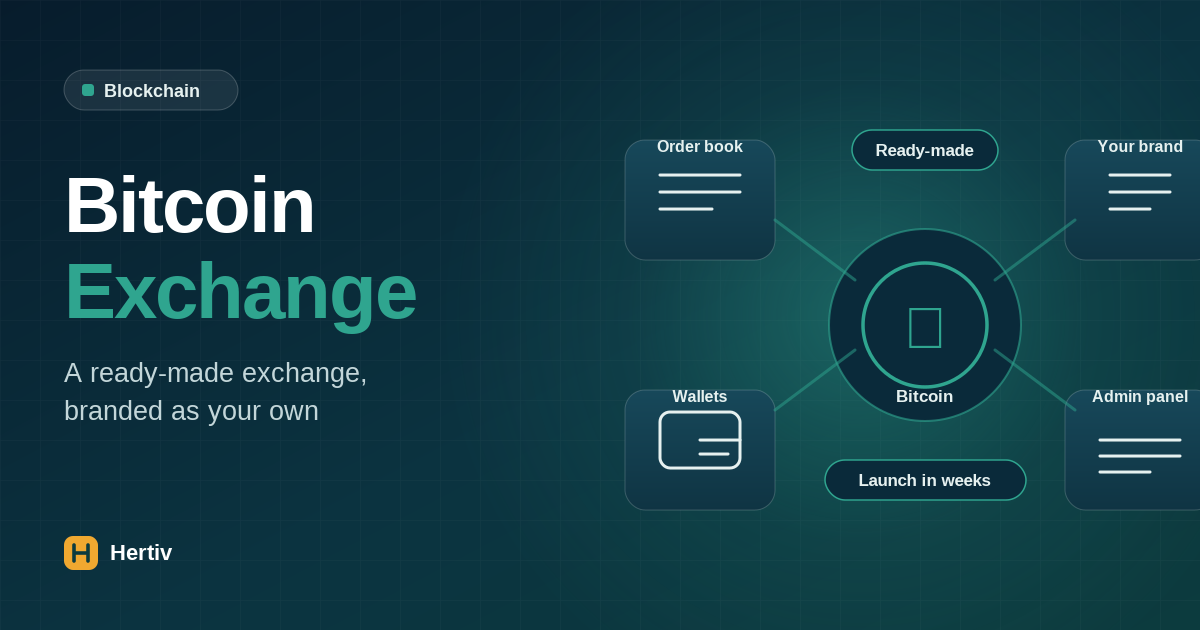
A white label bitcoin exchange is a ready-made trading platform a startup brands as its own. It covers trading, wallets and checks, so a team can launch in weeks.
On this page
Short answer
A white label bitcoin exchange is a ready-made trading platform that a startup brands and runs as its own product. It comes with the trading engine, wallets, user accounts and admin tools already built, so the team does not have to build an exchange from scratch. The startup adds its name, its design and its market, and the vendor supplies the software underneath.
What is a white label bitcoin exchange?
A white label bitcoin exchange is a trading platform built by one company and sold to another to run under its own brand. The startup buys or rents the software, puts its own name and design on it, and offers buying and selling of bitcoin to its customers. The vendor keeps supplying updates, security patches and support for the platform.
White label means the product is finished but unbranded. It is the same idea as a shop selling a product made by someone else under the shop's own label. The startup owns the customer relationship and the business, while the vendor owns the code and the running infrastructure in most deals.
| Part | What it does | Who supplies it |
|---|---|---|
| Trading engine | Matches buy and sell orders | Vendor |
| Wallets | Holds customer bitcoin safely | Vendor |
| User accounts | Sign-up, login, verification | Vendor |
| Admin panel | Fees, users, support, reports | Vendor |
| Payments | Bank transfers and card rails | Startup and partners |
| Branding | Name, logo, colours, domain | Startup |
For the launch sequence in detail, see white label crypto exchange launch steps.
Why do startups choose white label?
Startups choose white label because it removes the hardest and slowest part of the business: building a safe exchange. A trading engine, secure wallets and a compliance workflow take a skilled team many months to build and audit. A white label platform gives a startup all of that on day one, so the team can spend its time and money on customers instead.
Cost is the second reason. Building an exchange from scratch means hiring blockchain developers, security engineers and compliance staff before the first trade happens. A white label deal replaces most of that upfront cost with a licence fee or a share of trading fees, which is easier for a startup to fund.
Speed matters too. A startup that launches in weeks can learn from real users while a competitor is still hiring. The trade-off is control: the startup cannot change the core engine the way it could with its own code, and it depends on the vendor for fixes and upgrades. For most early-stage teams, that trade is worth it.
What makes a bitcoin exchange different?
A bitcoin exchange is different from a general crypto exchange because it centres on one asset and its users' expectations. Bitcoin buyers include first-time buyers who want a simple buy screen, and experienced traders who want an order book, charts and low fees. The platform has to serve both without confusing either.
Bitcoin also brings its own practical needs. Deposits and withdrawals run on the Bitcoin network, so the platform must handle confirmations, fees and address formats correctly. Many startups add a simple on-ramp: buy bitcoin with a bank transfer or card, and withdraw it to a personal wallet. That flow is what most customers actually use.
Liquidity matters more than features at the start. A new exchange with no orders on the book cannot give good prices, so most white label vendors offer shared liquidity or a market-making partner. Ask the vendor how liquidity works before you sign, because it decides whether your first customers get a fair price. The platform options are compared in white label crypto exchange platforms.
White label vs building from scratch
White label and building from scratch suit different startups. White label suits a team that wants to test a market quickly, has a small technical team and is happy to work within a vendor's design. Building from scratch suits a team with a distinct trading model, deep funding and a reason the standard platform cannot serve.
| Point | White label | Build from scratch |
|---|---|---|
| Time to launch | Weeks | Many months |
| Upfront cost | Licence fee | Full team salaries |
| Control | Branding and settings | Every part |
| Security work | Mostly vendor's job | Entirely your job |
| Best for | Testing a market fast | A distinct trading model |
Most startups should start white label and only consider a custom build after they have real users and revenue. A custom build is a second-stage decision, not a starting point. The money saved by starting white label can fund the marketing and support that actually win the first customers.
How to launch a white label bitcoin exchange, step by step
You launch a white label bitcoin exchange by picking a vendor, sorting out the legal and payment pieces, then opening to a small group of users before a full launch.
- Define the offer. Decide who the exchange is for, which pairs to list first and what the fees will be. Keep the first version small.
- Shortlist vendors. Compare two or three white label providers on trading features, wallet security, admin tools and support. Ask for a live demo with real trades.
- Check the legal side. Confirm what licence, registration or partnership your market requires, and what identity checks your customers must pass.
- Set up payments. Agree bank and card partners for deposits and withdrawals, and confirm settlement times and limits.
- Brand and configure. Apply your name, design and domain, set fees and limits, and connect your support tools.
- Test with a small group. Invite a small set of users, watch every trade and withdrawal, and fix problems before opening to everyone.
Do not skip the small-group test. The first real trades will find the gaps in your support, your payment flow and your admin process, and it is far cheaper to find them with fifty users than with five thousand. Hertiv's crypto exchange development service covers the same ground for teams that want help.
Example (hypothetical): a startup launching in 12 weeks
Example (hypothetical): a startup signs a white label deal in week one, spends four weeks on branding, legal checks and payment partners, and opens to 200 invited users in week eight. In the first month of trading, 4,000 trades are placed with an average size of $200, giving $800,000 of trading volume.
At a fee of 0.5 percent, that volume produces $4,000 of fee income in the month. The vendor licence costs $2,500 a month and support costs $1,000, leaving $500 before marketing and payment costs. The numbers show why the first months are about growth, not profit: the exchange needs more volume before fees cover the running costs.
By month six the same startup has 1,500 active traders and $4 million of monthly volume, which at 0.5 percent is $20,000 of fee income. The lesson is that a white label exchange is a volume business. The launch is fast, but the work after launch — winning users and keeping them trading — is where the business is actually built.
What are the common mistakes?
The most common mistakes with white label bitcoin exchanges are choosing a vendor on price alone, skipping the legal checks, and launching without liquidity.
- Choosing the cheapest vendor. A low licence fee often means weak support, slow fixes and poor wallet security. Compare the whole deal, not the headline price.
- Skipping legal advice. Exchange rules differ by market, and a licence or registration can take months. Start the legal work before you sign a vendor deal.
- Launching with no liquidity. An empty order book gives bad prices and drives early users away. Agree liquidity before launch day.
- Too many features at launch. A first version with ten trading features confuses new users. Launch with buying, selling and withdrawals, then add more.
- No plan for support. A stuck withdrawal is urgent for the customer. Staff support before launch, not after the first complaint.
Key takeaways
- A white label exchange is a finished platform a startup brands and runs as its own
- Startups choose white label for speed and lower upfront cost, accepting less control over the core
- Bitcoin exchanges need good liquidity, clear on-ramps and correct wallet handling
- Launch in steps: define the offer, pick a vendor, sort legal and payments, then test small
- Fees only cover costs once trading volume grows, so the work after launch is winning users
Frequently asked questions
How much does a white label bitcoin exchange cost?
Costs vary by vendor and scope, so ask each vendor for a written quote or see the vendor site. Expect a setup fee, a monthly licence fee and often a share of trading fees. The total depends on the features you need, the markets you serve and whether liquidity and custody are included.
Do I need a licence to run a bitcoin exchange?
It depends on your market. Most markets require a registration, a licence or a partnership with a licensed firm, plus identity checks on customers. The rules differ by country and change often, so get legal advice for your specific market before you launch.
Can I list other coins later?
Yes, most white label platforms support more coins than bitcoin, and you can add pairs after launch. Start with bitcoin only, prove the flow works, then add the next coin when you have the support and liquidity to handle it well.
What is the difference between white label and a clone script?
A clone script copies one exchange's feature set and needs a team to finish and run it, while a white label platform is a finished product with support, updates and running infrastructure. White label costs more per month but needs far less technical work from the startup.
How long does it take to launch?
Most teams launch in six to twelve weeks from signing a vendor deal, depending on legal checks, payment partners and branding. The software itself is ready on day one; the time goes on the pieces around it, such as banking, compliance and testing with real users.
Who holds the customers' bitcoin?
It depends on the vendor deal. Some vendors hold funds in their own custody, some use a third-party custodian, and some let the startup run its own wallets. Ask exactly who holds the keys, how they are stored, and what happens if the vendor stops operating.


