White Label Crypto Exchange Platform: What It Is and How to Choose
White label crypto exchange software gives you a ready trading platform under your own brand. Learn what is inside, how it works and how to pick a provider.
On this page
Short answer
A white label crypto exchange platform is ready-made trading software that a provider licenses to you so you can run a crypto exchange under your own brand. You get the trading engine, wallets, user accounts and admin tools without building them from scratch. You still own the brand, the users and the business decisions, while the provider keeps the software running and updated.
What is a white label crypto exchange platform?
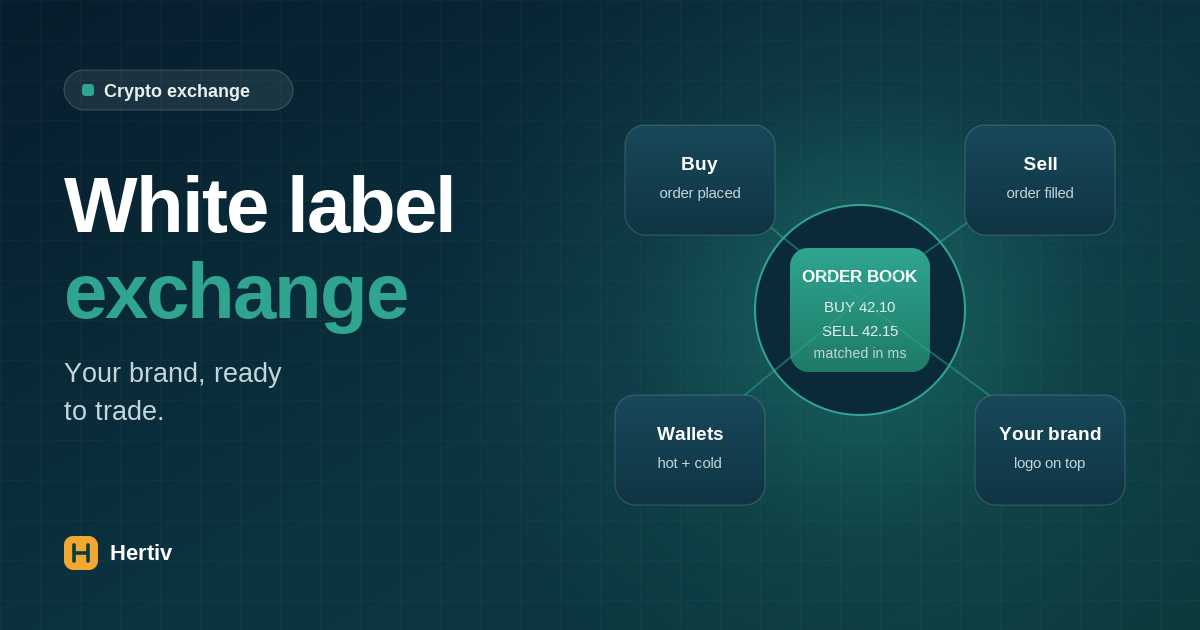
A white label crypto exchange platform is a ready-built software package that lets a business launch a cryptocurrency exchange under its own brand. The provider builds and maintains the trading engine, wallets and admin panel, and you put your name, logo and colours on the front. It is the same idea as a white label product in any other industry: the maker stays in the background and your brand faces the customer.
The alternative is building an exchange from scratch, which means hiring a team to write the matching engine, the wallet system, the security checks and the compliance tools. That takes months and a large budget. A white label platform cuts that to weeks because the core is already written and tested by other customers. You trade control for speed: you cannot change every part of the software, but you can launch far sooner.
Most providers sell the platform as a monthly licence plus a share of trading volume or a setup fee. Some charge a flat monthly fee and leave the revenue to you. For pricing, providers change their plans often, so check the vendor site before you budget. The licence usually covers software updates, security patches and basic support, while licences, banking and liquidity stay your job.
What is inside a white label exchange?
A white label exchange has five parts that work together, and a weak part in any one of them shows up as a bad experience for your users. The table below lists each part and what it does.
| Part | What it does | What to check |
|---|---|---|
| Trading engine | Matches buy and sell orders | Speed, order types, uptime record |
| Wallets | Holds deposits and pays withdrawals | Hot and cold storage split, key handling |
| User accounts | Sign-up, identity checks, limits | KYC flow, two-factor login, roles |
| Admin panel | Fees, listings, users, reports | Fee controls, listing tools, audit logs |
| Liquidity | Keeps order books filled | Source, depth, spreads on your pairs |
The trading engine is the heart of the platform. It takes orders from users and matches buyers with sellers, and it must do that fast even when the market moves quickly. Ask the provider how many orders per second the engine handles and what happens if it goes down. A slow engine means users see stale prices and failed orders.
Wallets deserve the same attention. A good platform keeps most funds in cold storage, which is offline, and only a small share in hot wallets for daily withdrawals. Ask who holds the keys and how withdrawals are approved. If the provider holds the keys, you are trusting their security as much as your own.
How does trading, custody and compliance work?
Trading on a white label exchange works the same way as on any exchange. A user deposits crypto or fiat, places an order, and the engine matches it against the order book. The platform then updates the user's balance and takes the trading fee you set. Liquidity usually comes from the provider's shared pool or from an external market maker, because a new exchange has too few users to fill its own order book.
Custody is the question of who controls the private keys. In a custodial setup the platform holds the keys and the user trusts you with their funds. In a non-custodial setup the user holds their own keys and the exchange never touches the funds.
Most white label platforms are custodial, which makes trading fast but puts the security burden on you and the provider. Read the provider's security audit reports before you sign, and ask when the last audit was done.
Compliance is your responsibility, not the provider's. You need the right licences for the countries you serve, identity checks for your users, and tools to spot suspicious transactions. A good platform ships with KYC and transaction monitoring tools, but it cannot get the licence for you.
Talk to a lawyer in each market before launch, because crypto rules differ widely and change often. You can read more about the wider service in crypto exchange development.
How to choose a white label exchange provider
Choosing a provider is the biggest decision in this project, because switching later is painful. Work through these five steps before you sign a contract.
- List your pairs and markets first. Write down which coins, which fiat currencies and which countries you will serve. A provider that is strong in one region may have no licences or banking partners in another.
- Test the trading engine under load. Ask for a demo with real order flow, not a slide deck. Place orders, cancel them, and watch how the book updates when the market moves.
- Check the security setup. Ask for audit reports, the hot and cold wallet split, how keys are stored, and how withdrawals are approved. If the provider will not share this, walk away.
- Read the fee and exit terms. Work out the total monthly cost at your expected volume, and check what happens to your users and their funds if you leave. You should be able to export user and transaction data.
- Talk to two existing customers. Ask them what broke in the first three months and how fast support answered. That tells you more than any sales call.
Do not pick a provider on price alone. The cheapest platform often has thin liquidity, slow support or weak security, and each of those costs you users. A provider with a clear track record and honest answers to hard questions is worth a higher monthly fee.
Example (hypothetical): a small exchange launch
Example (hypothetical): a small team plans an exchange for one country. They sign a white label platform at $2,000 a month plus 0.1% of trading volume, and they expect $500,000 of volume in the first month. The volume fee is 0.1% of $500,000, which is $500, so the platform costs $2,500 that month. They also budget $1,000 a month for support staff, which brings the monthly running cost to $3,500.
Revenue comes from trading fees. If the exchange handles 5,000 trades in the month at an average fee of $1.50 per trade, the fee income is 5,000 times $1.50, which is $7,500. Take away the $3,500 running cost and the exchange keeps $4,000 before tax, licences and marketing.
That is a simple picture, and real numbers will differ, but the shape is useful: volume is what pays the bills, so a platform with thin liquidity and slow trading will not reach the volume you need.
The same arithmetic shows why the provider choice matters. If the platform fee were $4,000 a month instead of $2,000, the running cost would be $5,500 and the monthly gain would fall to $2,000. If the engine were slow and volume fell by a third, fee income would drop to $5,000 and the exchange would lose money. Check the numbers at low, middle and high volume before you commit.
What does a white label exchange cost to run?
The platform licence is only part of the cost. You also pay for licences, banking, liquidity, support and marketing, and those often add up to more than the software itself. Licence costs vary by country and can take months to arrange, so start that work before you pick a provider. Banking is often the hardest part: many banks are cautious about crypto, and a payment partner can take weeks to approve.
Liquidity has its own cost. If you use the provider's shared pool, you usually pay a share of the spread or a monthly liquidity fee. If you hire a market maker, you pay a monthly retainer plus a share of the trading fees. Either way, budget for it from day one, because an empty order book is the fastest way to lose new users.
For pricing, providers change their plans often, so check the vendor site for current fees. A realistic budget lists the platform fee, the volume fee, licences, banking, liquidity, support staff and a reserve for the first three months.
If the total is more than your fee income at a realistic volume, the plan needs more users or lower costs before you launch. A related guide on the launch process is how to launch a white label crypto exchange.
What are the common mistakes?
The most common mistake is launching with no liquidity. A new exchange with an empty order book looks broken, and the first users leave and do not come back. Sort liquidity before you spend money on marketing, and test the book with real trades at real sizes.
The second mistake is treating compliance as an afterthought. Some teams launch first and plan to get licences later, then find their bank account closed or their domain blocked. Talk to a lawyer early, and do not serve a country until you know the rules there.
The third mistake is trusting the provider's security claims without evidence. Ask for audit reports and test the withdrawal flow yourself, including the approval steps. If only one person can approve a large withdrawal, that is a single point of failure.
The fourth mistake is copying the fee schedule of a large exchange. A new exchange needs low fees to attract traders, and it needs volume before it can charge more. Start with fees that bring users in, then raise them once the book is deep and users stay for the service. Keep a simple checklist in the admin panel and review it every week for the first three months.
Key takeaways
- A white label platform is ready trading software under your own brand, not a shortcut around licences, banking or security.
- Check the trading engine, the wallet setup and the liquidity before you sign anything.
- Work out the total monthly cost at low, middle and high volume, not just the headline licence fee.
- Liquidity first: an empty order book loses new users faster than any marketing can win them back.
- Compliance and security are your responsibility, even when the provider runs the software.
Frequently asked questions
What is a white label crypto exchange?
A white label crypto exchange is a ready-made trading platform that a provider licenses to a business, which then runs it under its own brand. The provider maintains the software, while the business owns the brand, the users and the trading decisions.
How long does it take to launch a white label exchange?
A typical launch takes a few weeks once the provider is chosen, because the core software already exists. Licences, banking and liquidity usually take longer than the software setup, so start those early.
Do I need a licence to run a white label exchange?
In most countries, yes. The licence rules depend on where your users live and what you offer, so you need legal advice for each market. The platform provider does not hold the licence for you.
Who holds the users' funds on a white label exchange?
In most white label setups the platform holds the funds in its wallets, which is called custodial. Ask the provider how keys are stored, how much sits in cold storage and how withdrawals are approved.
Can I switch providers later?
Switching is possible but painful, because you must move users, balances and trading history. Check the exit terms before you sign, including data export and how user funds are handled.
What does a white label exchange cost?
Costs vary by provider, volume and country, and providers change their plans often. Budget for the licence, volume fees, licences, banking, liquidity and support, and check the vendor site for current prices.


