When Is a Custodial Wallet the Right Choice?
A custodial wallet suits teams and newcomers who want password recovery and regulated custody. Learn when it fits and what to check first.
On this page
Short answer
A custodial wallet is the right choice when you want a company to hold your crypto keys and handle recovery, compliance and security on your behalf. It suits newcomers, businesses that need shared access and audit trails, and anyone who cannot risk losing a seed phrase. The trade-off is trust: the custodian controls the funds, so its licensing, reserves and security matter more than the wallet's features.
What is a custodial wallet?
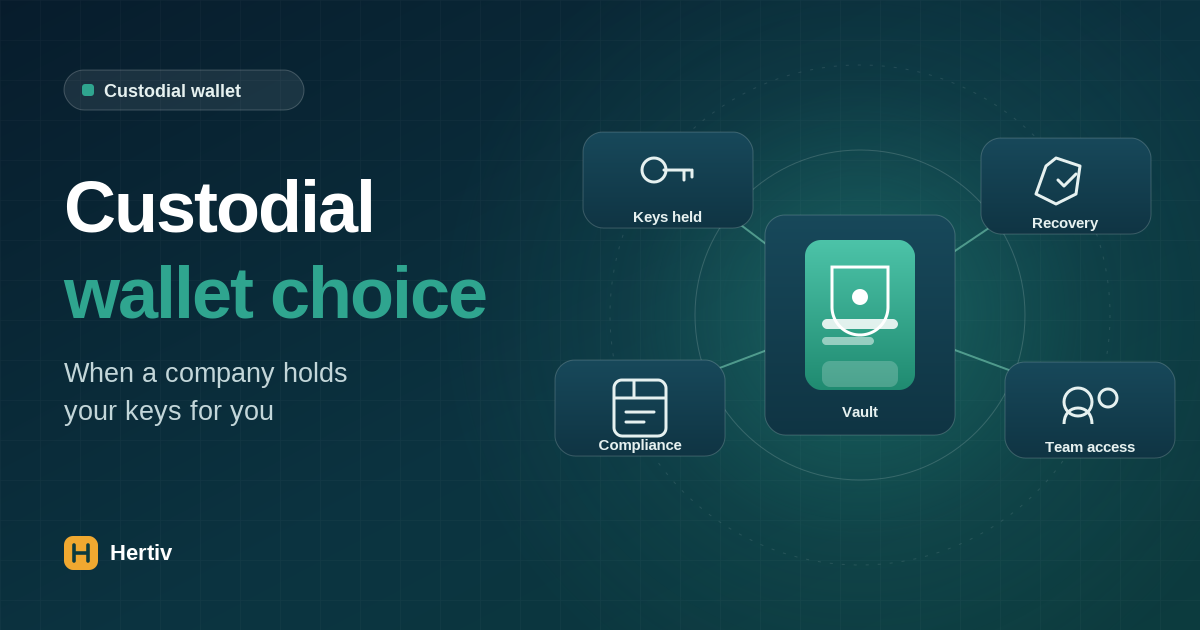
A custodial wallet is a crypto wallet where a company, not the user, holds the private keys that control the funds. The user owns the balance, but the custodian signs transactions and keeps the keys in its own systems.
The user logs in with a password and, usually, a second factor, much like an online bank account. The custodian signs transactions, stores the keys in its own systems, and can reset access if the user forgets a password.
This is the model most exchanges and many payment apps use. It trades direct control for convenience: the user never sees a seed phrase, and the company takes on the job of keeping the keys safe.
Custodial wallets also come in different shapes. Some are run by exchanges, some by dedicated custody firms, and some by payment apps that hold funds for their users. The details differ, but the core deal is the same: the company holds the keys, and the user trusts the company to act in their interest.
When does a custodial wallet make sense?
A custodial wallet fits some users far better than others. The table below sets out the situations where it is usually the right choice, and what to watch in each one.
| Situation | Why custodial fits | What to watch |
|---|---|---|
| New to crypto | No seed phrase to lose | Learn the basics before large sums |
| Business team | Shared access with approval rules | Set who can approve withdrawals |
| Regulated business | Custodian handles compliance checks | Confirm licences for your markets |
| Shared treasury | One wallet with an audit trail | Keep only working balances there |
| Recovery matters | Access can be reset after checks | Test recovery before you need it |
For a solo holder with technical skill, a wallet you control yourself may fit better. The comparison with the other model is set out in custodial vs non-custodial wallets.
What should you check before trusting a custodian?
Check licensing first. A custodian that holds customer funds should be licensed or registered in the markets it serves, and it should say so plainly on its website. If you cannot find a licence or a legal entity, treat that as a warning sign.
Ask how reserves and keys are handled. Some custodians publish proof of reserves or hold client funds in segregated accounts, and most keep the bulk of funds in cold storage, offline. A custodian that will not explain its key storage or its insurance cover is asking for blind trust.
Read the withdrawal rules before you deposit. Daily limits, approval delays and supported networks all affect how fast you can get funds out, and a custodian that freezes withdrawals during busy periods can leave a business short of cash.
Fees deserve the same attention as security. A custodian may charge a monthly fee, a fee per withdrawal, or a spread on conversions, and the cheapest headline rate is not always the cheapest total. Ask for the full fee schedule in writing, and work out what a typical month would cost before you commit.
How do recovery and access controls work?
Recovery is the main advantage of a custodial wallet. If a team member leaves or a password is lost, the custodian can reset access after identity checks, so funds are not lost with a forgotten phrase.
Good custodians let a business set approval rules, such as requiring two people to approve a withdrawal above a set amount. These controls turn the wallet into a shared treasury with an audit trail, which is what finance teams and auditors expect.
Some custodians split keys across parties using multi-party computation, so no single server holds a full key. See how to set up an MPC wallet for how that model works and when it fits.
What are the risks of custodial wallets?
The main risk is the custodian itself. If it fails, is hacked or freezes accounts, users may wait months to recover funds or lose them entirely. History has examples of large custodians and exchanges failing and leaving customers with nothing.
Counterparty risk cannot be removed, only reduced. Spread funds across more than one custodian, keep only working balances in a custodial wallet, and move long-term holdings to a wallet you control.
Regulatory risk matters too. A custodian can be ordered to freeze accounts, and rules can change in a market overnight. A business that depends on one custodian in one country has a single point of failure, so plan for that from the start.
Transparency is the best defence a user has. A custodian that publishes regular audits, names its insurance provider, and explains how client funds are kept separate from its own money is easier to trust than one that shares nothing. If a custodian will not answer basic questions about reserves and key storage, that silence is itself an answer.
Example (hypothetical): a small agency pays contractors
Example (hypothetical): a 12-person design agency pays 10 contractors $1,500 each month in a dollar-pegged stablecoin, a total of $15,000 a month. The agency uses a custodial wallet with two-person approval for withdrawals above $5,000, so no single employee can move the monthly payroll alone.
In one month, a contractor's login is lost. The custodian resets access after identity checks, and the $1,500 payment goes out the same day. If the agency had used a non-custodial wallet and lost the seed phrase, the whole $15,000 balance would have been out of reach.
The trade-off is a monthly custody fee of $49, which is $588 a year, against the risk of losing the full balance. For general wallet safety, see how to secure a crypto wallet.
What are the common mistakes?
The most common mistakes with custodial wallets are keeping everything with one custodian, never testing a withdrawal, and assuming insurance covers every loss.
- Keeping all funds with one custodian. One failure then puts the whole balance at risk; spread funds across custodians.
- Never testing a withdrawal. A wallet that cannot pay out quickly is useless in a busy week; test with a small amount first.
- Ignoring the terms on freezes. Read what lets a custodian freeze an account, and for how long, before you deposit.
- Sharing one login across the team. Shared logins remove the audit trail; give each person their own access with approval rules.
- Assuming insurance covers everything. Cover usually has limits and exclusions, so read the policy rather than trusting the headline.
Key takeaways
- A custodial wallet trades direct control for recovery, convenience and shared access
- It fits newcomers, teams and regulated businesses more than solo holders
- Licensing, segregated funds, cold storage and clear withdrawal rules matter most
- Spread funds across custodians and keep only working balances in one place
- Test a withdrawal before depositing a large balance
Frequently asked questions
Is a custodial wallet safer than a non-custodial wallet?
It depends on the user. A custodial wallet protects you from losing a seed phrase, which is the most common way individuals lose funds. A non-custodial wallet protects you from custodian failure. For most newcomers, the first risk is larger.
Can a custodian freeze my funds?
Yes. A custodian can freeze an account for a legal order, a fraud investigation, or a breach of its terms. Read the terms before depositing, and keep only working balances with any single custodian.
What happens if a custodian goes out of business?
Customers usually join a queue of creditors and may wait months or years for a partial return. Segregated client funds can improve the outcome, but there is no guarantee. This is why spreading funds matters.
Do custodial wallets charge fees?
Most do. Common charges are a monthly custody fee, a fee per withdrawal, and a spread on conversions. Fees vary by provider, so compare the full schedule on the provider's own pricing page before choosing.
Can a business use a custodial wallet for payroll?
Yes, and many do. A custodial wallet with approval rules and an audit trail fits payroll well, because more than one person can approve payments and every transfer is logged. Check local tax and employment rules first.
Should I keep all my crypto in a custodial wallet?
No. Keep working balances there and move long-term holdings to a wallet you control, or split them across custodians. A single custodian is a single point of failure, whatever its reputation.


