Proof of Reserves: What It Is, and How It Works
Proof of reserves shows an exchange holds enough assets to cover customer balances. Learn how Merkle-tree proofs work, what they prove, and how to check one.
On this page
Short answer
Proof of reserves is a method that lets an exchange or custodian show it holds enough assets to cover what it owes its customers, using a public record of wallets and a Merkle tree of balances. It proves a snapshot of holdings at one moment, but it does not prove the platform has no other debts or that its controls are sound.
What is proof of reserves?
Proof of reserves is a method an exchange or custodian uses to show that it holds enough assets to cover what it owes its customers. It combines a public record of the assets it controls with a record of customer balances, so anyone can check that the two match.
The idea is simple: a platform that holds customer funds should be able to prove the funds are there. Proof of reserves does this without publishing every customer's balance. It uses cryptography to let each customer check that their own balance was counted, while keeping other customers' details private.
The method became widely discussed after large exchanges failed while holding customer money they could not return. Since then, many exchanges publish proof of reserves on a regular schedule. It is a transparency tool, not a guarantee: it shows a snapshot at one moment, and it does not by itself prove that the platform is well run.
What proof of reserves proves, and what it does not
Proof of reserves proves that, at the moment the snapshot was taken, the platform controlled enough assets to match the customer balances it reported. That is a useful check, but it is narrower than many people assume.
It does not prove that the platform has no debts outside the reported balances. It does not prove that the assets are not borrowed for the snapshot. And it does not prove that the platform's internal controls, code or management are sound. A platform could pass a proof of reserves check and still fail for other reasons.
This is why proof of reserves is usually published alongside an auditor's attestation and other disclosures. The attestation states what the auditor checked, which wallets were included, and what was left out. Reading that statement matters as much as reading the headline ratio.
How a Merkle-tree proof of reserves works
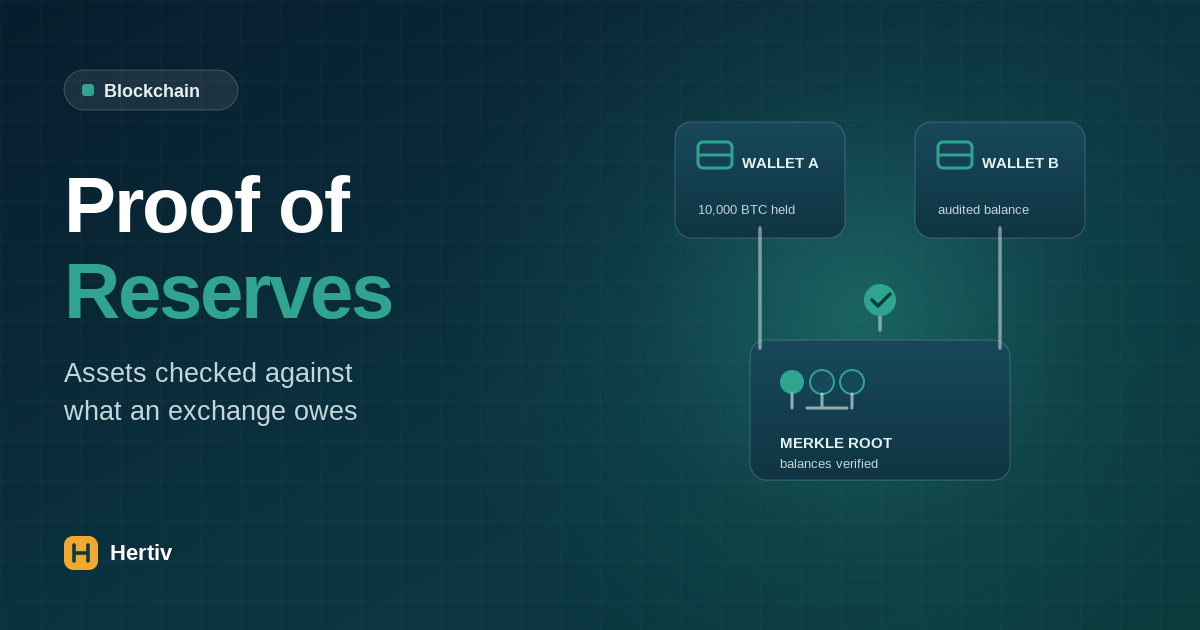
A Merkle tree is a data structure that turns many individual balances into one short fingerprint, called a root. The exchange lists every customer balance, pairs them up, and hashes each pair until a single root value remains. That root is published, and each customer gets the path that connects their balance to the root.
A customer can then check that their balance was included by following the path and recomputing the hashes. If any balance were changed or left out, the root would change, so the check would fail. The customer never needs to see other customers' balances to run this check.
| Part | What it is | What it shows |
|---|---|---|
| Asset wallets | Public addresses the platform controls | Which assets the platform holds |
| Liabilities list | Customer balances in a Merkle tree | What the platform owes |
| Merkle root | Single fingerprint of all balances | That no balance was changed |
| Auditor attestation | Written statement of what was checked | Scope, date and limits |
The asset side is checked by signing a message from the listed wallets, which proves the platform controls them. The liability side is checked through the Merkle tree. Together, they let an outside reader compare assets against liabilities.
Assets, liabilities and the attestation report
Assets are the coins and tokens the platform holds in wallets it controls. The report lists the wallet addresses and the balance in each, so the holdings can be checked on the public blockchain. Some platforms also list assets held with third-party custodians, which are harder to verify from the chain alone.
Liabilities are the amounts the platform owes its customers. In a Merkle-tree proof, the total liability is the sum of all customer balances in the tree. Some reports also include the liabilities of related companies, which matters when customer funds sit in a group structure.
The attestation report is written by an auditor or accounting firm. It states the date of the snapshot, the method used, and any limits on the work. A report that covers only some assets, or that is months old, is weaker than a recent report with a clear scope. Rules for crypto firms vary by jurisdiction, and the MiCA regulation in the EU sets one of the clearer frameworks for how such firms must operate.
Example (hypothetical): checking an exchange's proof
Example (hypothetical): an exchange publishes a proof of reserves dated 1 November. It lists wallets holding 10,000 BTC and a Merkle tree whose customer balances add up to 9,500 BTC. The ratio is 10,000 divided by 9,500, which is about 105%, so the exchange holds more than it owes.
A customer with 2 BTC checks their own path in the tree. They take their balance, combine it with the neighbouring hashes in the order given, and arrive at the published root. The match tells them their balance was included in the total.
The same customer then reads the attestation. It says the auditor checked the wallet signatures and the Merkle tree, but did not check loans the exchange may have taken from other firms. The customer notes this gap: the proof shows the assets were there on 1 November, but it says nothing about debts that are not customer balances.
Based on that, the customer decides to keep only a small working balance on the exchange and move the rest to a wallet they control. The proof helped, but it was one input among several.
What are the common mistakes?
The most common mistakes are treating proof of reserves as a full audit, ignoring the attestation, and trusting a stale snapshot.
- Treating the ratio as a safety score. A ratio above 100% says nothing about debts, code flaws or management risk.
- Skipping the attestation. The attestation lists what was checked and what was left out. A proof without a readable attestation is hard to judge.
- Trusting an old snapshot. Balances change daily. A proof from six months ago says little about today.
- Ignoring the asset mix. A platform can hold enough total value while holding the wrong assets, for example holding its own token instead of the coins customers deposited.
- Assuming the wallet list is complete. If a wallet is not listed, its contents are not part of the check.
If you hold funds on an exchange, checking the proof is worth doing, but it works best alongside other habits: withdrawing what you do not need for trading and using a wallet you control for longer-term holdings. For that, crypto wallet development services can explain the wallet options and how custody works.
How to check a proof of reserves yourself
You can check a proof of reserves yourself in a few steps, using the tools the exchange publishes.
- Find the latest report. Look for the most recent date and the auditor's attestation, not a marketing page.
- Read the scope. Note which assets and which companies are included, and what was left out.
- Check the ratio. Compare total assets against total liabilities. A ratio below 100% means the platform holds less than it owes.
- Verify your own balance. Use the exchange's Merkle-tree tool to confirm your balance was included in the tree.
- Check the wallets. Look up a few listed wallet addresses on a block explorer to confirm the balances.
- Repeat on the next report. A single check is a snapshot; regular checks show whether the position is stable.
If any step fails or the report is hard to find, treat that as a warning sign. A platform that wants to be trusted should make the proof easy to check. If you are building a product that holds customer funds, blockchain consulting can help you design reporting that customers and auditors can actually verify.
Key takeaways
- Proof of reserves compares a platform's assets against the balances it owes customers
- A Merkle tree lets each customer verify their own balance was counted without seeing others' balances
- A ratio above 100% is a snapshot, not a safety score: debts and controls are not covered
- Read the auditor's attestation for scope, date and limits before trusting the headline ratio
- Check the latest report, verify your balance in the tree, and repeat on the next report
Frequently asked questions
Does proof of reserves mean an exchange is safe?
No. It shows the platform held enough assets to cover customer balances at one moment. It does not check for debts outside those balances, borrowed assets, code flaws or poor management. Treat it as one transparency check among several, alongside regulation, audits and your own habit of withdrawing funds you do not need for trading.
How often should proof of reserves be published?
Monthly or more often is common among large exchanges, and more frequent reports give a clearer picture. A report that is several months old says little about the current position, because balances move daily. Look for the most recent date and a regular publishing schedule.
What is a Merkle tree in proof of reserves?
A Merkle tree is a structure that turns many customer balances into one short fingerprint, called a root. Each customer gets the path linking their balance to the root, so they can recompute the hashes and confirm their balance was included. If any balance changed, the root would change and the check would fail.
Can proof of reserves be faked?
A platform could borrow assets just for the snapshot, leave wallets or liabilities out of the report, or publish a report with a narrow scope. That is why the auditor's attestation and the completeness of the wallet and liability lists matter. A proof is only as strong as what was checked.
What ratio should proof of reserves show?
The ratio should be at least 100%, meaning assets equal or exceed customer balances. A ratio above 100% gives a small buffer. A ratio below 100% means the platform holds less than it owes, which is a clear warning sign.
Do all exchanges publish proof of reserves?
No. Some publish regular Merkle-tree proofs with auditor attestations, some publish only wallet lists, and some publish nothing. Regulated exchanges may face reporting duties under rules such as MiCA in the EU. When a platform publishes nothing, you have no way to check its holdings.


