What Is Hedge Fund Tokenization, and How Does It Work?
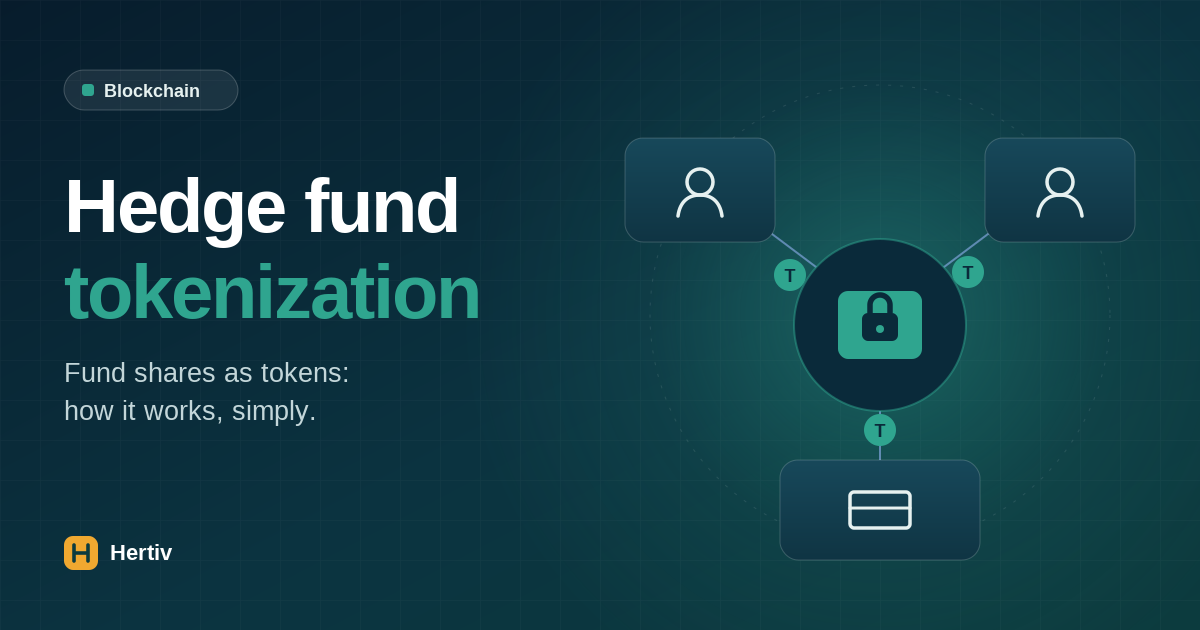
Hedge fund tokenization puts fund shares on a blockchain as tokens, so investors can buy, hold and transfer them onchain while the fund keeps working as before.
On this page
Short answer
Hedge fund tokenization is the process of recording ownership in a hedge fund as digital tokens on a blockchain. Each token represents a share of the fund, and buying, selling or transferring the token moves ownership of that share. The fund's strategy, manager and rules stay the same; only the record of who owns what changes.
What is hedge fund tokenization?
Hedge fund tokenization is the process of issuing digital tokens on a blockchain that represent shares in a hedge fund. Instead of a paper register or a fund administrator's database holding the record of who owns what, the ownership record lives on a shared ledger as tokens.
A hedge fund is a pooled investment fund that uses a range of strategies, such as long and short positions, borrowed money and derivatives, and it usually limits investors to institutions and wealthy individuals. Tokenization does not change the strategy or the manager. It changes how ownership is recorded, transferred and settled.
The token is a claim on the fund, not the fund itself. Its value follows the fund's net asset value, and the rights attached to it, such as redemption and reporting, are set by the fund's own rules and the law of the market where it operates.
How does hedge fund tokenization work?
Hedge fund tokenization works by creating tokens that map to fund shares and recording every transfer on a ledger. The fund, its administrator and its custodian still do their usual jobs; the ledger becomes the shared record they all read from.
- Set up the fund. The fund is formed with its usual legal structure, manager and administrator.
- Issue the tokens. Smart contracts mint tokens that represent shares, with rules for who can hold them.
- Check investors. Buyers pass identity and eligibility checks before they can receive tokens.
- Record ownership. The ledger shows who holds which tokens, replacing the paper register.
- Settle transfers. Buying or selling tokens moves ownership onchain, often the same day.
- Handle redemptions. An investor who redeems has tokens burned and receives cash under the fund's rules.
The smart contract enforces the fund's transfer rules, such as lock-up periods and eligible holders. A transfer to an ineligible wallet is blocked by the contract, not caught afterwards by a person.
What parts of a hedge fund get tokenised?
Tokenization usually covers the fund shares themselves, but it can also cover the fund's own operations, such as subscriptions, distributions and reporting. The table below shows what is tokenised and what it changes.
| What is tokenised | What changes | What stays the same |
|---|---|---|
| Fund shares | Ownership record moves onchain | Fund strategy and manager |
| Subscriptions | Investors subscribe with tokens | Eligibility and identity checks |
| Distributions | Payouts can go to token holders directly | Distribution policy |
| Reporting | Holdings are visible on the ledger | Audited financial statements |
| Secondary transfers | Shares can move between holders | Transfer rules and lock-ups |
The parts that stay the same matter most. Tokenization does not change the investment strategy, the fees or the risks of the fund. An investor still needs to understand the fund itself, not just the token.
What are the benefits of tokenising a hedge fund?
The main benefit of tokenising a hedge fund is faster and cheaper administration. Subscriptions, transfers and record-keeping that used to pass through several systems and take days can happen on one shared ledger, often the same day.
A second benefit is access. Smaller minimum investments become practical to administer, so a fund can open to a wider set of eligible investors without adding back-office cost for each one. That does not make the fund open to everyone: eligibility rules still apply.
A third benefit is transparency. The ledger shows holdings and transfers in near real time, which makes reporting and audits simpler. Investors can see their own position without waiting for a monthly statement, and the administrator works from the same record as everyone else.
There is also a cost argument for the fund manager. When subscriptions and transfers settle on one ledger, the administrator spends less time reconciling records between systems, and that saving can show up as lower administration costs over time. It is a saving, not a return: the fund still has to perform.
Real estate is the closest parallel: what real estate tokenization is explains how the same idea works for property.
What are the risks and limits?
Hedge fund tokenization carries the same investment risks as the fund itself, plus new ones from the technology and the rules. The token does not make the fund safer; it only changes how ownership is recorded.
- Regulatory risk. Rules for tokenised funds differ by market and are still changing in some places.
- Smart contract risk. A bug in the token contract can freeze transfers or misstate holdings.
- Custody risk. Tokens must be held safely, and losing the keys can mean losing access.
- Liquidity risk. A token does not create buyers. Secondary trading needs a venue and willing counterparties.
- Valuation risk. The token's price follows the fund's net asset value, which is only struck on the fund's own schedule.
An investor should check the fund, the manager and the legal structure first, and treat the token as a wrapper around those things. A well-run fund with a token is still a well-run fund; a poor fund with a token is still a poor fund.
Example: a tokenised hedge fund in numbers
Example (hypothetical): a hedge fund worth $50 million decides to tokenise its shares. It issues 50,000 tokens at $1,000 each, so the total token supply matches the fund's value exactly.
An investor buys 100 tokens for $100,000. That is 100 out of 50,000 tokens, which is 0.2% of the fund. If the fund grows by 10% to $55 million, each token is worth $55,000,000 divided by 50,000, which is $1,100, and the investor's 100 tokens are worth $110,000.
If the same investor later redeems, the 100 tokens are burned and the investor receives $110,000 in cash, less any redemption fee the fund charges. The arithmetic is simple because the token is just a share: its value is the fund's value divided by the number of tokens.
What are the common mistakes?
The common mistakes in hedge fund tokenization are treating the token as the investment, skipping the legal work, and assuming a token creates liquidity. Each one is avoidable with a short checklist before investing or launching.
- Judging the token instead of the fund, the manager and the strategy
- Launching before the legal structure and the market rules are clear
- Assuming tokenization removes lock-ups or eligibility rules
- Expecting a secondary market to appear on its own
- Skipping a smart contract audit before issuing tokens
- Forgetting custody, key management and recovery plans
For the wider picture, real-world asset tokenization use cases covers tokenization across asset types.
For how tokenised funds work in general, see fund tokenization.
Key takeaways
- Hedge fund tokenization records fund shares as tokens on a blockchain
- The fund's strategy, manager and rules stay the same; only the ownership record changes
- Smart contracts enforce transfer rules such as eligibility and lock-ups
- Benefits are faster administration, wider eligible access and clearer reporting
- The token does not reduce investment risk or create liquidity on its own
- Check the fund documents first, then the token and the legal structure
Frequently asked questions
Is a tokenised hedge fund the same as a crypto fund?
No. A tokenised hedge fund is a normal hedge fund whose shares are recorded as tokens. A crypto fund invests in crypto assets. The token here is a record of ownership, not the thing being invested in.
Can anyone buy a tokenised hedge fund?
No. Hedge funds limit investors to institutions and wealthy individuals, and those eligibility rules apply to tokenised shares too. Smart contracts can block transfers to ineligible wallets, so the token does not open the fund to the public.
Does tokenization make a hedge fund liquid?
Not by itself. A token only helps if there is a venue and willing buyers for the secondary trade. Most tokenised funds still have lock-ups and redemption windows set by the fund.
How is a tokenised hedge fund valued?
The token's value follows the fund's net asset value divided by the number of tokens. The fund strikes its net asset value on its own schedule, usually monthly or quarterly, so the token price updates then.
What happens when an investor redeems tokens?
The investor's tokens are burned and the investor receives cash under the fund's redemption rules, less any fee. The timing follows the fund's own redemption windows, which are usually monthly or quarterly, not the speed of the token transfer.
Do tokenised hedge funds need a licence?
It depends on the market and the fund structure. The fund itself needs whatever licence its market requires, and the token may add further rules. Check the legal position in your market before investing or launching.


