What Is the EU AI Act and Who Has to Follow It?
The EU AI Act is the first law of its kind for artificial intelligence, and it sorts AI systems by risk. Here is what it covers, who it binds and when it applies.
On this page
Short answer
The EU AI Act is Regulation (EU) 2024/1689, the European Union's law for artificial intelligence. It sorts AI systems into four risk tiers — unacceptable, high, limited and minimal — and sets duties that grow with the risk. It binds providers and deployers whose AI output is used in the EU, including companies based elsewhere.
What is the EU AI Act?
The EU AI Act is Regulation (EU) 2024/1689, the European Union's law for artificial intelligence. It entered into force on 1 August 2024 and is the first law of its kind: instead of banning or approving AI as one thing, it sorts each AI system by the risk its use carries and attaches duties that grow with that risk.
The Act covers AI systems placed on the market or put into service in the EU, and it also reaches companies outside the EU whose AI output is used there. A team in another country that sells an AI hiring tool to an EU employer, or runs a chatbot for EU customers, is inside its scope even though the team itself sits elsewhere.
The Act works through roles. A provider develops an AI system or model and puts it on the market under its own name, while a deployer uses an AI system in its own work. Importers and distributors carry their own duties too, so the chain from builder to user is covered rather than just one link of it.
What are the four risk tiers?
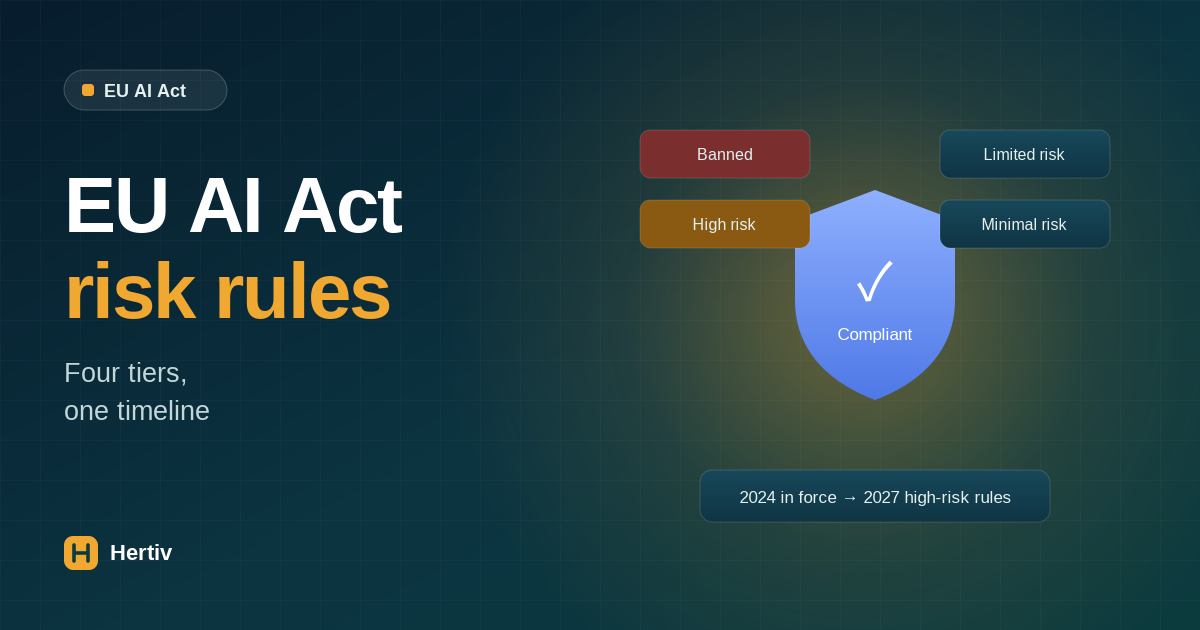
The Act sorts every AI system into one of four risk tiers, and the tier decides what the provider and deployer must do. The tiers describe uses, not technologies: the same language model can power a minimal-risk writing aid and a high-risk CV filter, and the rules follow the use.
The table below sets out the four tiers, what each one means and when its rules apply.
| Tier | What it means | Examples | Applies from |
|---|---|---|---|
| Unacceptable risk | Banned outright | Social scoring, workplace emotion recognition, untargeted face scraping | 2 February 2025 |
| High risk | Allowed, with strict requirements before and after sale | CV screening, credit scoring, exam proctoring, medical device AI | 2 December 2027 |
| Limited risk | Transparency duties only | Chatbots, deepfakes, AI-generated images and text | 2 August 2026 |
| Minimal risk | No mandatory duties | Spam filters, video game AI, recommendation engines | No rules under the Act |
The banned list covers practices such as social scoring, manipulative techniques that cause harm, exploiting vulnerabilities, most real-time remote biometric identification in public spaces for law enforcement, and emotion inference in workplaces or education, with narrow exceptions. Fines for banned practices run up to 35 million euros or 7% of worldwide annual turnover, whichever is higher.
Who has to follow the EU AI Act?
Providers carry the heaviest duties, because they design the system and decide what it can do. They must classify the system, meet the requirements for its tier, keep technical documentation and, for high-risk systems, run a conformity assessment before the system goes on the market.
Deployers — the organisations that use an AI system at work — carry duties of their own. A deployer of a high-risk system must use it as instructed, keep human oversight in place, watch its logs, and tell people when a decision about them was made with AI help. For how this fits into a wider programme of controls, see AI governance.
General-purpose AI models, such as the large models behind chatbots and coding assistants, have a separate regime. Their providers have carried baseline duties since 2 August 2025, including technical documentation, documentation for downstream providers, a copyright policy covering EU text-and-data-mining opt-outs, and a public summary of training content. Models with systemic risk carry extra duties on top.
Small businesses are not exempt, but the Act gives them lighter treatment in places, such as simplified technical documentation for high-risk systems. The duties still apply; only the paperwork is trimmed.
When does each part of the Act apply?
The Act applies in stages rather than all at once, and one amendment has already moved some dates. The Digital Omnibus on AI, Regulation (EU) 2026/1744, entered into force on 27 July 2026 and pushed the high-risk deadlines back, so older summaries that still show the original dates are out of date.
The table below gives the timeline as it stands, with the Omnibus dates for the high-risk rules.
| Date | What applies |
|---|---|
| 1 August 2024 | The Act enters into force |
| 2 February 2025 | Banned practices and the AI literacy duty |
| 2 August 2025 | General-purpose AI model duties and governance structures |
| 2 August 2026 | Transparency duties; the AI Office and Member State enforcement bodies |
| 2 December 2026 | Marking of AI-generated content; new banned practices |
| 2 December 2027 | High-risk rules for the Annex III use cases |
| 2 August 2028 | High-risk rules for AI inside regulated products |
The phased timetable means a team can plan in order: remove banned practices first, then meet the transparency and model duties, then build the high-risk controls before the 2027 and 2028 deadlines. Waiting until the last date to start the high-risk work is the most common planning error, because the documentation and testing take months.
What do high-risk AI systems have to do?
A high-risk system must meet six groups of requirements before it can be placed on the market, and keep meeting them while it is in use. The provider documents each one, and the deployer checks that the system is used as instructed.
- Risk management. A documented process that runs through the whole life of the system, finding, judging and reducing risks as the system changes.
- Data governance. Training, validation and testing data that is relevant, representative and checked for errors and bias.
- Technical documentation. A record that shows how the system was built, what it does and how it was tested.
- Record keeping. Automatic logging so the system can be watched, audited and investigated after an incident.
- Human oversight. A person who can understand the output, step in, and stop the system when it goes wrong.
- Accuracy, robustness and cybersecurity. Testing that the system performs as claimed and resists attack and bad inputs.
Most high-risk systems also need a conformity assessment before sale, which is a formal check that the requirements are met. For some systems the provider can assess itself; for others a notified body must be involved. The result is a declaration of conformity and a CE marking on the product.
For a plain-language look at the ideas behind these controls, see what AI governance means.
For the values side of the same question, see what responsible AI means.
Example (hypothetical): a hiring tool under the Act
Example (hypothetical): a company receives 2,000 applications for a warehouse role and reviews each one by hand, taking about 8 minutes per application. That is 2,000 x 8 = 16,000 minutes, or about 267 hours, of review time for one hiring round.
The company buys an AI screening tool that ranks the applications, and a recruiter checks the ranking in about 2 minutes per application. The same 2,000 applications now take 2,000 x 2 = 4,000 minutes, or about 67 hours, so the team saves 267 - 67 = 200 hours.
The saving is only part of the story, because CV screening is a high-risk use under the Act. The recruiter also reviews the 200 applications the tool flagged as borderline, at 10 minutes each, which is 200 x 10 = 2,000 minutes, or about 33 hours.
The net saving is 200 - 33 = 167 hours, and the company must also keep logs, give candidates a way to challenge the outcome, and watch the tool for bias between groups.
The lesson is that the Act does not ban the tool; it prices the oversight into the decision. A team that counts only the gross saving will understate the real cost of using a high-risk system.
What are the common mistakes?
The most common mistakes teams make with the EU AI Act are assuming it does not apply to them, classifying by technology instead of use, and leaving the high-risk work until the deadline.
- Assuming it does not apply. A non-EU company whose AI output is used in the EU is in scope, as is a team that only buys and deploys a system.
- Classifying the model, not the use. The same model can be minimal risk in one product and high risk in another; the tier follows the use case.
- Treating transparency as a checkbox. A chatbot that does not say it is AI, or AI content with no marking, breaches the transparency duties even when the system itself is lawful.
- Skipping the literacy duty. Staff who use AI at work must understand what it does and where it can go wrong; that duty has applied since February 2025.
- No inventory. Without a list of every AI system in use, a team cannot classify anything, and the banned practices are the first thing to miss.
- Trusting old dates. Summaries written before the Digital Omnibus still show the original high-risk dates; plan against the 2027 and 2028 dates instead.
Key takeaways
- The Act sorts AI by risk, not by technology
- Banned practices have applied since February 2025
- High-risk rules land in December 2027 and August 2028
- Deployers carry duties too, not just providers
- Start with an inventory of every AI system in use
Frequently asked questions
Does the EU AI Act apply outside the EU?
Yes. The Act reaches any provider or deployer whose AI output is used in the EU, even if the company is based elsewhere. A non-EU team that sells an AI hiring tool to an EU employer, or runs a chatbot for EU customers, must follow the rules for its system.
What counts as a high-risk AI system?
High-risk systems are AI that is a safety component of a regulated product, or that falls into one of eight use cases: biometrics, critical infrastructure, education, employment, essential services, law enforcement, migration and border control, and justice and democratic processes.
What is the difference between a provider and a deployer?
A provider develops an AI system or model and puts it on the market under its own name. A deployer uses an AI system in its own work, such as an employer screening CVs with a bought-in tool. Both roles carry duties under the Act.
What are the fines for breaking the EU AI Act?
Fines for banned practices run up to 35 million euros or 7% of worldwide annual turnover, whichever is higher. Other breaches carry lower fines, and giving wrong information to an authority carries its own penalty. Enforcement sits with the AI Office and Member State authorities.
What is the Digital Omnibus on AI?
The Digital Omnibus on AI is Regulation (EU) 2026/1744, an amendment that entered into force on 27 July 2026. It moved the high-risk deadlines to 2 December 2027 for the Annex III use cases and 2 August 2028 for AI inside regulated products, and added new banned practices.
Does the EU AI Act cover ChatGPT and other chatbots?
Chatbots fall under the limited-risk tier, so they must tell people they are interacting with AI. The model behind a chatbot also carries general-purpose AI duties, such as documentation and a public summary of training content. AI-generated content must be marked as machine-generated.


