What Is Responsible AI, and How Do Teams Use It?
Responsible AI means building and running AI systems that are fair, transparent, safe and accountable. Learn the five principles and how teams use them.
On this page
Short answer
Responsible AI is the practice of designing, building and running AI systems so they are fair, transparent, safe and accountable to the people they affect. It covers how data is collected, how models are tested, who can challenge a decision, and who is responsible when something goes wrong.
What is responsible AI?
Responsible AI is the practice of designing, building and running artificial intelligence systems so they treat people fairly, explain their decisions, stay safe in use, and have a named person accountable for them. It is not a single tool or a checklist at the end of a project; it is a way of working that runs from the first data decision to the last day the system is live.
The idea grew because AI systems now decide who gets a loan, which job applications are read, what medical risk a patient carries and which content people see. When those decisions are wrong or biased, real people lose money, work or care. Responsible AI is the answer to that risk: build the system so its decisions can be checked, challenged and fixed.
It applies to every team that ships AI, not only to large companies. A startup with a small support agent still needs to know what its model does with customer data, how it handles mistakes, and who answers when a customer complains.
What are the principles of responsible AI?
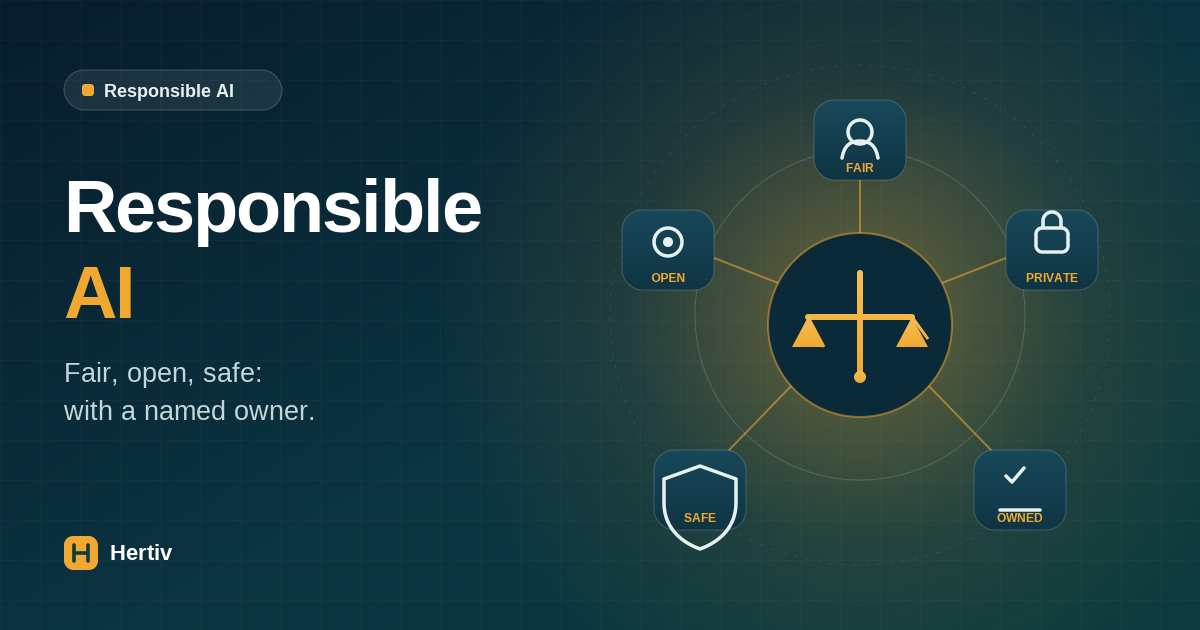
Responsible AI rests on five principles that most teams and regulators agree on. Fairness means the system does not systematically disadvantage a group of people because of age, gender, ethnicity or another protected characteristic. Transparency means the team can explain, in plain language, what the system does and why it gave a particular answer.
Privacy means personal data is collected with consent, used only for the stated purpose, and protected from leaks. Safety means the system is tested for harmful outputs and failure modes before it ships, and monitored after launch. Accountability means a named person or team owns the system and its decisions, and there is a way for affected people to appeal.
| Principle | What it means in practice | How teams check it |
|---|---|---|
| Fairness | No group is systematically disadvantaged | Test results across demographic groups |
| Transparency | Decisions can be explained in plain language | Keep logs and publish a model card |
| Privacy | Data is collected with consent and protected | Review data sources and access controls |
| Safety | Harmful outputs are tested for and blocked | Red-team the system before launch |
| Accountability | A named owner answers for decisions | Assign an owner and an appeal route |
How do teams put responsible AI into practice?
Teams put responsible AI into practice by adding a few concrete steps to the normal build process. It starts with the data: check where training data came from, whether consent covers the use, and whether any group is missing or over-represented. A biased dataset is the most common source of an unfair model.
Next comes testing. Before launch, the team tests the model on slices of users, not only on the average, and looks for groups where accuracy drops or errors cluster. It also probes the model with hostile or unusual inputs to find harmful outputs before users do.
Then comes documentation and oversight. The team writes a short model card describing what the system does, what data it was trained on, what it is not for, and how it was tested. A named owner signs off on the launch, and a review date is set to re-check the system once it is live.
Who is responsible for responsible AI?
Responsibility for AI sits with the team that ships it, not with the model provider. If your product uses a third-party model, you still own the decision your product makes with it. That means someone in your organisation must be named as the owner of each AI system, with the authority to pause it when it misbehaves.
Larger teams add a review board or a governance lead who checks new AI features before launch. Smaller teams can do the same work with a short review meeting and a written record of the decisions made. The size of the process should match the risk of the system: a support chatbot needs less review than a model that screens job applicants.
Regulators are also part of the picture. Rules on AI are growing in several regions, and they increasingly require risk assessments, documentation and human oversight for high-risk systems. A team that already documents its models and tests for bias is in a much better position when a new rule arrives. For the governance angle in a regulated sector, see AI governance in healthcare.
Example (hypothetical): screening job applications
Example (hypothetical): a hiring startup builds a model that ranks 2,000 job applications and passes the top 200 to a recruiter. In testing, the team checks the pass rate by group and finds that women pass at 8 in 100 while men pass at 14 in 100, even though the underlying qualifications are similar.
The team traces the gap to the training data: past hiring decisions favoured candidates from a small set of universities, and the model learned that pattern. They rebuild the training set with a wider mix of backgrounds, remove the university name as a feature, and re-test. The pass rates move to 11 in 100 for women and 12 in 100 for men.
The arithmetic: before the fix, 200 of 2,000 applications passed, but the mix was skewed. After the fix, the same 200 places are shared more evenly, and the recruiter still sees the strongest candidates because the model now ranks on skills and experience rather than on a proxy for background.
Where does responsible AI go wrong?
Responsible AI goes wrong most often when it is treated as paperwork. A team writes a policy, files it, and keeps building the same way. The policy only helps if it changes decisions: which data is used, which tests run, and who can stop a launch.
Another failure is testing only the average. A model can look accurate overall while failing badly for one group of users. Slice the tests by age, language, region and any other group that matters for your product, and look at the worst group, not the average.
A third failure is shipping without a way back. If a model starts giving harmful or wrong answers, the team needs a kill switch, a fallback and a way to tell affected users. Build the off-ramp before launch, not after the first incident.
For a practical view of testing, read how to test AI models.
Also read how to measure AI ROI, which covers the cost of getting this work wrong.
Common mistakes with responsible AI
The most common mistake is assuming a model is fair because the team never intended bias. Bias comes from data and design choices, not from intent, so good intentions are not a defence. Test for it directly, with real data, before you ship.
Another mistake is hiding the AI from users. People should know when they are talking to a model and what it does with their data. Hiding it destroys trust when it is found out, and in some regions it breaks the law.
Finally, teams forget that responsible AI is ongoing. Data drifts, users change and models age. Set a review date, re-run the tests, and keep the documentation current. A system that was responsible at launch can stop being responsible a year later.
Key takeaways
- Responsible AI means fair, transparent, safe and accountable systems.
- The five principles are fairness, transparency, privacy, safety and accountability.
- Test on slices of users, not only on the average.
- A named owner must be able to pause the system when it misbehaves.
- Responsible AI is ongoing: review, re-test and update documentation.
Frequently asked questions
Is responsible AI a legal requirement?
It depends on where you operate and what the system does. Some regions now require risk assessments, documentation and human oversight for high-risk AI, such as hiring or credit decisions. Even where the law is silent, the same practices reduce risk and build trust with customers.
What is a model card?
A model card is a short document describing what a model does, what data it was trained on, how it was tested, and what it should not be used for. It gives reviewers, customers and regulators a clear picture of the system without needing to read the code.
How do you test an AI model for bias?
Split your test data by the groups that matter, such as age, gender, language or region, and compare accuracy and error rates across them. Look at the worst-performing group, not the average. If one group is much worse, trace the cause in the data or the features.
Does responsible AI slow down development?
It adds some steps, but it saves time later. Catching a bias or safety problem in testing is far cheaper than fixing it after launch, when customers and regulators are involved. Most of the work fits into the normal build process.
Who should own responsible AI in a startup?
One named person should own each AI system, with the authority to pause it. In a small team that can be the product lead or the CTO. The owner does not do all the work alone, but they are the person who answers when something goes wrong.
What is the difference between responsible AI and AI safety?
AI safety focuses on preventing harmful outputs and system failures. Responsible AI is broader: it adds fairness, privacy, transparency and accountability to safety. A system can be safe in the narrow sense and still be unfair, which is why teams need both.


