What Is ERC-1155? The Multi-Token Standard
ERC-1155 is a token standard that lets one smart contract manage many token types at once, both fungible and non-fungible. Here is how it works and where it is used.
On this page
Short answer
ERC-1155 is an Ethereum token standard that lets a single smart contract manage many different token types, including fungible tokens and non-fungible tokens. It was designed for games and other apps that need thousands of item types, because it can move several token types in one transaction instead of one contract per type. A game can hold its currency, weapons and land in one contract, and transfer them together.
What is ERC-1155?
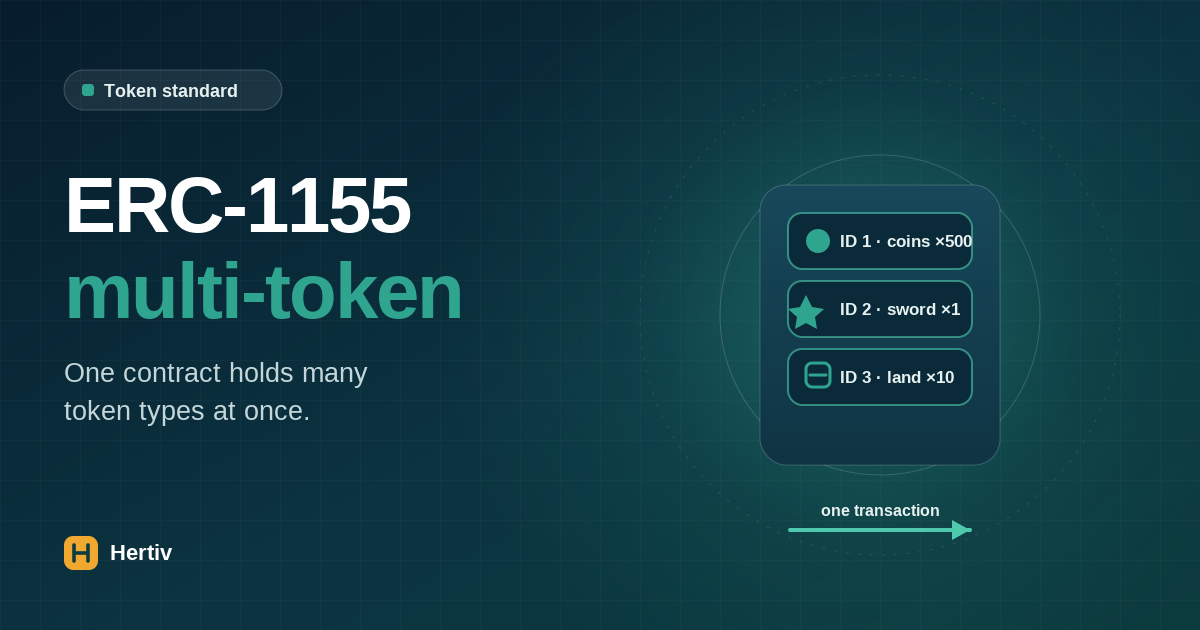
ERC-1155 is a token standard on Ethereum that allows one smart contract to hold and manage many token types at once. Each token type has its own ID, and each ID can be fungible, like a currency, or non-fungible, like a unique item. A single contract can therefore hold a game's gold coins, its swords and its land plots, with each type tracked by its own ID and balance.
It was proposed to fix a practical problem: before ERC-1155, each token type needed its own contract, so a game with hundreds of item types needed hundreds of contracts. That made deployment expensive and transfers slow, since moving several item types meant several transactions. ERC-1155 folds all of them into one contract, so one transaction can move many types at once.
ERC-1155 sits alongside the older standards rather than replacing them. What are ERC-20 tokens covers the fungible-token standard, and ERC-721 covers one-of-a-kind tokens; ERC-1155 handles the cases where an app needs both, in bulk.
How is ERC-1155 different from ERC-20 and ERC-721?
The difference is scope. ERC-20 defines one fungible token per contract: every unit is identical and interchangeable, like a currency. ERC-721 defines one non-fungible token type per contract: every token is unique, like a deed or a collectible. ERC-1155 defines many token types per contract, and each type can be fungible or non-fungible, so a single contract can hold a whole catalogue.
| Standard | Tokens per contract | Fungible | Non-fungible | Typical use |
|---|---|---|---|---|
| ERC-20 | One type | Yes | No | Currencies, stablecoins |
| ERC-721 | One type | No | Yes | Collectibles, deeds |
| ERC-1155 | Many types | Yes | Yes | Game items, tickets |
Batch transfers are the other big difference. ERC-1155 can move several token types in a single transaction, which cuts the number of transactions and the gas cost when a user buys a bundle of items. ERC-20 and ERC-721 move one token type per transaction, so the same bundle would need several calls.
How do ERC-1155 transfers work?
An ERC-1155 transfer moves a quantity of a token ID from one address to another. The sender calls a transfer function with the token IDs and the amounts, and the contract updates the balances for each ID. A single call can include several IDs, so a player who buys a sword, a shield and 100 gold coins receives all three in one transaction.
The standard also includes a safe transfer check. When tokens are sent to a contract, the receiving contract must confirm it can handle them, which prevents tokens from being locked in a contract that cannot return them. Operators can also be approved to move tokens on a user's behalf, which is how marketplaces list and sell items without taking custody of them.
Because the contract holds many types, wallets and marketplaces need to read token IDs rather than contract addresses to tell items apart. That is a small integration cost, and it is the reason ERC-1155 is less common than ERC-721 for simple one-of-a-kind collectibles.
Where is ERC-1155 used?
Games are the main use case, because a game has many item types and players trade them in bundles. A game can issue its currency, consumables and equipment as ERC-1155 tokens in one contract, and players can trade a whole loadout in a single transaction. The same pattern fits event tickets, where one contract holds many ticket tiers, and loyalty programmes, where points and rewards live side by side.
Tokenised assets use it too. A platform can hold many asset classes in one contract, and how RWA tokenization works explains the wider pattern of putting real-world assets on chain. ERC-1155 is also used for semi-fungible tokens: items that are identical within a type but distinct across types, such as 1,000 identical concert tickets of one tier.
Example (hypothetical): a game shop with one contract
Example (hypothetical): a game issues three token types in one ERC-1155 contract: gold coins (ID 1), health potions (ID 2) and swords (ID 3). A player buys a starter pack of 500 gold coins, 10 potions and 1 sword. The shop sends all three in one transaction: 500 of ID 1, 10 of ID 2 and 1 of ID 3, and the player's balances update to 500, 10 and 1.
If the same pack used one contract per type, the shop would need three transactions: one for the coins, one for the potions and one for the sword. At a gas cost of $0.30 per transaction, the single ERC-1155 transfer costs $0.30, while the three separate transfers cost 3 x $0.30 = $0.90.
The saving is small per pack, but across 10,000 packs it is $3,000 versus $9,000. That gap is why games with many items choose the multi-token standard.
What are the limits of ERC-1155?
ERC-1155 is more complex to integrate than ERC-20 or ERC-721. Wallets, marketplaces and explorers must handle token IDs and batch transfers, and not every tool supports them equally. A token that only needs one type is simpler and cheaper to build on the older standards, and many marketplaces still list ERC-721 items more prominently, so an ERC-1155 project may get less visibility at first.
Security also needs care. The batch transfer and operator approval features add code paths that must be audited, and a mistake in the approval logic can let an operator move more than intended. Teams building on ERC-1155 should budget for a contract audit, and what is ERC-3643 shows a different standard that adds compliance checks for regulated assets.
Common mistakes with ERC-1155
The most common mistakes are choosing ERC-1155 when a simpler standard would do, and skipping the integration work that batch transfers need. A single-token project built on ERC-1155 pays the complexity cost without the benefit, and a marketplace that does not display token IDs will confuse users.
- Using ERC-1155 for a single token type instead of ERC-20 or ERC-721
- Not testing batch transfers with the wallets and marketplaces users will use
- Approving operators without limits on what they can move
- Forgetting the safe transfer check, so tokens can be locked in a contract
- Skipping an audit for a contract that holds many token types
- Assuming every marketplace displays ERC-1155 items the same way
ERC-1155 is a tool for catalogues, not for single tokens. Pick it when the app has many item types or needs batch transfers, and keep the simpler standards for everything else. For building on Ethereum generally, Ethereum development covers the stack and the process.
Key takeaways
- ERC-1155 lets one contract manage many token types, fungible and non-fungible.
- Batch transfers move several token types in one transaction, cutting gas cost.
- Games, tickets and loyalty programmes are the main use cases.
- It is more complex to integrate than ERC-20 or ERC-721.
- Use it for catalogues of items, not for a single token type.
Frequently asked questions
What is ERC-1155 in simple terms?
ERC-1155 is an Ethereum standard that lets one smart contract hold many token types at once. Each type has an ID and can be fungible or non-fungible, so a game can keep its currency, weapons and land in one contract.
Is ERC-1155 fungible or non-fungible?
Both. Each token ID in an ERC-1155 contract can be fungible, like coins, or non-fungible, like a unique item. The standard supports both kinds in the same contract, which is why games use it for currencies and equipment together.
How is ERC-1155 different from ERC-721?
ERC-721 holds one type of unique token per contract, so each contract is one collection. ERC-1155 holds many types per contract, each fungible or non-fungible, and can move several types in a single batch transfer, which cuts gas costs for bundles.
Why do games use ERC-1155?
Games have many item types and players trade them in bundles. One ERC-1155 contract holds the whole catalogue, and a single transaction can move a sword, a shield and gold coins together.
Can ERC-1155 tokens be traded on marketplaces?
Yes, but support varies. Marketplaces need to read token IDs and batch transfers, and not every platform displays ERC-1155 items the same way, so teams should test with the marketplaces their users use.
Is ERC-1155 safe to build on?
It is a widely used standard, but its batch transfer and operator features add code that should be audited. Teams should also test the safe transfer check so tokens cannot be locked in a contract.


