What Is Blockchain Interoperability, and How Does It Work?
Blockchain interoperability lets separate blockchains share data and move assets between them. Here is how it works, and where it breaks.
On this page
Short answer
Blockchain interoperability is the ability of separate blockchains to exchange data and value with each other, so an asset or a message created on one chain can be used on another. Without it, each chain is an island: tokens, records and apps built on one network cannot reach the others, and users must move value through exchanges or manual steps.
What is blockchain interoperability?
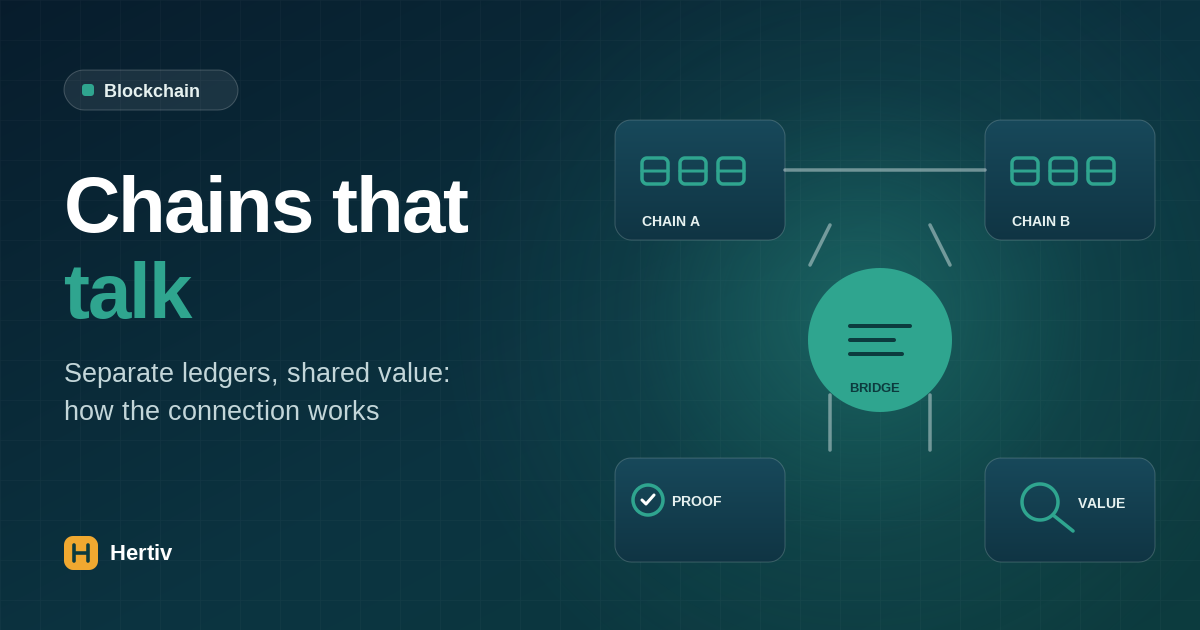
Blockchain interoperability is the ability of two or more separate blockchains to read each other's data and to move assets or messages between them. A blockchain is a shared ledger that only its own nodes agree on, so by default it knows nothing about what happens on another chain.
Interoperability adds a connection between those ledgers. It lets a token issued on one chain be used in an app on another, or lets a contract on one chain react to an event on another. The connection can be a bridge, a relay chain, a shared messaging protocol, or a set of rules that two chains both follow.
The goal is simple: a user should not have to care which chain an asset started on. For builders, it means an app can draw on the users, liquidity and data of several chains at once. The practical side of building such apps is covered in what smart contract development involves.
Why do blockchains need to talk to each other?
Blockchains need to talk to each other because no single chain does everything well. One chain may be cheap and fast, another may be the most secure, and a third may hold the users or the assets an app needs.
Without a connection, value and users get stuck. A stablecoin held on one chain cannot pay for a service on another. A record written on a supply-chain ledger cannot be read by the finance app on a different network. Each gap forces users into extra steps: moving funds through an exchange, wrapping a token, or copying data by hand.
Interoperability also spreads risk. If one chain goes down or becomes expensive to use, an app that can reach several chains can keep working. The trade-off is that every connection adds a new point of failure, which is why the design of the connection matters as much as the connection itself.
How does blockchain interoperability work?
Blockchain interoperability works by proving that something happened on one chain, then acting on that proof on another chain. The table below shows the main approaches and what each one relies on.
| Approach | How it works | What it trusts |
|---|---|---|
| Asset bridge | Locks an asset on chain A and mints a matching token on chain B | The bridge operators or contract |
| Relay chain | A hub chain checks the state of connected chains and passes messages | The hub chain's validators |
| Atomic swap | Two parties exchange assets directly, with both sides locked until both agree | The swap contract, not a middleman |
| Messaging protocol | Relayers carry signed messages between chains for contracts to act on | Relayers and message verification |
| Wrapped tokens | A custodian or contract holds the original and issues a token that stands for it | The custodian or the contract |
Most real systems combine these ideas. A bridge may use a messaging protocol to carry proofs, and a relay chain may run the verification itself. The key question for any design is always the same: who or what do you have to trust for the proof to be true?
What are the main ways to move assets across chains?
The main ways to move assets across chains are lock-and-mint, burn-and-mint, and liquidity pools, and they differ in speed, cost and who holds the original asset.
Lock-and-mint is the most common. The user locks the original asset in a contract on the first chain, and the bridge mints a matching token on the second chain. To go back, the matching token is burned and the original is released. The original asset stays locked while the copy circulates, so the bridge must be secure enough to guard it.
Burn-and-mint works for tokens that exist natively on both chains. The token is burned on the first chain and minted on the second, so there is no locked reserve to guard.
Liquidity pools take a different route: the bridge holds pools of assets on both chains and swaps between them, which is fast but depends on the pools being deep enough. For the token standards involved, how rollups scale chains shows a related scaling approach that also moves value between layers.
What are the risks of cross-chain bridges?
The main risks of cross-chain bridges are that the locked assets become a target, the proof can be faked, and the two chains can disagree about what happened.
A bridge that locks assets holds a large pool of value in one place, which makes it an attractive target. If the contract or the operators are compromised, the locked assets can be taken while the copies on the other chain keep circulating. This is why bridge security reviews focus on who can sign, how many signatures are needed, and what happens if a key is lost.
Other risks are quieter. A chain can reorganise, which changes the history the bridge relied on. A message can arrive late, so a contract acts on stale information. And a bridge can be paused or censored by its operators. A team that depends on a bridge should know its trust assumptions, its pause controls, and what happens to users if the bridge stops.
Example (hypothetical): a retailer accepts payment across two chains
Example (hypothetical): a small online retailer accepts a stablecoin on chain A, but its supplier is paid on chain B. Each week the retailer collects 2,000 stablecoins on chain A and needs them on chain B.
The retailer uses a lock-and-mint bridge. It locks 2,000 stablecoins on chain A and receives 2,000 wrapped stablecoins on chain B. The bridge charges a fee of 0.3%, which is 6 stablecoins, so the retailer has 1,994 to pay the supplier. The supplier accepts the wrapped tokens because they can be redeemed for the original.
One week the bridge pauses for maintenance. The retailer cannot move that week's 2,000 stablecoins, so it keeps a buffer of 500 stablecoins already on chain B to cover the supplier. The buffer costs the retailer nothing to hold, but it means the business keeps running when the bridge does not. The lesson is to plan for the bridge being down, not just for it working.
What are the common mistakes?
The most common mistakes with blockchain interoperability are trusting a bridge without checking who controls it, assuming a wrapped token is the same as the original, and ignoring what happens when the connection fails.
- Skipping the trust check. A bridge run by a small set of signers is only as safe as those signers. Read who can move the locked assets before you use it.
- Treating a wrapped token as the original. A wrapped token is only worth the original while the bridge can redeem it. If the bridge fails, the copy can lose its backing.
- No fallback plan. If the only route between two chains is one bridge, a pause stops the whole flow. Keep a buffer or a second route for critical payments.
- Ignoring finality. A transfer that looks complete can be undone if the source chain reorganises. Wait for enough confirmations before acting on the other side.
- Building on one bridge's rules. Each bridge has its own fees, limits and supported assets. An app that depends on one bridge's details is hard to move.
Teams planning a cross-chain product can start from how to create a web3 dApp, which covers the app side of working with more than one chain.
Key takeaways
- Blockchain interoperability lets separate chains exchange data and value instead of working as islands
- Bridges, relay chains, atomic swaps and messaging protocols all prove an event on one chain and act on it on another
- Lock-and-mint, burn-and-mint and liquidity pools are the main ways to move assets across chains
- Every connection adds a trust assumption, so check who holds the locked assets and who can move them
- Keep a buffer or a second route for critical flows, because bridges can pause
Frequently asked questions
What is the difference between a bridge and a wrapped token?
A bridge is the system that moves value between chains, while a wrapped token is the copy it issues on the destination chain. The bridge locks the original asset and mints the wrapped token, and burning the wrapped token releases the original.
Is blockchain interoperability the same as a multi-chain app?
No. A multi-chain app simply runs on several chains, while interoperability means those chains can exchange data and value with each other. An app can be multi-chain without any connection between the chains it uses.
Are cross-chain bridges safe to use?
They carry real risk, because the locked assets are a large target and the proof can be wrong. Use bridges that publish their trust assumptions and audits, move small amounts first, and keep a fallback for critical payments.
What is an atomic swap?
An atomic swap is a direct exchange of assets between two parties on different chains, where both sides are locked until both agree. Either the whole swap happens or nothing happens, so neither party has to trust the other.
Can smart contracts on different chains talk to each other?
Yes, through messaging protocols and relay chains that carry signed proofs between chains. A contract on one chain can then act when it receives a verified message from another chain.
Do I need interoperability for a single-chain app?
No. If your app and its users live on one chain, you do not need a bridge. Interoperability only matters when value, data or users need to cross from one chain to another.


