What Is Argo Blockchain, and What Does It Do?
Argo Blockchain is a London-based company that mines Bitcoin at scale. Learn what it does, how mining works and why it has been restructuring.
On this page
Short answer
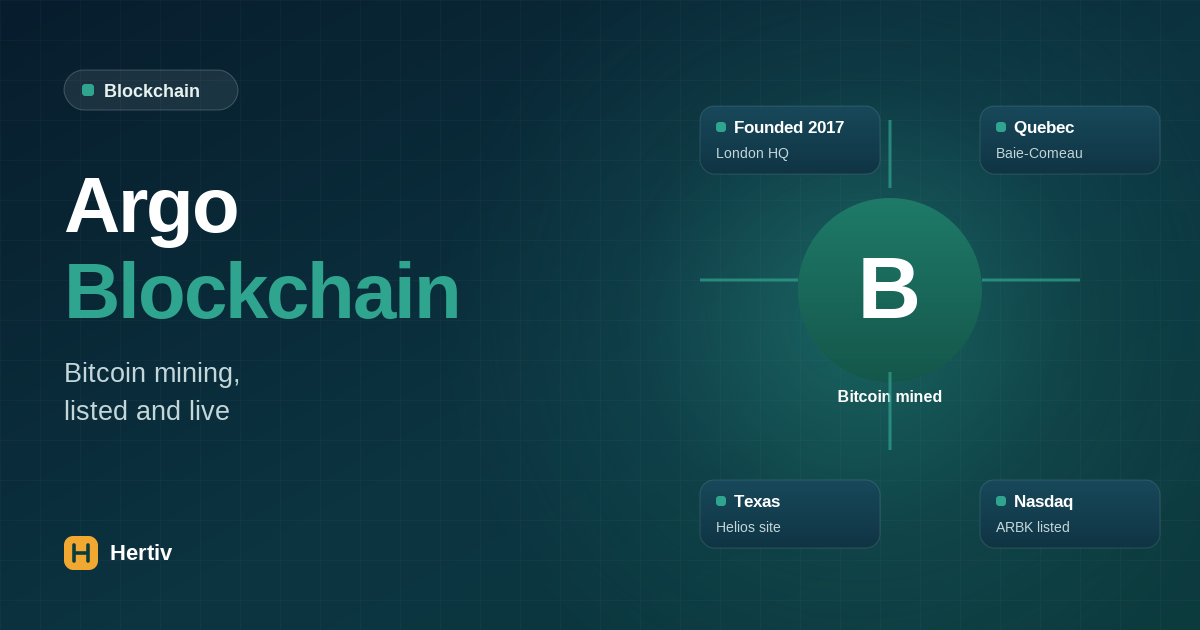
Argo Blockchain is a London-based blockchain technology company focused on large-scale Bitcoin mining. Founded in 2017, it runs mining facilities in North America, where specialised computers validate Bitcoin transactions and earn block rewards. It listed on the London Stock Exchange in 2018 and on Nasdaq in 2021, and after a restructuring it delisted from London in December 2025 while keeping its Nasdaq listing.
What is Argo Blockchain?
Argo Blockchain is a London-based blockchain technology company focused on large-scale Bitcoin mining. It was founded in 2017 and was among the first Bitcoin miners to list on a public stock market, joining the London Stock Exchange in 2018 and Nasdaq in 2021.
The company earns its income by mining Bitcoin. It runs large numbers of specialised computers, called ASIC miners, in facilities in North America. Those machines validate transactions on the Bitcoin network, and in return the company earns newly issued Bitcoin and transaction fees.
Argo is a public company, which means anyone can buy its shares, and it must publish its results and filings. That openness is part of why people ask about it: it is one of the few ways to follow a Bitcoin miner's business through public records rather than through the coin itself.
How does Bitcoin mining work?
Bitcoin mining is the work of checking new transactions and adding them to the blockchain. Miners compete to solve a puzzle, and the first to solve it adds the next block of transactions. The winner earns the block reward, which is newly issued Bitcoin plus the fees on the transactions in that block.
The block reward falls over time. Bitcoin's design halves the reward about every four years, and after the 2024 halving it stands at 3.125 Bitcoin per block. About 144 blocks are mined each day, so the network issues about 450 new Bitcoin a day in total, shared among all the miners in proportion to their computing power. Ethereum took a different path and moved away from mining entirely, as explained in what Ethereum is.
Mining is mostly a power business. The machines run around the clock and use a large amount of electricity, so a miner's costs are dominated by power prices, the efficiency of its machines, and the cost of the site. A miner that pays more for power than its rivals earns less from the same machines, which is why miners hunt for cheap and steady electricity.
What does Argo run, and where?
Argo runs mining facilities in North America, with operations in Quebec, Canada, and Texas in the United States. Its Quebec site is a data centre in Baie-Comeau that started running in 2021, and its Texas site is the Helios facility in Dickens County, a large site built to draw power from the Texas grid.
The company has said its operations are mostly powered by renewable energy, which matters for two reasons. First, renewable power can be cheaper in the right locations, which lowers the cost of each coin mined. Second, it answers the common criticism that Bitcoin mining wastes energy, though the claim depends on the actual power mix at each site.
Argo's fleet has aged over time. The company has noted that its mining machines are more than four years old and are coming to the end of their useful economic life, and that replacing them will need major spending. That is one reason its daily Bitcoin output has fallen: fewer and older machines, plus the halving, mean fewer coins mined per day.
Why has Argo been restructuring?
Argo has been restructuring because its debts grew larger than the business could support. In 2025 it warned that there were doubts about its ability to keep going as a business, and it entered a restructuring plan with Growler Mining, a US mining company, which took a majority stake of more than 87 percent.
As part of that plan, Argo delisted from the London Stock Exchange, with the last day of trading on December 11, 2025, and the delisting taking effect the next day. It kept its Nasdaq listing in the United States, and the restructuring gave it a recapitalised balance sheet, new power infrastructure and mining equipment from Growler.
The restructuring is a reminder that a listed miner is a company with debts, costs and shareholders, not just a way to hold Bitcoin. Its share price moves with the Bitcoin price, but it also moves with the company's own debts, its machine fleet and its power costs. Anyone following the company should read its filings, not only the Bitcoin price.
A Bitcoin layer 2 explainer shows a different side of the same network: the technology, rather than the companies that mine it.
How does Argo compare with other miners?
Argo compares with other miners on four points: scale, power cost, machine age and balance sheet. The table below shows what each one means for a mining company.
| Point | What it means | Why it matters |
|---|---|---|
| Scale | How much computing power it runs | More power means more coins |
| Power cost | What it pays per unit of electricity | The biggest running cost |
| Machine age | How new and efficient its miners are | Old machines earn less per unit of power |
| Balance sheet | Debts against cash and assets | Debts can force a sale or restructuring |
| Power source | Where the electricity comes from | Affects cost and public image |
Argo's story shows how these points interact. It built a large Texas site, but its machine fleet aged, its debts grew, and the halving cut its income. The restructuring fixed the balance sheet and brought in new equipment, but the company still has to prove it can mine at a cost below what each coin earns.
Example (hypothetical): how a miner's share is worked out
Example (hypothetical): the Bitcoin network issues about 450 new Bitcoin a day, since 144 blocks a day times 3.125 Bitcoin per block is 450. A miner's share of that depends on its share of the network's total computing power.
Suppose a miner runs 1 percent of the network's computing power. Its expected share is 1 percent of 450, which is 4.5 Bitcoin a day. If it runs 0.5 percent, its expected share is 2.25 Bitcoin a day. The actual number varies day to day, because mining is a lottery, but over weeks the average comes close to the expected share.
Power cost decides whether that share is worth having. Suppose the miner uses 10 megawatts of power, which is 10,000 kilowatts, running 24 hours a day. That is 240,000 kilowatt-hours a day. At 5 cents per kilowatt-hour, the power bill is $12,000 a day. If the coins it mines are worth less than that plus its other costs, it loses money on every day it runs.
What are the common mistakes?
The most common mistakes are treating a miner as a way to hold Bitcoin, ignoring the power bill, and reading the share price as a verdict on the technology.
- Confusing the miner with the coin. Owning shares in a miner is not the same as owning Bitcoin; the miner has debts, costs and a management team.
- Ignoring power costs. Power is the biggest running cost. A miner with expensive power earns less from the same machines.
- Forgetting the halving. Every halving cuts the new coins per block, so a miner needs more efficiency or lower costs just to stand still.
- Trusting old machine numbers. A fleet that was efficient four years ago may be uneconomic now, as Argo's own filings note.
- Skipping the filings. A listed miner's filings show its debts, its output and its plans; the share price alone does not.
If you want to understand Argo, start with what it mines, where it mines it and what it owes. A short blockchain development read on how the network works will help you separate the technology from the company built on top of it.
Key takeaways
- Argo Blockchain is a London-based company focused on large-scale Bitcoin mining
- It listed in London in 2018 and on Nasdaq in 2021, then delisted from London in December 2025
- Mining earns block rewards, which halved to 3.125 Bitcoin per block in 2024
- Power cost, machine age and debt decide whether a miner makes money
- A restructuring with Growler Mining gave Argo a new balance sheet and equipment
Frequently asked questions
What is Argo Blockchain?
Argo Blockchain is a London-based blockchain technology company focused on large-scale Bitcoin mining. Founded in 2017, it runs mining facilities in North America, where specialised computers validate Bitcoin transactions and earn block rewards. It listed on the London Stock Exchange in 2018 and on Nasdaq in 2021.
How does Argo Blockchain make money?
Argo makes money by mining Bitcoin. Its computers validate transactions on the Bitcoin network, and in return the company earns newly issued Bitcoin and transaction fees. Its profit depends on the Bitcoin price, its power costs, the efficiency of its machines and its debts.
What happened to Argo Blockchain in 2025?
Argo entered a restructuring plan with Growler Mining, which took a majority stake of more than 87 percent. As part of the plan, Argo delisted from the London Stock Exchange in December 2025, while keeping its Nasdaq listing in the United States.
Where are Argo Blockchain's mining facilities?
Argo operates mining facilities in North America, with a data centre in Baie-Comeau, Quebec, Canada, and the Helios facility in Dickens County, Texas. The company has said its operations are mostly powered by renewable energy.
Is Argo Blockchain the same as the Argo blockchain network?
No. Argo Blockchain is a company that mines Bitcoin. It is not a blockchain network of its own, and it should not be confused with other projects that use the name Argo. Always check which Argo a source is talking about.
Is buying Argo shares the same as buying Bitcoin?
No. Owning shares in a miner is not the same as owning Bitcoin. The miner has debts, power costs, ageing machines and a management team, so its shares can move very differently from the Bitcoin price. This article is not investment advice.


