What Is API-First Development, and When Does It Pay Off?
API-first development means designing the API contract before building the product, so every client uses the same interface. Learn how it works and when it pays off.
On this page
Short answer
API-first development means designing the application programming interface before building the product that uses it, so the API becomes the contract every part of the system is built against. Teams can then build the web app, the mobile app and partner integrations in parallel, each against the same agreed interface, instead of waiting for one another's code.
What is API-first development?
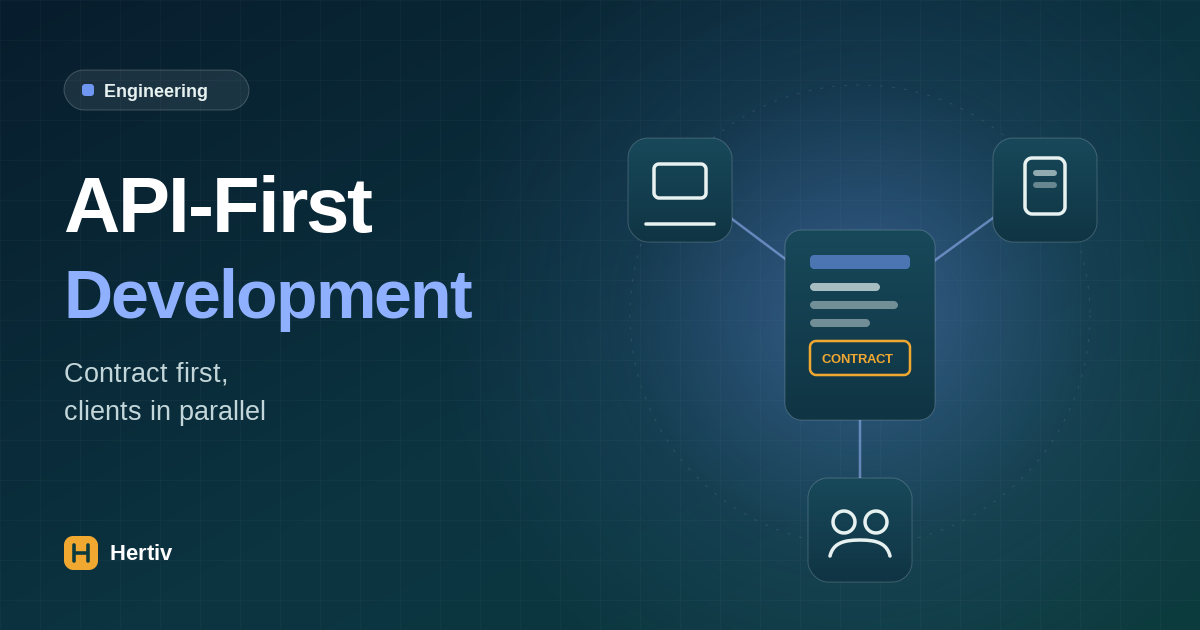
API-first development is an approach where a team designs the application programming interface (API) before building the product that uses it, so the API becomes the contract that every part of the system is built against. The interface is agreed first, and the web app, the mobile app and any partner integrations are all built to use it.
An API is the point where one piece of software asks another for data or an action: log in, fetch a list, save a form, take a payment. In a code-first project, the API grows out of whatever the first app needs, and other clients have to work around it. In an API-first project, the API is the product, and the apps are its clients.
The table below shows how the two approaches differ in practice, and why the order of work matters more than the tools.
| Question | API-first | Code-first |
|---|---|---|
| What is designed first? | The API contract | The first app's screens |
| Who uses the API? | Every client, by design | Whoever finds it later |
| How do new clients start? | From the contract and mock data | By reading existing code |
| Where are changes agreed? | In the contract, before coding | After the code is written |
| What breaks when it changes? | Clients that ignore the contract | Anything that depended on it |
The point is not the API itself. It is that teams can work in parallel: the backend team builds the service, the frontend team builds against a mock of the contract, and a partner team starts its integration before the real service exists. API integration use cases show what that reuse looks like once the API is live.
Why do teams choose API-first?
Teams choose API-first because it removes the waiting between teams and makes the product easier to extend later. When the contract is agreed first, nobody is blocked waiting for someone else's code.
The first benefit is parallel work. A frontend team can build screens against a mock API that returns example data, while the backend team builds the real service. When the real service is ready, the frontend switches from the mock to the live API, and the work that was done against the mock still holds.
The second benefit is reuse. A product that starts as a web app usually gains a mobile app, a partner integration or an internal tool. If the API was designed for one client, each new client needs changes. If it was designed as a contract, each new client just uses it.
The third benefit is clearer decisions. Writing the contract forces the team to name the resources, the fields and the errors before writing code. That discussion surfaces disagreements early, when they are cheap to fix, instead of after the code is written. Microservices teams use the same idea at a larger scale: the contract between services is agreed before the services are built.
How does an API-first workflow run?
An API-first workflow runs by agreeing the contract, mocking it, building against the mock, and then replacing the mock with the real service. Each step has a clear owner and a clear output.
- Name the resources. List the things the API deals with, such as users, orders and payments, and what each one contains.
- Write the contract. Define the endpoints, the request and response shapes, the status codes and the error format, in a format both people and tools can read.
- Review the contract. Walk through it with the teams that will use it, and fix the naming, the missing fields and the awkward flows before any code exists.
- Build a mock. Create a fake service that returns example data for the contract, so client teams can start building immediately.
- Build the clients and the service in parallel. Frontend, mobile and backend teams work at the same time, each against the same contract.
- Test the contract. Check that the real service matches the contract, so a client built against the mock works against the real thing.
The contract is a document, but it is also a test. A contract test sends requests to the real service and checks that the responses match what the contract promises. When the service changes, the test fails, which tells the team the contract needs updating before clients break.
That test is what keeps API-first honest. Without it, the contract drifts from the service, and clients built against the document fail against the real thing. With it, the contract stays true, and the parallel work it enabled keeps paying off.
What does a good API contract include?
A good API contract includes the resources, the fields, the errors and the rules for change, written clearly enough that a new developer can build a client from it without asking questions. If the contract needs a meeting to explain it, it is not finished.
The resources come first: what the API deals with, and what each resource contains. A resource should have a clear name, a stable identifier, and fields that mean the same thing every time they appear. A field called "total" should not mean one thing on an order and another on a refund.
Errors come next. Every endpoint should say what happens when the request is wrong, when the caller is not allowed in, and when the thing asked for does not exist. A client that knows the error format can handle failures gracefully instead of crashing or showing a blank screen.
Finally, the contract should say how it changes. Fields can be added, but removing or renaming a field breaks every client that uses it. The usual rule is to add new fields and keep old ones working, and to mark old fields as deprecated with a date before removing them. That rule is what lets an API grow without breaking the clients that depend on it.
Example (hypothetical): one API, three clients
Example (hypothetical): a team builds a booking product with three clients: a web app, a mobile app and a partner portal. Without API-first, each client gets its own backend work. Suppose each one needs 40 hours of backend work, so the three together need 120 hours.
With API-first, the team spends 60 hours designing and building one shared API, then 10 hours per client connecting it. That is 60 plus 30, which is 90 hours in total. The saving is 120 minus 90, which is 30 hours, and the three clients now share one contract instead of three separate backends.
The saving grows when a fourth client appears. Without the shared API, a fourth client would need another 40 hours. With it, the fourth client needs only the 10 hours of connection work, because the API already exists. The numbers are invented to show the arithmetic, not a real project.
The point is that the saving is not in the first build. It is in the second and third clients, and in every change after that, because a change to one shared API reaches all clients at once instead of being repeated three times.
What are the common mistakes?
The most common mistakes in API-first development are writing the contract after the code, letting the contract drift from the service, and designing the API for one client only.
- Writing the contract last. A contract written after the code just describes what was built. It does not enable parallel work, which is the main reason to go API-first.
- Letting the contract drift. If the service changes and the contract does not, clients built against the contract will fail. Contract tests catch the drift.
- Designing for one client. An API shaped around one app's screens is hard for the next client to use. Design for the resource, not the screen.
- Too many fields, too soon. Adding every field anyone might want makes the contract hard to change. Start with what the clients need now, and add fields as new clients ask for them.
- No versioning plan. An API that cannot change without breaking clients will freeze. Agree how fields are added and removed before the first release.
Another mistake is treating the mock as the finished API. A mock returns example data, but it does not check authorisation, validate input or handle errors. A client that works against a mock has only proved it can read example data. API testing covers how teams check the real service against the contract.
How do you start with API-first?
You start with API-first by picking one feature, writing its contract, and building the feature against a mock before the real service exists. A small pilot proves the workflow before the whole team adopts it.
Choose a feature with more than one client, such as a list that appears in both the web app and the mobile app. Write the contract for that feature only, agree it with the teams that will use it, and build a mock that returns example data.
Then build the clients against the mock while the backend team builds the real service. When the service is ready, switch the clients to it and run contract tests to confirm the responses match. If the switch is smooth, the workflow works, and the team can use it for the next feature.
If the switch is not smooth, the contract or the tests need work, and the team has learned that on one feature rather than on the whole product. For teams building a new product from scratch, custom software development work often starts with this same pilot: one contract, one mock, one feature, then the rest.
Key takeaways
- The API contract is agreed before the product is built, not after
- API-first lets client teams build against a mock while the service is built
- A good contract names resources, fields, errors and the rules for change
- Contract tests stop the service drifting away from what clients expect
- Start with one feature and one mock, then widen the approach
Frequently asked questions
Is API-first the same as having an API?
No. Most products have an API, but in a code-first product the API grows out of the first app's needs. API-first means the contract is designed first, on purpose, so every client is built against the same interface, rather than the API being whatever the first app happened to need.
Does API-first slow the first release down?
It can add time up front, because the contract must be written and agreed before building starts. That time is usually recovered when client teams work in parallel instead of waiting, and when a second client needs the same API. For a product with one client and no plans for more, it may not be worth it.
What tools do teams use for API-first?
Teams use a contract format that both people and tools can read, a mock server that returns example data from the contract, and contract tests that check the real service against the contract. The exact tools matter less than the workflow: contract first, mock second, parallel building third.
How is API-first different from microservices?
API-first is about the order of work: the contract comes before the code. Microservices is about how a system is split into services. The two work well together, because each service in a microservices system needs a contract, but a single-service product can also be built API-first.
Who writes the API contract?
The team that owns the service writes the first draft, but the teams that will use the API review it before building starts. A contract that only the service team understands will fail its first real client, so the review is part of the work, not a courtesy.
Can you move an existing product to API-first?
Yes, by picking one feature at a time. Write the contract for that feature, build a mock, and move its clients onto the new contract. Rewriting the whole product at once is rarely worth it, but moving feature by feature spreads the cost and proves the value as you go.


