What Is Agentic AI, and How Does It Work?
Agentic AI is software that works toward a goal on its own: it plans the steps, uses tools, checks its own results and asks for help when it is stuck.
On this page
Short answer
Agentic AI is a form of artificial intelligence that works toward a goal with little human input. Given a goal, such as answering customer questions or preparing a report, it plans the steps, uses the tools it has been given, checks its own work and adjusts when something goes wrong. It differs from a chatbot, which only replies when spoken to.
What is agentic AI?
Agentic AI is software that takes a goal and works out how to reach it, rather than waiting for a person to tell it each step. The word agentic comes from agency, the ability to act. An agentic system is given a goal, a set of tools and some rules, and it then plans, acts and checks its own progress until the goal is done or it needs human help.
The difference from an ordinary AI tool is who drives the work. A chatbot answers one question at a time and stops. An agentic system keeps going: it reads the question, looks up the answer, drafts a reply, checks it against the rules, and sends it or hands it to a person. The human sets the goal and the limits; the system handles the steps in between.
| Part | What it does | Example |
|---|---|---|
| Goal | What the system must achieve | Answer customer questions well |
| Plan | The steps it will take | Read, search, draft, check, send |
| Tools | What it can use | Knowledge base, order system, email |
| Memory | What it remembers | Past orders and earlier replies |
| Checks | What stops a bad action | Rules, limits and human review |
Agentic AI is not a single product. It is a way of building AI systems out of a model, a planner, tools and checks, and it is the step after chatbots for teams that want AI to do work rather than only answer questions. The related idea of AI agents is covered in AI agent use cases.
How is agentic AI different from a chatbot?
A chatbot waits for a message, replies once and forgets the exchange. An agentic system keeps a goal in mind across many steps and can take actions of its own, such as looking up an order, changing a booking or filing a ticket. The chatbot is a conversation; the agent is a worker with a to-do list.
The difference shows in what each one can do without a person. A chatbot cannot check a delivery status unless the user asks it to, and it cannot do anything after the chat ends. An agentic system can notice that an order is late, check the carrier, draft a message to the customer and flag the case for a human, all without being asked at each step.
That independence is also the risk. A chatbot that gives a wrong answer is a small problem; an agent that sends a wrong refund or cancels the wrong order is a large one. That is why agentic systems need limits: which tools they may use, how much they may spend, and which actions need a human to approve them first.
Most teams start with a chatbot and add agentic behaviour slowly, one task at a time. A support team might first let the system draft replies for a human to send, then let it send simple replies on its own, and only later let it issue refunds within a small limit.
Each step is tested before the next one is allowed. The definition of the building block itself is in what an AI agent is.
How does an agentic AI system work?
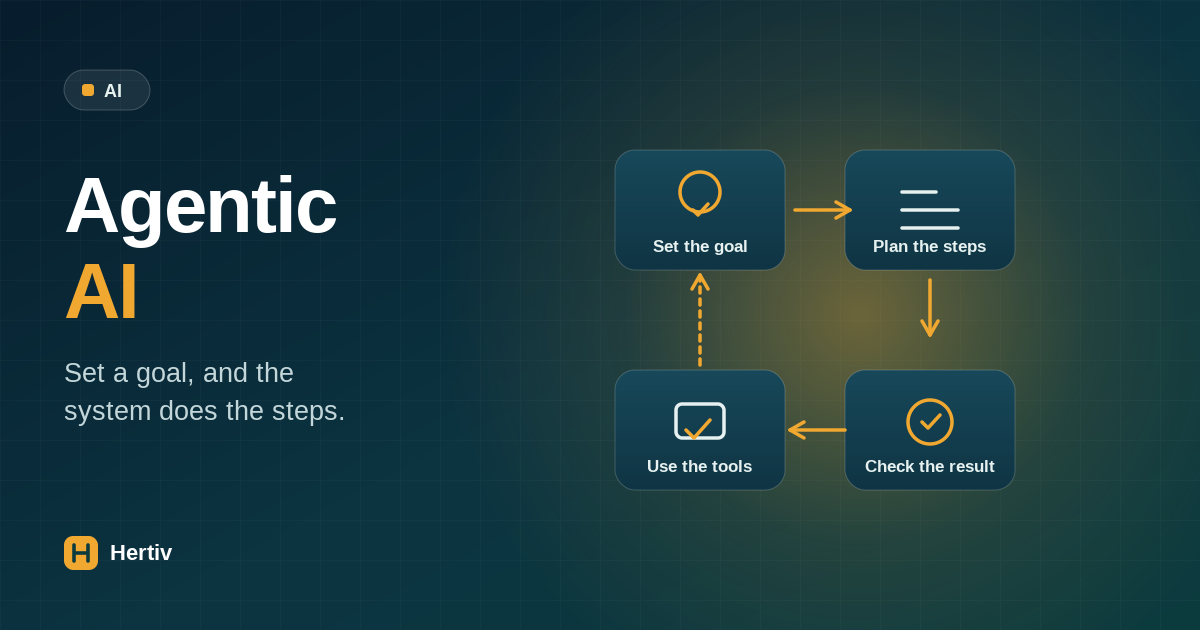
An agentic AI system works in a loop: it reads the goal, makes a plan, takes one step, looks at the result, and then decides what to do next. The loop repeats until the goal is reached, the system runs out of steps, or it hits a rule that says a human must decide.
A typical loop looks like this:
- Read the goal and the context. The system takes the task and the facts it needs, such as the customer, the order and the history.
- Make a plan. It breaks the goal into steps and picks the tools for each step.
- Take one step. It calls a tool, for example searching the knowledge base or checking an order.
- Check the result. It compares the result with the goal and the rules, and decides whether to continue, retry or stop.
- Act or hand over. It finishes the task, or passes it to a human with a summary of what it did and why.
The loop is only as good as its tools and its checks. Good tools give the system real facts — the order status, the policy text, the customer's history — instead of letting it guess. Good checks stop it from acting on a guess: a rule that says refunds over a set amount need approval, or that the system must quote the policy it used.
Memory matters too. A system that remembers earlier steps in the same task can avoid repeating work and can explain what it did. A system with no memory will ask the same question twice and will not notice when it goes in circles. Keeping a short log of each step is the simplest form of memory and the easiest to review.
Where is agentic AI used today?
Agentic AI is used today in customer support, back-office work and research, where the tasks are clear, the tools exist and a human can check the result. The common thread is a job that takes several steps and happens often enough to be worth automating.
In support, an agent reads a ticket, finds the order, checks the policy, drafts a reply and, for simple cases, sends it. In operations, an agent watches for late deliveries, checks the carrier, and drafts a message to the customer before anyone complains. In research, an agent gathers facts from several sources, checks them against each other and writes a short brief for a person to read.
Software teams use agentic systems to triage bug reports, run tests and draft fixes for a developer to review. Finance teams use them to gather documents for a report and to flag numbers that do not match. In each case the system does the gathering and the drafting, and a person makes the decision that matters.
The pattern is the same everywhere: the agent does the repetitive steps, the human keeps the judgement. Teams that skip the human check usually regret it, because the first bad action an agent takes on its own is often the one nobody expected. The test for whether a task fits is simple: if you can write the rules for it and check the result quickly, an agent can probably do it.
What does it take to build one?
Building an agentic AI system takes a clear goal, good tools, firm limits and a test set. The goal should be one job, not a whole department: answer refund questions, triage support tickets, or prepare a weekly report. A narrow goal is easier to test and easier to trust.
The steps are:
- Pick one job. Choose a task that happens often, has clear rules and a result you can check.
- List the tools it needs. Write down every system the agent must read or change, and give it the narrowest access that works.
- Set the limits. Decide what it may do alone, what needs approval, and the maximum it may spend or change.
- Write the rules. Put the policies in plain language the system can quote, so its answers can be checked.
- Build a test set. Collect real examples of the job, including awkward ones, and run the system on them before it touches real customers.
- Watch it live. Log every step, review the failures each week, and widen the limits only when the results are steady.
Most teams build the first version with a small proof of concept, which is the approach described in how to build an AI proof of concept. The proof of concept is not the product; it is the test that shows whether the job fits an agent at all.
Example (hypothetical): a support team tries an agent
Example (hypothetical): a support team of six handles 300 questions a day. Each question takes about 5 minutes to answer, so the team spends 300 times 5 minutes, or 25 hours a day, on replies. The team decides to try an agentic system on the simplest questions first.
They give the agent one job: answer delivery-status questions. The agent reads the question, looks up the order, checks the carrier, and drafts a reply. A human reviews each draft before it is sent. In the first week the agent handles 200 of the 300 questions, and the human reviews take about 1 minute each, which is 200 minutes, or about 3 hours 20 minutes a day.
The remaining 100 questions still take 5 minutes each, which is about 8 hours 20 minutes a day. Added together, the team now spends about 11 hours 40 minutes a day on replies instead of 25 hours, saving about 13 hours 20 minutes a day. The saving comes from the agent doing the looking-up, not from the human working faster.
The team does not widen the agent's job until the review shows the drafts are right almost every time. When the agent makes a mistake, the human corrects it and the team adds the case to the test set, so the same mistake is less likely next time. The agent earns more freedom one checked result at a time.
What are the common mistakes?
The most common mistakes with agentic AI are giving the agent too much freedom too soon, giving it bad tools, and skipping the human check on the actions that matter.
- No limits. An agent with access to refunds, cancellations and customer data and no spending cap will eventually do something expensive.
- Guessing instead of looking up. An agent without access to the real order or policy will invent an answer that sounds right.
- No test set. Testing on five easy examples and going live is how the first awkward customer finds the gap.
- Too broad a goal. Telling an agent to run support is not a goal; answering delivery questions is.
- No logging. If the system does not record what it did, nobody can explain a bad outcome or fix it.
- Removing the human too early. Letting the agent act alone before its results are steady is the fastest way to lose trust.
Key takeaways
- Agentic AI works toward a goal on its own, planning steps, using tools and checking its own results
- A chatbot replies once and stops; an agent keeps working across several steps until the goal is done
- The loop is read, plan, act, check and hand over, and it is only as good as its tools and limits
- Start with one narrow job, a test set and a human review, then widen the agent's freedom slowly
- The human keeps the judgement: agents do the repetitive steps, people make the decisions that matter
Frequently asked questions
Is agentic AI the same as an AI agent?
Almost. An AI agent is the software itself, while agentic AI is the approach of building systems that act toward a goal with little human input. People use the two terms for the same thing in practice, but agentic AI stresses the independence: the system plans and acts, rather than only replying when asked.
Can agentic AI work without a human?
It can do the steps, but it should not run without human oversight on anything that matters. A human sets the goal, the limits and the rules, reviews the results, and takes over when the system is unsure. The aim is to save the human's time, not to remove the human from decisions that carry risk.
What tools does an agentic system need?
It needs the tools that match its job: a knowledge base for facts, an order or ticket system for records, and a way to send messages or update records. Each tool should give the narrowest access that works. A system with too much access can do damage, and a system with too little will guess instead of looking things up.
How do you stop an agent making a mistake?
You set limits before it runs: which actions need approval, the maximum it may spend or change, and the rules it must quote. You also log every step and review the failures each week. Most mistakes come from missing facts or unclear rules, so fixing the tools and the rules is usually more useful than blaming the model.
Is agentic AI only for large companies?
No. A small team can use it for one job, such as answering delivery questions or drafting replies, with a modest setup. The cost is in the time to write the rules, build the test set and review the results, not in the size of the company. Start with one job and one tool, and grow from there.
What is the difference between agentic AI and automation?
Ordinary automation follows a fixed script: if this happens, do that. Agentic AI plans its own steps and adapts when the result is not what it expected. Automation is best for work that never changes; agentic AI fits work where the steps vary and the system must decide what to do next.


