What Are Neural Networks, and How Do They Work?
A neural network is a computer model that learns patterns from examples. Learn how layers, weights and training turn raw data into predictions.
On this page
Short answer
A neural network is a computer model made of connected layers that learns patterns from examples. Each connection carries a weight, and training adjusts those weights so the network's output moves closer to the right answer. Given enough examples, the network can sort images, predict text or flag fraud without anyone writing rules for each case.
What is a neural network?
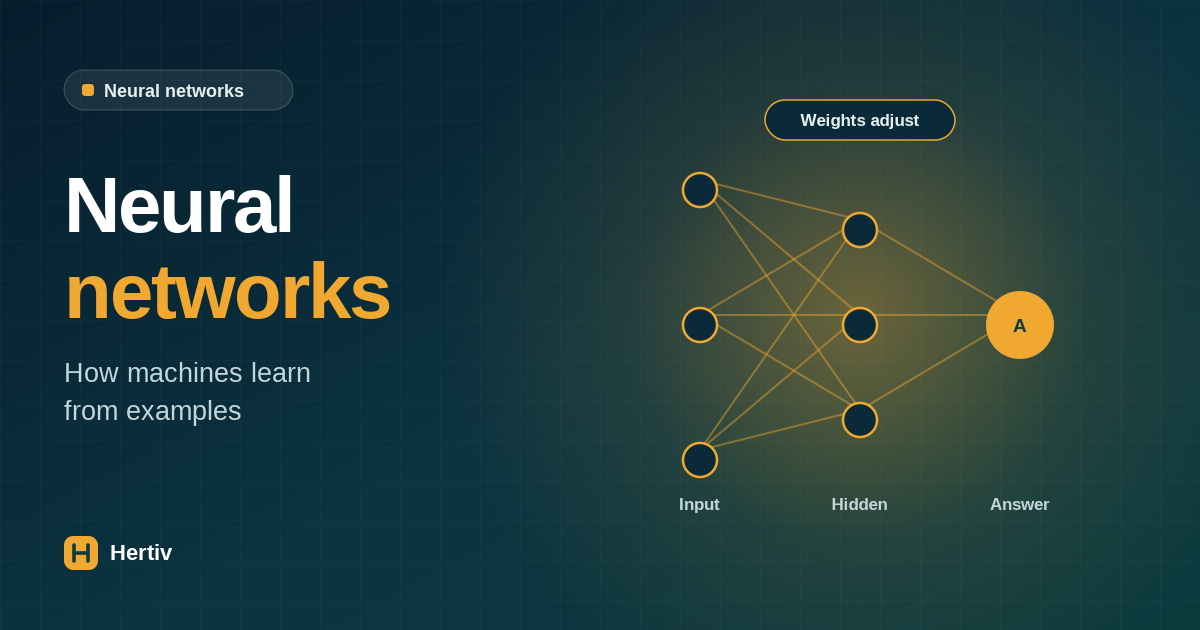
A neural network is a computer model made of layers of small units, called neurons, that pass numbers to each other. The first layer takes in raw data, such as pixels from an image or words from a sentence. Each later layer combines those numbers into more useful patterns, and the last layer gives the answer, such as a label, a score or a prediction.
Each connection between neurons carries a weight, a number that says how much that connection matters. A large weight means the signal has a strong effect on the next layer; a small weight means it barely matters. Learning is the process of adjusting these weights until the network gives the right answer often enough.
Neural networks are different from ordinary programs. In an ordinary program, a person writes rules: if the image has four legs and fur, call it a dog. In a neural network, nobody writes those rules. The network finds them by looking at many labelled examples. For the broader field, see what is machine learning.
How does a neural network learn?
A neural network learns by making guesses, measuring the error, and adjusting its weights a little at a time. The process repeats over many examples until the guesses are good enough. The table below shows the main parts of that process.
| Part | What it does |
|---|---|
| Input layer | Takes in raw data, such as pixels or words |
| Hidden layers | Combine signals into patterns, layer by layer |
| Output layer | Gives the answer, such as a label or a score |
| Weights | Numbers that set how much each connection matters |
| Loss | A measure of how wrong the current guess is |
| Training | Repeatedly adjusting weights to reduce the loss |
Training needs labelled examples: inputs paired with the right answer. The network guesses, the loss tells it how wrong it was, and a method called backpropagation works out which weights to change and by how much. After many passes over the examples, the weights settle into values that give good answers on new data too.
Two risks matter. If the network memorises the training examples instead of learning the pattern, it fails on new data. This is called overfitting, and it is fixed with more varied examples and simpler models. If the examples are biased, the network learns the bias, so the data must be checked before training.
What are the main types of neural networks?
The main types of neural networks differ in how their layers are arranged, and each type fits a different kind of data. The choice depends on what the input looks like and what the answer should be.
- Feedforward networks. The simplest type: data flows one way, from input to output. They work for tables of numbers, such as credit scores or sensor readings.
- Convolutional networks. Built for images. They look at small patches of pixels at a time, so they can find edges, shapes and objects. They power image search, face recognition and medical scans.
- Recurrent networks. Built for sequences, such as text or time series. They remember what came before, so they can handle order and context.
- Transformers. The type behind modern language models. They weigh every word in a passage against every other word, which lets them handle long text well.
Most real systems combine types. A chatbot may use a transformer for language and a simple network for ranking answers. The type matters less than the data: a well-chosen network trained on poor data still gives poor answers.
Where are neural networks used?
Neural networks are used wherever a pattern is easier to learn from examples than to write as rules. Image recognition is the classic case: nobody can write a rule for what a cat looks like, but a network trained on many cat photos learns it.
Other common uses include speech recognition, translation, recommendations, fraud detection and demand forecasting. In business, the most common use is sorting and scoring: sorting support tickets, scoring loan applications, or ranking products for a shopper. For business examples, see neural network applications in business.
Neural networks are not the right tool for every job. If the rules are clear and the data is small, a simple model or a hand-written rule is cheaper and easier to explain. Use a neural network when the pattern is complex, the data is plentiful, and a small error is acceptable.
How do you build a neural network in 6 steps?
Building a neural network follows a short sequence. Work through it before training anything, so the result is measured and not guessed.
- Define the answer. Write down exactly what the network should output: a label, a score or a number. A vague answer makes training impossible to judge.
- Gather labelled examples. Collect inputs paired with the right answer. Check the labels, because wrong labels teach wrong patterns.
- Split the data. Keep part of the data aside for testing, so you can measure how the network does on examples it has never seen.
- Pick a type and size. Start with the simplest type that fits the data. A small network that works beats a large one that overfits.
- Train and measure. Train on the training data, then test on the held-out data. If the gap between the two is large, the network is memorising, not learning.
- Deploy and watch. Put the model behind a simple check that catches bad answers, and re-train it when new data arrives. For how a small pilot is usually scoped, see how to build an AI proof of concept.
Keep the first version small. A network that sorts one kind of ticket well is more useful than a large model that does five jobs badly.
Example (hypothetical): a shop sorts support tickets
Example (hypothetical): a small online shop gets 600 support tickets a week and sorts them by hand into billing, delivery and returns. A team member spends about an hour a day on sorting. The shop trains a simple neural network on 2,000 old tickets, each labelled with the right category.
At first the network gets 480 of 600 tickets right, which is 80%. The team adds 1,000 more labelled tickets, including the tricky cases where customers mention two problems at once. After retraining, the network gets 540 of 600 right, which is 90%. The remaining 60 tickets go to a person, who also checks the ones the network is unsure about.
Sorting now takes about 15 minutes a day instead of an hour. The network did not replace the support team; it removed the easy sorting so the team could spend its time answering customers.
What are the common mistakes?
The most common neural network mistakes are training on bad data, using a model that is too large, and skipping the held-out test.
- Bad labels. If the training labels are wrong or inconsistent, the network learns the wrong pattern. Check labels before training, not after.
- Too large a model. A huge network on a small dataset memorises the examples and fails on new ones. Start small and grow only if the test score improves.
- No held-out test. Measuring on the training data tells you nothing. Always keep data aside that the network never sees during training.
- Ignoring bias in the data. If the examples reflect a bias, the network will repeat it. Review the data for gaps before you trust the output.
- No check on live answers. A model that worked in testing can drift as data changes. Watch its live answers and retrain when they get worse.
Key takeaways
- A neural network learns patterns from labelled examples by adjusting weights between layers
- Training is a loop: guess, measure the error, adjust the weights, repeat over many examples
- Convolutional networks fit images, transformers fit text, and simple networks fit tables of numbers
- Neural networks suit complex patterns with plenty of data, not clear rules with little data
- Always test on data the network has never seen, and watch its live answers after launch
Frequently asked questions
What is the difference between a neural network and machine learning?
Machine learning is the broad field of teaching computers to learn from data. A neural network is one type of machine learning model, built from layers of connected units. Other machine learning models include decision trees and linear models.
Do neural networks need a lot of data?
They need enough labelled examples to find the pattern, which can be hundreds or many thousands depending on the task. Simple problems need less. When data is scarce, a simpler model or a pre-trained network is usually the better choice.
What is deep learning?
Deep learning means neural networks with many hidden layers. More layers let the network learn more detailed patterns, such as the difference between two similar objects in an image. Deep learning needs more data and more computing power than shallow networks.
Can a neural network explain its answers?
Usually not in plain words. A neural network can show which inputs mattered most, but it cannot explain its reasoning the way a person can. For decisions that need an explanation, a simpler model may be the right choice.
How long does it take to train a neural network?
It depends on the size of the network and the amount of data. A small network on a few thousand examples can train in minutes. A large language model needs far more data and computing power, and can take weeks.
Are neural networks the same as AI?
No. AI is the broad idea of machines doing tasks that need intelligence. Neural networks are one way to build AI systems, and they are the method behind most modern image, speech and language tools.


