Neural Network Applications in Business: Where They Fit
Neural networks power forecasting, fraud checks, recommendations and document reading. Learn where they fit in a business, what data they need, and how to start.
On this page
Short answer
A neural network is a machine learning model made of layers of simple units that learn patterns from examples, and businesses use it for forecasting, classification, recommendations and reading documents. It fits where the business has enough labelled examples, the pattern is hard to write as rules, and a wrong answer is cheap enough to check.
What is a neural network in business terms?
A neural network is a machine learning model that learns patterns from examples, instead of following rules a person wrote. In business terms, you feed it past cases with known outcomes, such as orders, claims or customer messages, and it learns to predict the outcome for new cases.
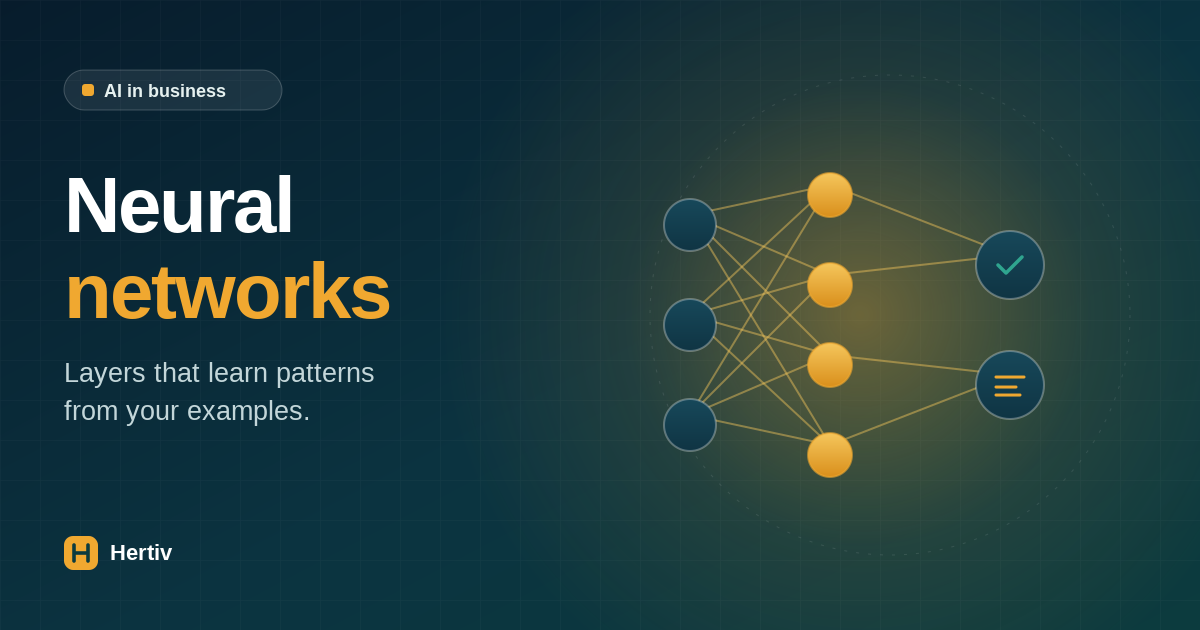
The model is built from layers of simple units. Each layer turns the input into a slightly more useful form, and the final layer produces the prediction: a category, a number or a short piece of text. Training adjusts the connections between units until the predictions match the examples well enough to be useful.
What makes neural networks different from older methods is that they learn the features themselves. A rules-based system needs a person to list the signals that matter; a neural network finds them from the data. That is why they fit messy inputs such as images, speech and free text, where the signals are hard to name in advance.
A AI product development team can help decide whether the problem needs a neural network or a simpler model.
Where do neural networks fit in a business?
Neural networks fit in a business where the task repeats, the data exists, and the pattern is too tangled for fixed rules. The strongest uses are forecasting, classification, recommendations and reading documents, because each one has many past examples to learn from.
| Use | What the model does | Data it needs |
|---|---|---|
| Demand forecasting | Predicts sales or stock needs | Past sales, seasons, prices |
| Fraud and risk checks | Flags unusual transactions | Past transactions, outcomes |
| Recommendations | Suggests products or content | Past views, buys, ratings |
| Document reading | Extracts fields from invoices | Labelled documents |
| Customer messages | Sorts and drafts replies | Past messages, replies |
| Quality inspection | Spots defects in images | Labelled photos |
| Churn prediction | Flags customers likely to leave | Usage, billing, support history |
Forecasting and fraud checks are usually the first fit, because the data already exists in sales and finance systems. Document reading and message sorting follow, because they save staff time on work that repeats every day. Pick the use where a small improvement is worth real money, not the use that sounds most advanced.
What data does a neural network need?
A neural network needs enough labelled examples to learn the pattern, and the examples must match the cases it will see in use. Labelled means each example carries the right answer: the invoice with the correct fields, the transaction marked fraud or not, the message with the right category.
Volume matters, but quality matters more. A thousand clean, correctly labelled examples beat ten thousand messy ones, because the model learns whatever is in the data, including the errors. If the labels came from different people with different rules, the model will learn the inconsistency, not the pattern.
Before building, check three things: whether the labels exist or must be created, whether the data covers the cases the model will see, and whether the data is allowed to be used this way under your privacy rules. Labelling is often the largest cost in a neural network project, and it is the cost teams most often forget to budget.
For the models that sit underneath these uses, see top machine learning algorithms.
For the newer sequence models, see transformer vs RNN.
How do you start a neural network project?
You start a neural network project by picking one narrow use, proving it on past data, and then testing it on live work with a human in the loop. A narrow first project proves the value and the data before the team spends on a larger build.
- Pick one use. Choose the use where a small improvement is worth real money and the data already exists.
- Define the answer. Agree on what the model must output, and how you will know if it is right.
- Build the dataset. Gather and label past examples, and split them into training and test sets the model has not seen.
- Try a simple model first. A simpler model sets a baseline, so you know whether the neural network is actually better.
- Test on live work. Run the model beside staff, let staff correct it, and measure the accuracy on real cases.
- Ship with a human in the loop. Let the model suggest, and let staff approve, until the accuracy is proven.
Step four is the one teams skip, and it is the one that saves the most money. If a simple model reaches the accuracy you need, the neural network was never necessary, and the simpler model is cheaper to run and easier to explain.
Example: a retailer predicting stock-outs
Example (hypothetical): a retailer with 40 stores wants to predict which products will run out of stock each week, so staff can move stock before shelves empty. The team has two years of sales, stock and promotion data.
The team picks one product group with 200 items and builds a dataset of weekly sales, stock levels and promotions, labelled with whether each item ran out. A simple model predicts 68 of 100 stock-outs; a neural network predicts 82 of 100, with 12 false alarms. The team ships the neural network with a human in the loop: the system suggests transfers, and store managers approve them.
Over 12 weeks, the 200 items run out 240 times in total. The old manual process caught 150 of them in time; the model catches 197, which is 47 more, and the false alarms cost about 30 minutes of staff time each week. The gain is real, but it came from the data and the approval step, not from the model alone.
What does it cost and how long does it take?
A first neural network project usually takes two to four months, and the cost depends on the data work, the model work and the integration. The figures here are rough planning ranges, not quotes, and vendor prices should be checked on the vendor's own site.
The main cost drivers are data labelling, model training and evaluation, and the integration into the system where staff will use the predictions. A use with clean, labelled data is a much smaller build than one where labelling must start from scratch, because labelling can take longer than the model work itself.
Running costs continue after launch: hosting, monitoring, retraining and labelling new examples. Budget for regular retraining, because customer behaviour changes, and a model trained on last year's data will slowly give worse answers. Before committing to a larger build, a proof of concept for AI is the cheaper way to test whether the data and the accuracy are good enough.
What are the common mistakes?
The most common mistakes are starting with the model instead of the data, skipping the simple baseline, and shipping without a human in the loop.
- Starting with the model. Teams pick a neural network before checking whether the labels exist or the data is clean.
- No simple baseline. Without a simpler model to compare against, nobody knows whether the neural network is actually better.
- Testing on training data. Accuracy on data the model has already seen says nothing about accuracy on new cases.
- Shipping without review. A model that acts alone will make confident mistakes that nobody catches until a customer complains.
- Ignoring drift. Customer behaviour changes, and a model that is never retrained slowly gets worse.
- No owner. Someone must own the data, the labels and the retraining schedule, or the model will quietly go stale.
Key takeaways
- Neural networks fit tasks with many labelled examples and patterns too tangled for rules
- Forecasting, fraud checks and document reading are usually the first fit
- Clean labels matter more than data volume
- Always test against a simpler model before committing to a neural network
- Ship with a human in the loop and retrain as behaviour changes
Frequently asked questions
What business problems are neural networks good at?
They are good at forecasting, fraud checks, recommendations, document reading, message sorting and quality inspection. Each one repeats often, has many past examples to learn from, and follows a pattern that is hard to write as fixed rules.
How much data does a neural network need?
It depends on the task, but quality matters more than volume. A thousand clean, correctly labelled examples beat ten thousand messy ones. Before building, check whether the labels exist, whether they cover the cases the model will see, and whether the data may be used this way.
Is a neural network better than a simpler model?
Not always. A simpler model is cheaper to run, easier to explain and sometimes just as accurate. Always build the simple model first as a baseline, and only use a neural network when it clearly beats that baseline on cases it has never seen.
How long does a neural network project take?
A first project usually takes two to four months, depending on the data work, the model work and the integration. Labelling is often the largest cost and the longest step, so check the data before committing to a timeline.
What does a neural network cost to run?
Running costs are hosting, monitoring, retraining and labelling new examples. The exact figures depend on the model size and the volume of predictions, so treat any figure as a rough planning range and check vendor prices on the vendor site.
Can a small business use neural networks?
Yes, by starting with one narrow use where the data already exists, such as forecasting for one product group or sorting one kind of customer message. A proof of concept on past data is the cheapest way to find out whether the accuracy is good enough.


