What Are Bitcoin Runes and How Do They Work?
Bitcoin Runes are fungible tokens created and moved on Bitcoin, using its UTXO model. Here is how runestones work and how Runes differ from BRC-20.
On this page
Short answer
Bitcoin Runes are a fungible token protocol on Bitcoin that creates and moves tokens using small instructions, called runestones, written into ordinary Bitcoin transactions. Balances live in UTXOs, so runes move the way bitcoin moves.
What are Bitcoin Runes?
Bitcoin Runes are fungible tokens created and moved directly on the Bitcoin blockchain, using Bitcoin's own UTXO model. A rune is a token with a fixed supply, a name and a symbol, and its balances ride on ordinary Bitcoin transaction outputs, so runes move the way bitcoin moves.
Runes were created by Casey Rodarmor, the developer behind Ordinals, and launched at block 840,000, the block of the fourth Bitcoin halving on 20 April 2024. The launch was timed for the halving on purpose, to give miners extra fee income just as their block subsidy was halved.
Runes broaden what Bitcoin can do. Bitcoin itself was built to move bitcoin, not to track other tokens. Runes add a token layer on top, without changing Bitcoin's rules and without a separate chain. For the base layer itself, see what a blockchain is and how it works.
How do Runes work?
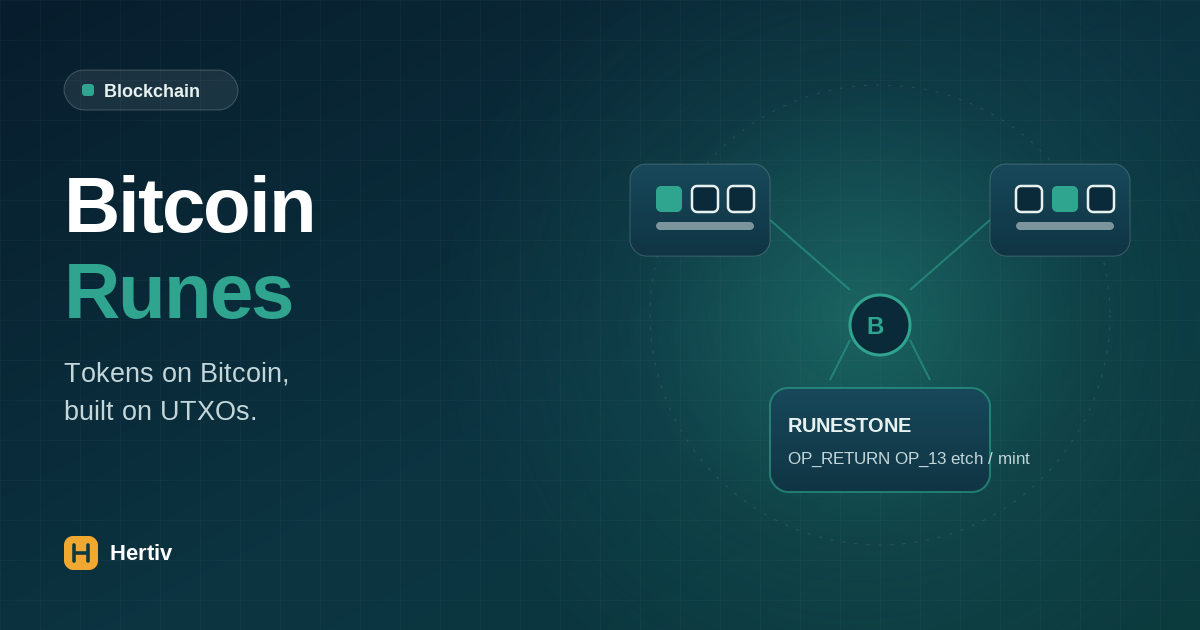
Runes work by writing small instructions, called runestones, into Bitcoin transactions. A runestone sits in an OP_RETURN output, which is an output worth zero bitcoin that nobody can spend, so it never enters the set of unspent outputs that every node must store.
A runestone can do three things: etch a new rune, mint units of an existing rune, or move balances between outputs. The instructions are compactly encoded numbers, and the runestone starts with OP_RETURN followed by OP_13 as a marker. Token balances themselves live in ordinary UTXOs, so spending an output that carries 1,000 units of a rune moves those 1,000 units into the new outputs.
Bitcoin itself checks no token rules. The network sees only ordinary transactions with a small data output. Wallets, indexers and explorers read the runestones and track the balances, which is why Runes are described as a protocol on top of Bitcoin rather than a change to it.
Runes vs BRC-20: what is different?
BRC-20 was the first popular fungible token standard on Bitcoin, built on Ordinals inscriptions in March 2023. Runes was designed as a leaner replacement, after BRC-20 created large numbers of tiny junk UTXOs that bloated the set every node must store and made running a node more expensive.
| Feature | Runes | BRC-20 |
|---|---|---|
| Where the data sits | OP_RETURN output, which nodes can drop | Inscriptions written into witness data |
| Where balances live | Ordinary UTXOs | Off-chain indexers tracking inscriptions |
| UTXO bloat | Minimal, by design | Large numbers of tiny junk UTXOs |
| Transfer | Edicts in a runestone move balances between outputs | A new inscription is written for each transfer |
| Creator | Casey Rodarmor, as a protocol | Built on Rodarmor's Ordinals by a third party |
| Launch | Block 840,000, April 2024 halving | March 2023 |
Rodarmor has been candid about the space, saying most tokens are memes, and built Runes as harm reduction: if people are going to create tokens on Bitcoin regardless, they should at least do it in a way that does not burden the network. For how token supply and economics are usually designed, see what tokenomics is.
How are Runes created and moved?
Creating a rune is called etching. The etcher writes a runestone that names the rune, sets its symbol, its divisibility and its supply, and may set minting terms such as how many units each mint creates and when minting ends. Rune names initially had to be 13 or more characters, with one fewer character becoming available about every four months.
Minting is open when the etcher allows it. Anyone can mint units of an open rune until the cap is reached, and the first-come-first-served race is what drove the fee spike at launch: popular tokens were fully minted within a few blocks, and the miner of block 840,000 received 37.6 BTC in fees.
Moving runes uses edicts in a runestone, which assign amounts of a rune to specific outputs. Anything left over follows the pointer in the runestone, or the first non-OP_RETURN output. Sending runes to an OP_RETURN output burns them, and a malformed runestone becomes a cenotaph, which burns the runes in the transaction's inputs.
What can Runes be used for?
Runes are fungible tokens, so they fit the same uses as tokens on other chains: meme coins, community tokens, points, and tokenised assets. The difference is the base layer: the token rides on Bitcoin's security and its UTXO model rather than on a smart contract platform.
| Use | How Runes fit | What to watch |
|---|---|---|
| Meme coins | Fixed-supply tokens with open minting | Most have no use beyond trading |
| Community tokens | Tokens for a group, game or creator | Distribution and fairness of the mint |
| Loyalty and points | Units that represent rewards or access | Redemption needs an off-chain system |
| Tokenised assets | Units that represent a real-world claim | The claim depends on the issuer, not the protocol |
| Fee income for miners | Runes activity pays transaction fees | Fees spike at launch and settle after |
Runes do not add smart contracts to Bitcoin. A rune cannot run code, hold logic or enforce rules on its own. Anything beyond holding and moving units needs software outside the chain, such as a marketplace, a wallet or an issuer's own system. For tokens that do run code, see how to create an NFT token.
Example (hypothetical): launching a community rune
Example (hypothetical): a gaming community wants a rune with a supply of 10,000,000 units. The etcher sets the mint terms so each mint creates 2,000 units. That means 10,000,000 / 2,000 = 5,000 mints are needed to reach the cap.
At launch, demand is high and the first 1,000 mints are claimed within the first hour. That is 1,000 x 2,000 = 2,000,000 units, or 20 percent of the supply, in one hour. Fees spike while the race runs, then settle as the remaining 4,000 mints are claimed more slowly over the following days.
One member sends 5,000 units to a friend by writing an edict in a runestone. The friend's wallet reads the runestone and shows the new balance. The lesson is that the protocol moves units, but the value of the units depends on what the community does with them afterwards.
What are the common mistakes?
The most common mistakes with Runes are treating a rune as an investment, ignoring the fee race at launch, and assuming the protocol enforces the token's promises.
- Buying the hype. Most runes are memes with no use beyond trading. A fixed supply does not make a token valuable.
- Ignoring fees at launch. Open mints race for the cap, and fees spike. Minting late or in small amounts can cost more in fees than the tokens are worth.
- Trusting the protocol for off-chain promises. A rune that claims to represent an asset depends on the issuer, not on Bitcoin. The protocol only moves units.
- Malformed runestones. A bad runestone becomes a cenotaph and burns the runes in the transaction's inputs. Check the runestone before sending.
- Sending to the wrong output. Runes sent to an OP_RETURN output are burned. Double-check the destination before confirming.
- Assuming smart contracts. Runes have no code and no logic. Anything beyond holding and moving units needs software outside the chain.
Key takeaways
- Runes are fungible tokens that ride on Bitcoin's UTXO model
- A runestone in an OP_RETURN output etches, mints or moves runes
- Runes were designed to avoid the UTXO bloat that BRC-20 caused
- Bitcoin checks no token rules; wallets and indexers track the balances
- Runes add no smart contracts, so any logic lives outside the chain
- A malformed runestone becomes a cenotaph and burns the input runes
Frequently asked questions
What are Bitcoin Runes?
Bitcoin Runes are a fungible token protocol on Bitcoin that creates and moves tokens using small instructions, called runestones, written into ordinary Bitcoin transactions. Balances live in UTXOs, so runes move the way bitcoin moves.
Who created Bitcoin Runes?
Casey Rodarmor, the developer behind Ordinals, created Runes and launched it at block 840,000, the block of the fourth Bitcoin halving on 20 April 2024. He designed it as a leaner replacement for BRC-20.
How are Runes different from BRC-20?
BRC-20 writes token data into inscriptions and tracks balances with off-chain indexers, which created large numbers of tiny junk UTXOs. Runes store instructions in OP_RETURN outputs and track balances in ordinary UTXOs, which is far lighter on the network.
Can Runes run smart contracts?
No. Runes have no code and no logic. They can hold and move units, but anything beyond that, such as a marketplace, a game or a redemption system, needs software outside the chain.
What happens if a runestone is malformed?
A malformed runestone becomes a cenotaph. The runes in the transaction's inputs are burned, an etched rune becomes unmintable, and mints count against the cap but burn what they mint.
Are Bitcoin Runes a good investment?
Most runes are memes with no use beyond trading, and their creator has said so openly. A fixed supply does not make a token valuable, and fees at launch can exceed the value of the tokens minted.


