How to Create an NFT Token, Step by Step
Creating an NFT token means preparing your media and metadata, then minting the token on a blockchain. Here is the full process, from wallet to marketplace.
On this page
Short answer
An NFT token is a unique digital record on a blockchain that proves ownership of a specific item, such as an image, a song or a ticket. Creating one means setting up a wallet, preparing your media and metadata, deploying or using a smart contract, and minting the token, which writes it onto the chain.
What is an NFT token?
An NFT token is a unique record on a blockchain that proves ownership of one specific item. Unlike a normal crypto token, where every unit is identical, each NFT has its own identity, so it can stand for one image, one song, one ticket or one membership. The token itself is usually a small entry in a smart contract, while the media file it points to is stored elsewhere.
Two standards cover most NFT tokens. ERC-721 is the standard for one-of-one tokens, where each token is unique. ERC-1155 is the standard for editions, where many copies of the same item share one contract. Knowing which one you need comes before you mint anything, because it decides how the token behaves.
An NFT does not store the image on the chain in most cases. The chain stores the token and a link to the media and its metadata, which are usually kept on a file system such as IPFS or on a server. If that link breaks, the token still exists but the image may not load, so storage matters as much as the mint. For what NFTs are used for, see NFT use cases.
What do you need before you start?
Before you mint, you need four things: a crypto wallet, some crypto to pay the network fee, the media file, and the metadata that describes it. A wallet such as MetaMask holds your tokens and signs the transactions, and it is also how marketplaces know who you are.
The media file is the item itself: an image, a video, an audio file or a 3D model. Keep the file size reasonable, because large files cost more to store and load slowly for buyers. A still image under a few megabytes is the usual starting point.
The metadata is a small text file that names the item, describes it and links to the media. It also lists traits, such as colour or rarity, which marketplaces show as filters. Write the metadata carefully, because it is what buyers read before they decide. See how to create an NFT token on the ERC-404 standard for a newer standard that mixes fungible and non-fungible traits.
How to create an NFT token in seven steps
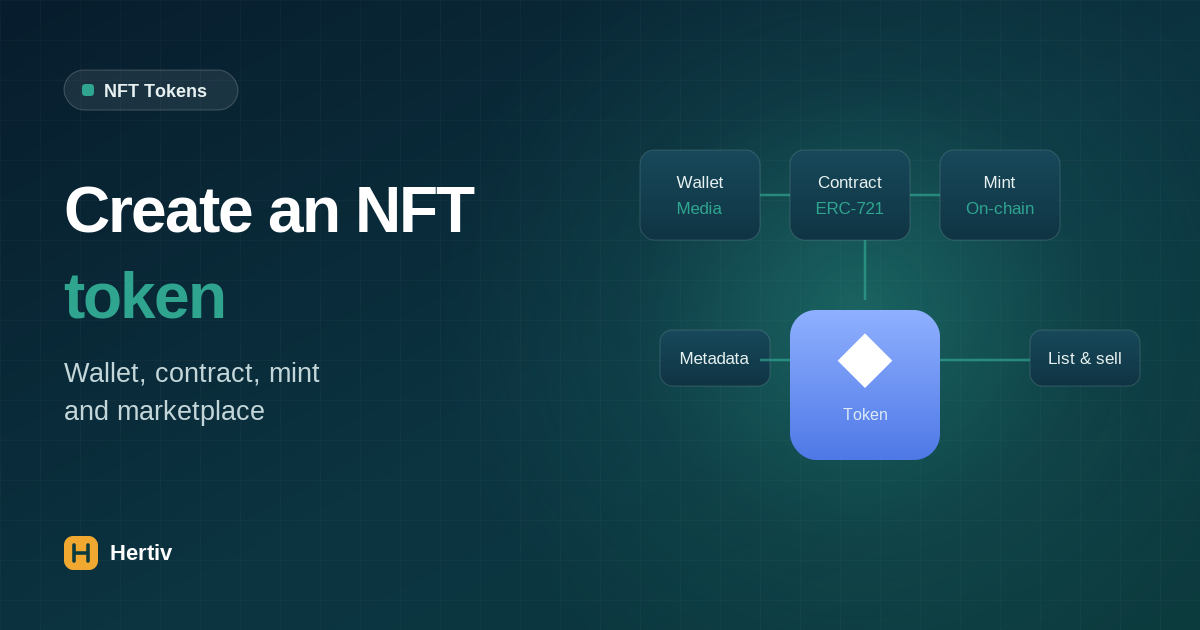
Create an NFT token in seven steps, starting with the wallet and ending with the listing. The mint itself takes minutes; the preparation is the real work.
- Set up a wallet. Install a wallet such as MetaMask, write down the recovery phrase on paper, and never share it with anyone.
- Choose a blockchain. Pick the chain your buyers use, such as Ethereum for the largest market or a lower-fee chain for cheaper minting.
- Prepare the media and metadata. Finalise the file, write the name and description, and upload both to storage such as IPFS.
- Pick the standard. Use ERC-721 for one-of-one items and ERC-1155 for editions with many copies.
- Deploy or use a contract. Either deploy your own smart contract or mint through a marketplace collection, which uses a shared contract.
- Mint the token. Pay the network fee, sign the transaction, and wait for the chain to confirm it.
- List it for sale. Set a fixed price or an auction on a marketplace, and check that the image, name and traits show correctly.
Test with one token before you mint a whole collection. A mistake in the metadata or the contract is cheap to fix on one token and costly to fix on a hundred. For a chain-specific guide, see how to create an NFT on Arbitrum.
Which blockchain and standard should you choose?
The chain you choose decides the fee, the audience and the tools. Ethereum has the largest NFT market and the most marketplaces, but its network fees are higher than most alternatives. Lower-fee chains cost less to mint on, but their buyer base is smaller, so the choice is a trade-off between cost and reach.
| Chain | Standard | Trade-off |
|---|---|---|
| Ethereum | ERC-721, ERC-1155 | Largest market, higher fees |
| Polygon | ERC-721, ERC-1155 | Low fees, Ethereum-compatible |
| Solana | Metaplex | Low fees, fast, different tools |
| Cardano | Native tokens | Low fees, smaller market |
For a first token, pick the chain where your buyers already are. If you plan to sell to collectors on the largest marketplaces, that is Ethereum. If you plan to give away many tokens or sell at a low price, a lower-fee chain makes more sense. The standard follows the item: one-of-one means ERC-721, editions mean ERC-1155.
What does it cost to create an NFT?
Creating an NFT costs a network fee, called gas, which you pay to the chain to record the mint. The fee changes with the chain and with how busy the network is, so it can be a few cents on a low-fee chain and much more on Ethereum at a busy time. Check the current fee in your wallet before you confirm the mint.
Marketplaces add their own costs. Some charge a fee when you mint, some charge a fee only when the token sells, and some let you mint for free and take the fee from the sale. The exact terms differ by marketplace, so read them before you list; see the vendor site for the current rates.
There are also costs people forget. Storing media, designing the item, and promoting the listing all take time or money. A token that nobody sees will not sell, so budget for the work after the mint, not just the mint itself. For a related build, see how to create NFTs on the Cardano blockchain.
Example (hypothetical): minting a 100-piece collection
Example (hypothetical): an artist mints a collection of 100 NFT tokens on a low-fee chain. Assume the network fee is $2 per mint, so minting the whole collection costs 100 x $2 = $200 in fees.
The artist lists each token at a fixed price of $50. If 40 tokens sell, sales total 40 x $50 = $2,000. The marketplace takes a fee on each sale; assume the fee is 5% of the sale price, so the fee on $2,000 of sales is $2,000 x 0.05 = $100, leaving $2,000 - $100 = $1,900.
After the $200 minting cost, the artist keeps $1,900 - $200 = $1,700 from the 40 sales. The 60 unsold tokens cost $60 x $2 = $120 to mint and earn nothing, so the real profit depends on how many tokens sell, not on how many were minted. Mint fewer tokens first and add more only when the first ones sell.
What are the common mistakes?
The most common mistakes when creating an NFT token are minting before the metadata is ready, ignoring the storage link, and pricing without knowing the fees.
- Metadata last. A token with a wrong name or missing traits is hard to fix after minting.
- Weak storage. Media kept on a personal server can vanish; use durable storage such as IPFS.
- Wrong standard. Minting editions as ERC-721 or one-of-ones as ERC-1155 creates confusion for buyers.
- Ignoring fees. Gas and marketplace fees can eat the whole sale price on a cheap token.
- Sharing the recovery phrase. Anyone with the phrase can take the wallet and every token in it.
- Minting too many. A large collection that does not sell costs money for nothing.
Key takeaways
- An NFT is a unique record on a chain that proves ownership of one item
- ERC-721 is for one-of-one items, ERC-1155 is for editions with many copies
- Prepare the media and metadata before you mint anything
- Test with one token before minting a whole collection
- The chain you choose trades fees against audience size
Frequently asked questions
What is an NFT token?
An NFT token is a unique record on a blockchain that proves ownership of one specific item, such as an image, a song or a ticket. Each NFT has its own identity, unlike normal crypto tokens where every unit is identical. The token usually points to media stored elsewhere.
How much does it cost to create an NFT token?
The main cost is the network fee, called gas, which changes with the chain and how busy the network is. It can be a few cents on a low-fee chain and much more on Ethereum at a busy time. Marketplaces may also charge a fee on minting or on sale, so check the current rates before you list.
Do I need to write code to create an NFT?
No. Marketplaces let you mint through a shared contract with no code, which is enough for a first token. Writing your own smart contract gives you control over royalties and rules, but it needs a developer and an audit before real money is involved.
What is the difference between ERC-721 and ERC-1155?
ERC-721 is the standard for one-of-one tokens, where each token is unique. ERC-1155 is the standard for editions, where many copies of the same item share one contract. Use ERC-721 for unique items and ERC-1155 when you want to sell many copies of the same item.
Where is the NFT image stored?
In most cases the image is not on the chain. The chain stores the token and a link to the media and its metadata, which are usually kept on a file system such as IPFS or on a server. If that link breaks, the token still exists but the image may not load.
Can I create an NFT for free?
Some marketplaces offer free minting, where the fee is taken from the sale instead of paid up front. You still need a wallet and the media, and the marketplace fee applies when the token sells. Check the marketplace terms before you list, because free minting is not free selling.


