Web3 in IoT: What Changes for Connected Devices
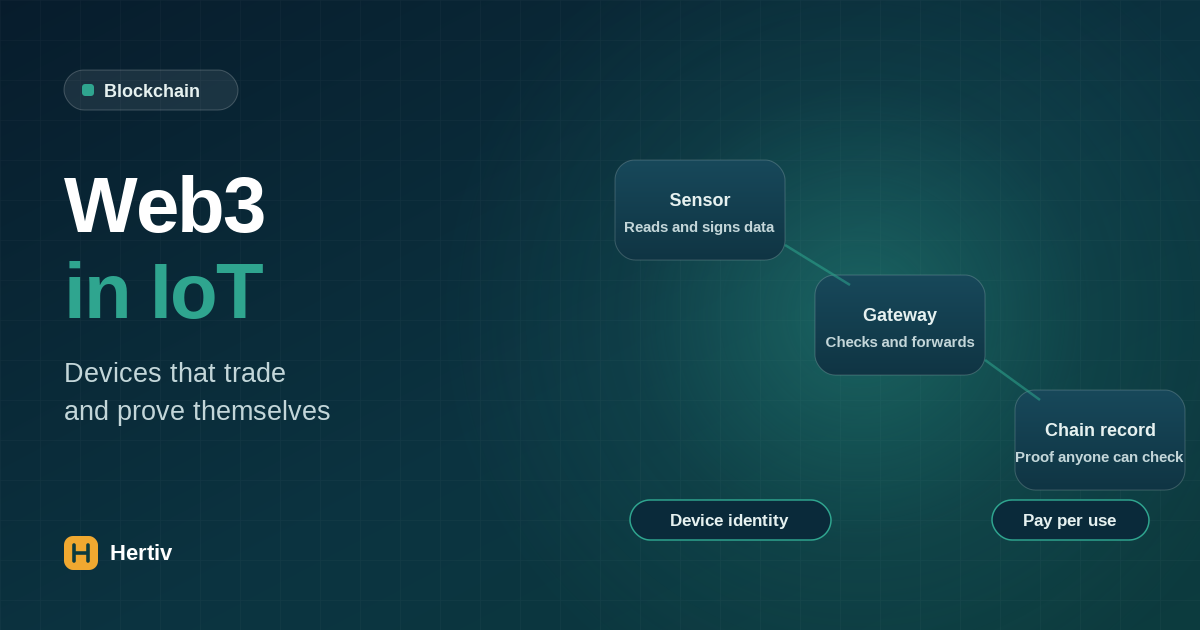
Web3 gives connected devices their own identity, a way to pay each other and a shared record, so devices can trade and prove what they did with no central platform.
On this page
Short answer
Web3 in IoT is the use of blockchain tools in connected devices: each device gets its own identity on a chain, devices can pay each other in tokens for data or services, and a shared record proves what each device did, without a single company controlling the whole network.
What is Web3 in IoT?
Web3 in IoT is the use of blockchain tools in connected devices. Each device gets its own identity on a chain, devices can pay each other in tokens for data or services, and a shared record proves what each device did, without a single company controlling the whole network.
Today most IoT devices report to one company's platform. That company holds the data, decides who can see it and can change the rules. Web3 changes the shape of that control: the device holds its own keys, the record of what it did lives on a shared chain, and the rules for who can read the data are set in code that anyone can check.
| Part | Without Web3 | With Web3 |
|---|---|---|
| Identity | Account on one company's platform | Own keys and identity on a chain |
| Payments | Monthly bill to the platform | Devices pay each other per use |
| Data | Stored and sold by the platform | Owner decides who may read it |
| Proof | Trust the platform's word | Shared record anyone can check |
| Control | One company sets the rules | Rules set in code, visible to all |
Web3 in IoT is still young, and most real deployments are small pilots rather than large networks. But the idea is clear: devices that can prove their identity, pay for what they use and share data on their owner's terms. For the background, read what a blockchain is first.
How do devices get an identity on a blockchain?
Devices get an identity on a blockchain by holding their own cryptographic keys and registering a public identifier on the chain. The device keeps a private key in a secure chip or module, and the matching public key is recorded on chain as the device's identity. Anyone can check that a message signed with that key came from that device.
This identity does what a username and password cannot. It cannot be guessed, it cannot be reused by another device, and it works without asking a central server to confirm it. When a sensor sends a reading, it signs the reading with its key, and anyone who reads the record can check the signature and know the reading came from that sensor.
The identity can also carry permissions. A device's record can say what it may do, who owns it and when it was made. If the device is sold, the ownership record moves with it, and the new owner can check the device's history before trusting it. That history is what makes the identity useful for buyers and auditors, not just for the devices themselves.
How do devices pay each other?
Devices pay each other through small token payments that are recorded on chain. When a device uses a service, such as buying a weather reading, renting bandwidth or charging a battery, it sends a small payment in tokens to the device that provided it. The payment and the service are recorded together, so both sides can prove what happened.
These payments are usually tiny, often far less than a cent, which is why they need a chain with low fees. A device that charges a car battery by the minute, or a sensor that sells its readings one at a time, cannot afford a payment that costs more than the service itself. That is why many IoT pilots use chains or side networks built for cheap, fast payments.
The point is not the token itself but the settlement. Two devices that have never met can trade without a middleman, because the chain records the payment and the service at the same time.
If the service is not delivered, the payment does not happen, and if the payment is not made, the service stops. A team planning such a system can look at blockchain IoT use cases to see where this pattern is already being tried.
How does Web3 change who owns IoT data?
Web3 changes who owns IoT data by letting the device owner set the rules for reading it, instead of handing the data to a platform that decides. The readings stay with the owner, and access is granted through keys and smart contracts that say who may read what, for how long, and for what price.
A practical pattern is a data marketplace. A farmer's soil sensors collect readings, and the farmer can sell those readings to a weather service or an insurer, one batch at a time, with the buyer paying in tokens and the access ending when the deal ends. The farmer keeps the data, the buyer gets what it paid for, and the chain records the deal.
This only works if the data is worth buying and the access control is real. If the data is public anyway, or if the buyer can copy it and resell it, the marketplace breaks down. That is why the strongest cases are data that is fresh, local and hard to get any other way, such as readings from a specific place at a specific time.
What are the limits of Web3 in IoT today?
The limits of Web3 in IoT today are cost, speed, power and law. Each one is real, and each one shapes where the idea works and where it does not. A pilot that ignores them will look good in a demo and fail in the field.
Cost and speed come first. Writing to a chain costs a fee and takes time, and a sensor that sends a reading every minute cannot afford to write every reading on chain. Most pilots solve this by writing summaries or proofs to the chain and keeping the raw readings off chain, in a store the owner controls.
Power is the next limit. A small battery sensor cannot run the cryptography and the radio traffic that a full blockchain node needs, so it talks to a gateway that does the heavy work on its behalf. That gateway becomes a point of trust, which weakens the idea of removing middlemen.
And the law is still catching up: if a device makes a payment or signs a contract, it is not always clear who is responsible when something goes wrong. The same caution applies to any new network, as what Web3 is explains.
Example (hypothetical): a cold-chain sensor that proves its own readings
Example (hypothetical): a food company ships medicine in a refrigerated truck, and the buyer wants proof the temperature stayed below 8 degrees for the whole trip. The truck carries a sensor that reads the temperature every 6 minutes, which is 10 readings an hour, or 240 readings a day.
The sensor signs each reading with its own key and sends it to a gateway, which writes a daily summary to a chain: the day, the number of readings, and the highest and lowest temperatures. Over a 30-day trip, the sensor should produce 7,200 readings, and the gateway records 7,188 of them, with 12 readings missing when the truck passed through a tunnel with no signal.
When the truck arrives, the buyer checks the chain record, sees the 7,188 readings and the 12 gaps, and reads the highest temperature, which was 7.4 degrees. The buyer accepts the shipment because the record shows the temperature never rose above 8 degrees, and the gaps are explained by the tunnel. The company did not need to trust the driver's word, because the sensor's own signed record was on the chain.
What are the common mistakes?
The most common mistakes in Web3 IoT are putting every reading on chain, trusting a gateway without checking it, and building a marketplace for data nobody wants to buy.
- Writing everything on chain. A sensor that writes every reading on chain will run out of money on fees, so write summaries and proofs instead.
- Trusting the gateway blindly. If a gateway does the signing, it can fake the readings, so check what the gateway can and cannot do.
- Building a marketplace with no buyers. Data only sells if it is fresh, local and hard to get elsewhere.
- Forgetting the keys. If a device loses its keys, it loses its identity, so plan how keys are made, stored and replaced.
- Ignoring the law. Device payments and data sales may need licences or contracts, so check the rules before the pilot goes live.
Key takeaways
- Web3 gives each IoT device its own identity, payments and shared record
- Devices pay each other per use, without a central platform in the middle
- The owner sets who may read the data, and the chain records each deal
- Write summaries and proofs on chain, not every raw reading
- Check the gateway, the keys and the law before the pilot goes live
Frequently asked questions
Is Web3 in IoT the same as blockchain in IoT?
Mostly, but Web3 adds the idea of devices holding their own identity and paying each other, not just recording data on a chain. Blockchain in IoT often means using a chain as a shared record. Web3 in IoT adds token payments, data marketplaces and device-owned identity on top of that record.
Can a small sensor really hold its own keys?
Yes, if it has a secure chip or module that stores the key and signs messages. The sensor does not need to run a full blockchain node; it signs its readings and sends them to a gateway that writes to the chain. The key stays on the device, so the signature proves the reading came from that sensor.
Why would a device need to pay another device?
Because many IoT services are used in tiny amounts: a car charging for a few minutes, a sensor buying one weather reading, a drone renting bandwidth for a minute. A monthly bill does not fit that pattern, so the devices settle each use with a small token payment recorded on chain.
What happens if a device loses its keys?
It loses its identity and cannot prove its readings any more. That is why key management matters: the device needs a way to store the key safely, and the owner needs a way to replace a lost key and record the change on chain, so the device's history stays linked to the new key.
Is Web3 in IoT used in real products today?
It is used in small pilots and early products, such as cold-chain tracking, energy trading between homes, and data marketplaces for sensor readings. Large-scale networks are still rare, because the costs, the power needs and the legal questions are not fully solved.
Do I need a token to use Web3 in IoT?
Not always. Some systems use a chain only for identity and records, and settle payments in normal money off chain. A token is needed when devices pay each other on chain, or when access to data is sold through a smart contract. The choice depends on whether the payments need to happen on chain.


