Web 3.0 and DeFi: How They Work Together
Web 3.0 gives users control of their data and identity, and DeFi is the financial layer built on top of it. Here is how the two fit together and where to start.
On this page
Short answer
Web 3.0 is the next stage of the web, where users own their data and identity through wallets and blockchains instead of accounts held by platforms. DeFi, or decentralised finance, is the set of financial services built on those blockchains, such as lending, trading and payments, that run on smart contracts instead of banks.
What is Web 3.0?
Web 3.0 is the next stage of the web, in which users own their data, identity and digital assets instead of handing them to a platform. You connect with a wallet, a piece of software that holds your keys, and you carry your identity from one app to another without creating a new account each time.
The shift is about control. In the current web, a platform stores your profile, your content and your history, and it can change the rules or close your account. In Web 3.0, that data lives in wallets and on blockchains, so the user decides what to share and with whom.
Web 3.0 is not one product. It is a set of building blocks: blockchains for shared records, wallets for identity, tokens for ownership and smart contracts for rules that run on their own. DeFi is the financial layer built from those blocks. For the basics, see what is Web3.
What is DeFi?
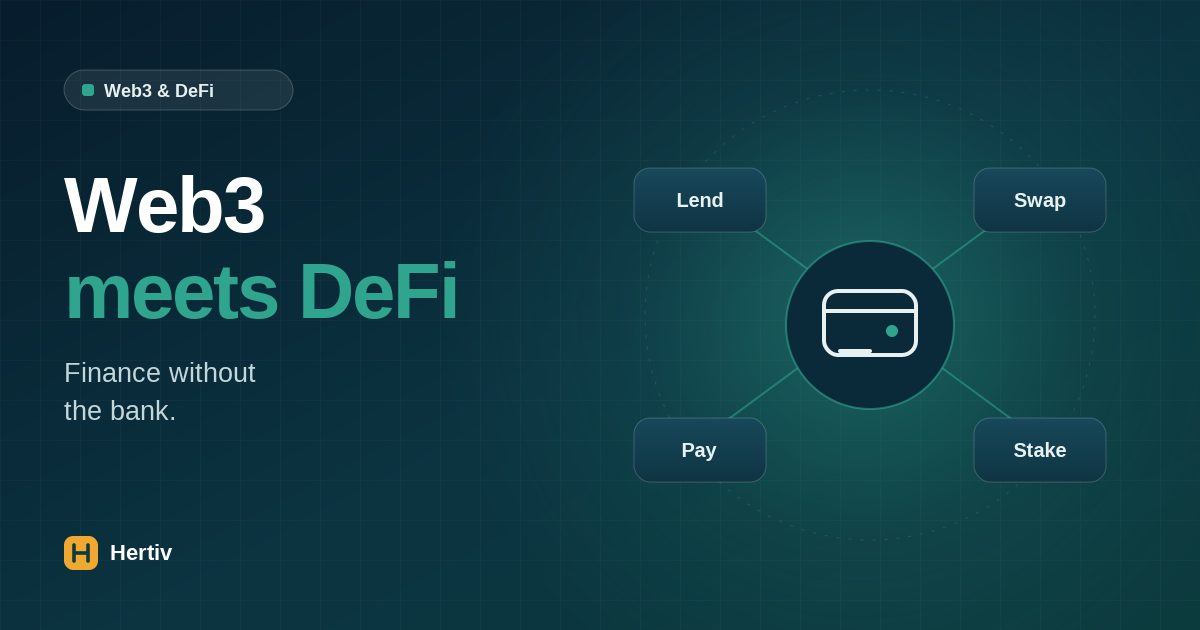
DeFi, short for decentralised finance, is a set of financial services that run on blockchains through smart contracts instead of through banks and brokers. Lending, trading, payments and saving are handled by code that anyone can inspect, rather than by a company that holds your money.
The key difference from a bank is custody. In DeFi, you usually keep control of your funds in your own wallet and give a smart contract permission to act on them for one transaction. In a bank, the bank holds your money and decides what you may do with it.
| DeFi service | What it does | Traditional match |
|---|---|---|
| Lending | Lend assets and earn interest | Savings account |
| Trading | Swap tokens without an exchange account | Broker or exchange |
| Stablecoins | Tokens pegged to a currency | Bank balance |
| Payments | Send value across borders | Wire transfer |
| Staking | Lock tokens to secure a network | Term deposit |
DeFi is open to anyone with a wallet and an internet connection, which is why it attracts users who cannot open a bank account or who pay high fees to move money. That openness is also why it needs care: there is no support desk to reverse a mistake.
How Web 3.0 and DeFi fit together
Web 3.0 and DeFi fit together because DeFi needs the parts that Web 3.0 provides. A wallet gives you an identity and a place to hold funds. A blockchain gives you a shared record that no single company controls. A smart contract gives you rules that run the same way for everyone.
Take a simple example. In Web 3.0, a creator sells a digital pass directly to fans, and the sale is recorded on a blockchain. In DeFi, the same creator can lend the income from those sales, or accept payment in a stablecoin, without opening a merchant account. The identity, the ownership and the money all move through the same wallet.
The two also share the same risks. A bug in a smart contract, a lost wallet key or a misleading token can cost real money in both. That is why the articles that cover popular DeFi use cases spend as much time on risks as on rewards.
What you can do with Web 3.0 and DeFi
The practical uses fall into a few groups. Each one suits a different need, and most people use only one or two of them.
| Use | What it looks like | Who it suits |
|---|---|---|
| Payments | Send stablecoins to anyone, anywhere | Freelancers and cross-border teams |
| Saving and lending | Earn interest by lending tokens | Holders with funds they can lock up |
| Trading | Swap tokens without an account | Traders who want direct control |
| Creator income | Sell passes and collectibles direct | Creators with a loyal audience |
| Community ownership | Members hold tokens that vote | Groups that share decisions |
Start with the use that solves a real problem for you. Payments suit teams that pay people across borders. Creator income suits artists with fans who want to support them. Chasing every use at once is how people lose money.
Risks to understand before you start
DeFi removes the bank, but it also removes the safety nets that banks provide. There is no one to call when a transaction goes wrong, and a smart contract bug can drain funds in minutes. Understand the risks before you put money in.
- Smart contract risk. Code can have bugs, and a bug in a contract that holds funds can be exploited. Use services that have been audited by an independent firm.
- Price swings. Crypto assets can fall sharply in a day. Stablecoins reduce this risk, but even they have failed in the past.
- Scams. Fake tokens, fake websites and fake support accounts are common. Check every address and link before you act.
- Lost keys. If you lose your wallet keys and have no backup, the funds are gone. Write the recovery phrase down and store it safely.
- Changing rules. Regulation of DeFi differs by country and is still changing. Check the rules where you live before you start.
For retail examples and their risks, see DeFi use cases in retail. Treat every new service as unproven until you have read its audit and tried it with a small amount.
How to start in five steps
Starting safely means going slowly and testing with small amounts. The steps below keep the risk low while you learn how the pieces work.
- Set up a wallet from the official source and write down the recovery phrase on paper.
- Buy a small amount of a stablecoin from a regulated exchange.
- Move a small amount to your wallet and check that it arrives.
- Try one service, such as a payment or a lending pool, with a small sum.
- Keep records of every transaction for tax and for your own checks.
Example (hypothetical): a freelancer is paid 200 dollars in stablecoins by a client abroad. The payment arrives in 10 minutes and costs 1 dollar in fees, against a bank wire that took 3 days and cost 25 dollars. She keeps 100 dollars in the wallet for spending and moves 100 dollars back to her bank, which takes 1 day. The saving is real, but only because she tested the route with 20 dollars first.
Common mistakes with Web 3.0 and DeFi
The most common mistake is putting in more money than you can afford to lose, because a service looked safe. In DeFi, safety comes from audits, time in the market and your own checks, not from a polished website.
- Investing money you need for rent or bills
- Trusting a token because it was promoted online
- Skipping the recovery phrase backup
- Approving a contract without reading what it can do
- Using a service that has never been audited
Start small, keep your keys safe and read before you approve. Web 3.0 and DeFi reward patience and punish haste, so let your first month be a learning month, not a trading month.
Key takeaways
- Web 3.0 gives users control of identity and data through wallets and blockchains.
- DeFi is the financial layer on top: lending, trading, payments and saving by smart contract.
- You keep custody of your funds, so there is no support desk to reverse a mistake.
- Start with one use that solves a real problem, and test it with a small amount.
- Check audits, keep your recovery phrase safe, and read before you approve.
Frequently asked questions
What is the difference between Web 3.0 and DeFi?
Web 3.0 is the wider web where users own data and identity through wallets and blockchains. DeFi is the financial part of that web: lending, trading and payments that run on smart contracts instead of banks.
Do I need crypto to use Web 3.0?
Most Web 3.0 apps need a wallet and a small amount of crypto to pay transaction fees, even for free services. Some apps cover the fees for you, but a wallet is still the usual way to sign in.
Is DeFi safe?
DeFi carries real risks: smart contract bugs, price swings, scams and lost keys. Services that have been audited and used for years are safer than new ones, but no DeFi service is risk-free. Never put in money you need.
Can I use DeFi without a bank account?
Yes, a wallet and an internet connection are enough to use most DeFi services. That is why DeFi suits people who cannot open a bank account, though cashing out to local money still needs an exchange or a buyer.
What is a smart contract?
A smart contract is code stored on a blockchain that runs automatically when its conditions are met, such as releasing a payment when a delivery is confirmed. It replaces a middleman with rules that anyone can read.
How do I start with Web 3.0 and DeFi?
Set up a wallet from the official source, write down the recovery phrase, and try one small payment with a stablecoin. Learn the steps with small amounts before you use any service for real money.


