DeFi Use Cases in Retail: 7 Patterns Worth Building
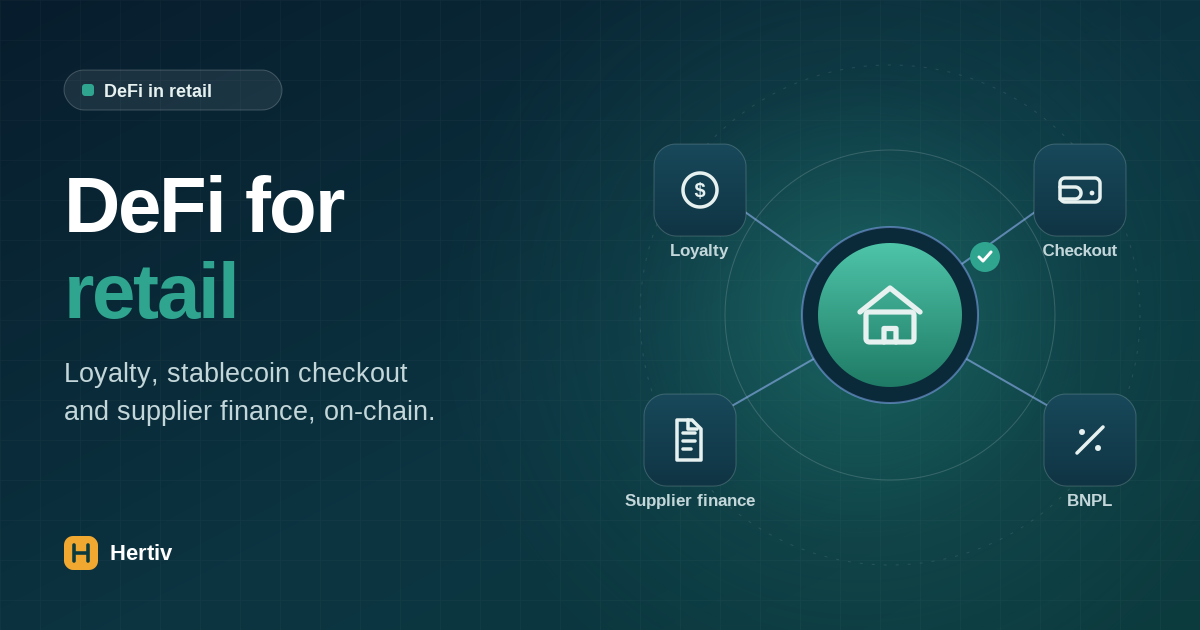
DeFi in retail means tokenised loyalty, stablecoin checkout, BNPL lending, supplier finance and more. Here are seven patterns, what data each needs, and how to choose.
On this page
Short answer
DeFi use cases in retail focus on payment settlement, tokenised loyalty and gift cards, embedded instalment lending, supplier finance, and tokenised real-world assets. Each needs different data and compliance work, so most retailers start with stablecoin payments or loyalty tokens before moving to credit products.
Which DeFi patterns fit retail, and how do they compare?
DeFi in retail rarely means a full decentralised storefront. It means using on-chain settlement, tokenisation or lending primitives to solve a specific retail money flow: paying, rewarding, financing a purchase, or paying a supplier. The table below compares the seven patterns that come up most often in real retail conversations.
| Use case | What it does | Typical data needed | Effort |
|---|---|---|---|
| Stablecoin checkout | Customer pays in a stablecoin; merchant settles on-chain | Wallet addresses, FX rates, KYC/AML data | Medium |
| Tokenised loyalty points | Points become transferable tokens with rules | Loyalty ledger, redemption rules, accounting | Medium |
| Tokenised gift cards | Gift card balances issued as tokens | Issuance records, breakage data, fraud signals | Medium |
| Embedded BNPL via lending pools | Instalment credit funded by on-chain lenders | Credit scoring, repayment history, jurisdiction rules | High |
| Supplier finance | Invoices tokenised and discounted to funders | Invoice data, ERP records, supplier KYC | High |
| Tokenised receipts or warranties | Proof of purchase and warranty as a token | Order data, product IDs, service history | Low |
| Tokenised real-world assets | Fractional ownership of inventory or property | Asset valuation, custody, legal wrapper | High |
Effort estimates assume an existing e-commerce or ERP stack and a compliance team that can review the design. Patterns with credit or securities exposure take longer because the legal work usually outweighs the engineering. For a broader map of what is being built in this space, see the blockchain use-case library.
Stablecoin checkout and how settlement actually works
Stablecoin checkout lets a customer pay with a dollar-pegged token and the merchant receive settlement on-chain, usually within minutes rather than days. The merchant still needs a way to convert to local currency, so most implementations pair an on-chain receipt with an off-ramp partner.
A workable flow looks like this:
- Customer selects stablecoin at checkout and connects a wallet.
- The store creates an order with a short expiry and a quoted amount.
- The customer sends the token to a merchant-controlled address.
- A listener confirms the transaction and marks the order paid.
- Treasury converts to fiat on a schedule or on demand.
Pros - Settlement is fast and visible to both sides. - Works well for cross-border customers where card acceptance is weak.
Cons - Adds treasury, accounting and AML obligations. - Refunds and chargebacks need new processes.
Tokenised loyalty points and gift cards
Tokenised loyalty points turn a closed store ledger into a transferable or programmable asset. That can make points more useful to customers, but it also changes how you account for liability and breakage.
The design questions matter more than the chain choice. Decide whether points are transferable between customers, whether they expire, and who can mint or burn them. A common pattern is a permissioned token where the retailer controls issuance and partners can accept the token under a shared rule set. Gift cards follow a similar pattern but carry stricter consumer-protection rules in many jurisdictions.
Pros - Points can be spent across partner brands without rebuilding each ledger. - Promotions become programmable: a rule can award points for a category or a campaign window.
Cons - Accounting for outstanding liability gets harder when balances move off your system. - Transferability can attract fraud and secondary trading you did not plan for.
For retailers weighing this against broader AI and data work, the retail and e-commerce page covers related patterns.
Embedded BNPL and consumer lending through DeFi pools
Embedded buy-now-pay-later uses on-chain lending pools to fund instalment purchases at checkout. The retailer or a licensed partner keeps the underwriting decision; the pool supplies capital and the smart contracts handle disbursement and repayment.
This is the highest-effort pattern on the list because it combines credit risk, consumer-lending rules and smart-contract risk in one product. A realistic design keeps underwriting off-chain, records the loan on-chain, and uses an oracle or signed message to confirm repayment events. If your team is exploring the lending mechanics, our DeFi development page covers protocol building blocks such as pools, collateral and liquidation logic.
Pros - Can widen access to instalments without a bank balance sheet. - Repayment and interest logic is transparent and auditable.
Cons - Consumer-credit licensing and disclosure rules vary widely by market. - Default handling and collections still need a human process.
Supplier finance and tokenised receivables
Supplier finance is often the pattern with the clearest payback. A retailer approves an invoice, the invoice is represented as a token, and funders can discount it and wait for payment at maturity. Suppliers get earlier cash, and the retailer keeps its payment terms.
The plumbing is unglamorous: invoice data from the ERP, supplier onboarding and KYC, a legal wrapper that confirms the receivable is genuine and assignable, and a settlement process at maturity. Many teams run this on a permissioned network rather than a public chain because the participants are known counterparties. Our enterprise blockchain page covers that model.
Pros - Direct benefit to suppliers, which matters for retention. - Less dependent on a single bank for working-capital capacity.
Cons - Requires legal agreements per jurisdiction. - Invoice fraud controls must be strong before any tokenisation.
Example (hypothetical): a retailer approves a 100,000 invoice due in 90 days. A funder pays 98,000 today and receives 100,000 at maturity. The 2,000 difference is the funder's return for the period; the arithmetic is illustrative only and real pricing varies by counterparty and term.
Tokenised receipts, warranties and real-world assets
Two lighter patterns sit at the edges. Tokenised receipts and warranties give a customer a verifiable proof of purchase that a service partner can check without calling your support line. Tokenised real-world assets go further, representing inventory, equipment or property as fractional tokens.
Receipts and warranties are a low-effort starting point. They do not move money, so compliance review is lighter, and the customer benefit is concrete: faster claims and less paperwork. Tokenised real-world assets are a different scale of project.
They need a valuation method, a custody arrangement and a legal structure that makes the token claim enforceable. That is why most retailers treat them as a later phase, often in partnership with an asset manager.
Pros - Receipts and warranties build familiarity with wallets and tokens at low risk. - Real-world asset tokenisation can free capital tied up in inventory or property.
Cons - Asset tokenisation needs legal and valuation work that dwarfs the code. - Customer adoption of wallets remains a real constraint outside crypto-native segments.
How to prioritise which DeFi use case to build first
Pick the pattern that solves a money flow you already measure, then test it in one corridor or category. The order below works for most mid-market and enterprise retailers.
- Map the money flows. List payments, refunds, loyalty liability, supplier terms and working capital. Note where settlement is slow or expensive.
- Score each pattern on regulatory exposure. Payments and credit carry more rules than receipts or loyalty tokens.
- Check data readiness. Stablecoin checkout needs wallet and FX data; supplier finance needs clean invoice data from the ERP.
- Run a narrow pilot. One country, one payment method, one supplier group. Define success as settlement time, fraud rate and support tickets.
- Decide on build versus partner. Custody, on-ramps and licensing are usually better bought than built; the customer experience is where you differentiate.
For teams that need a second opinion before committing, a short blockchain consulting engagement can pressure-test the design.
Key takeaways
- Stablecoin checkout cuts card-network settlement to near-real-time but adds treasury and licensing work.
- Tokenised loyalty points become transferable and programmable, which changes accounting and breakage assumptions.
- Embedded BNPL via DeFi lending pools works best when underwriting stays with the retailer or a licensed partner.
- Supplier finance is often the fastest payback: receivables can be tokenised and discounted without a bank in the middle.
- Treat every pattern as a payments or securities question first, then a smart-contract question.
- Start with one corridor or one product category; measure settlement time and fraud before expanding.
Frequently asked questions
Do retailers need a crypto licence to accept stablecoin payments?
It depends on the jurisdiction and on what you do with the funds. Accepting a stablecoin and converting to fiat may fall under payments or virtual-asset rules, while holding customer funds usually does. Most retailers work with a licensed on-ramp or payment partner rather than obtaining a licence themselves.
Is DeFi cheaper than card payments for a retailer?
Not automatically. On-chain settlement can reduce some network fees, but you add treasury conversion, compliance and support costs. The saving is clearest for cross-border sales or high-value orders where card fees and FX costs are material. Model the full cost before deciding.
Can loyalty points be tokenised without becoming a security?
Often yes, if the points are a closed-loop reward with no expectation of profit and no investment contract. The details matter: transferability, tradability and marketing language all affect the analysis. Get local legal advice before launch, because rules differ by market.
What data does supplier finance tokenisation need?
You need approved invoice data from the ERP, supplier identity and KYC records, payment terms, and a legal agreement confirming the receivable can be assigned. Clean invoice data is usually the hardest part, because many ERPs hold duplicates and disputed items.
Should we build on a public chain or a permissioned network?
Public chains suit consumer-facing payments and loyalty where open wallets help adoption. Permissioned networks suit supplier finance and partner programmes where all participants are known. Many retailers end up with both over time, connected through a treasury and reporting layer.
How long does a first DeFi retail pilot take?
A narrow pilot such as stablecoin checkout in one market typically takes a few months, with legal review often taking as long as the engineering. Credit and asset-tokenisation projects take longer because they need valuation, licensing and custody arrangements.


