7 Ways Banks Benefit from Blockchain Technology
Banks benefit from blockchain where it removes reconciliation, speeds settlement or proves a record. These seven ways are the ones with working products behind them.
On this page
Short answer
Banks benefit from blockchain technology where a shared ledger removes work they do today: reconciling the same record, waiting days for settlement, or proving a document is genuine. These seven benefits are the ones banks are already building around, with real products rather than trials.
How do banks benefit from blockchain?
Banks benefit from blockchain when the ledger replaces a step they pay for today. A payment that settles in minutes, a trade document that every party can see, or a customer check that can be reused are all savings a bank can measure in time and cost.
Use this comparison to shortlist. Effort assumes the bank works with a regulated partner for custody and compliance.
| Benefit | What changes | Who gains | Effort |
|---|---|---|---|
| Faster cross-border payments | Days become minutes | Retail and corporate clients | Medium |
| Cheaper settlement | Fewer middlemen in the chain | Treasury, trading desks | Medium |
| Digitised trade finance | Paper documents become shared records | Trade finance teams | High |
| KYC and identity reuse | One verified check serves several units | Onboarding teams | High |
| Tokenized deposits | Deposits move like tokens, 24 hours a day | Corporate clients | High |
| Fraud reduction | Records that are hard to alter | Risk and audit teams | Low |
| New products | Custody, stablecoins, tokenized assets | Product teams | High |
Start with the benefit that matches a cost your bank already measures, such as settlement fees or onboarding time, and prove the saving on one corridor before expanding.
Faster payments and cheaper settlement
1. Faster cross-border payments: best for banks with slow corridors
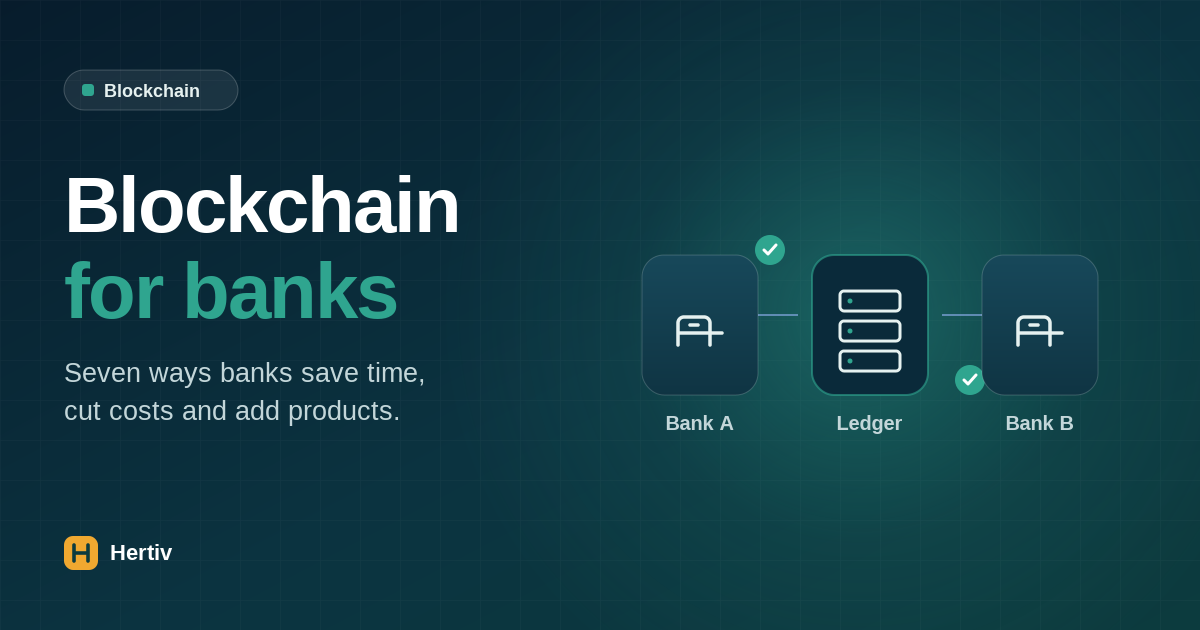
A cross-border payment today passes through correspondent banks, each taking a fee and a day. On a shared ledger, the sending bank and the receiving bank see the same record, so the money can arrive in minutes and the customer can track it end to end.
The gain is biggest on thin corridors where correspondent fees are high and delays are long. Banks usually start with one corridor and a stable settlement asset, then add more once the first route runs cleanly for a quarter.
Pros: minutes instead of days, lower fees, full payment tracking for customers.
Cons: needs a licensed off-ramp in each country and enough liquidity on the route.
2. Cheaper settlement: best for treasury and trading desks
Settlement is where banks pay middlemen to move value between accounts. A tokenised deposit or a stablecoin lets two banks settle directly on a shared ledger, cutting out one or two intermediaries and the fees they charge.
The saving is real only if the settlement asset is trusted. A bank should settle in a token issued by a regulated entity with audited reserves, and it should keep a fallback to the old rails if the token market freezes.
Pros: fewer intermediaries, settlement outside banking hours, lower per-trade cost.
Cons: depends on the settlement token staying redeemable at par.
Digitised trade finance and KYC reuse
3. Digitised trade finance: best for banks buried in paper
Trade finance runs on documents that travel by courier: letters of credit, bills of lading and inspection certificates. A shared ledger gives the exporter, the importer and both banks the same documents at the same time, so nobody waits for a paper copy to arrive.
Smart contracts can release payment once the shipping documents are verified on chain. The result is faster payment for exporters and fewer disputes about which version of a document counts.
Pros: faster document handling, fewer disputes, a shared audit trail.
Cons: needs every party on the same platform, which takes time to arrange.
4. KYC and identity reuse: best for groups onboarding the same customer twice
A customer who opens accounts at two units of one banking group is usually checked twice, with the same documents. A shared identity record lets the second unit reuse the first unit's verified check, with the customer's consent, instead of starting from scratch.
The record holds a proof that the check happened, not the documents themselves, so personal data stays where it was collected. Each unit still owns its own compliance decision, so reuse shortens onboarding rather than removing it.
Pros: faster onboarding, fewer repeated document requests, one source of truth.
Cons: needs shared standards and consent handling across units.
Tokenized deposits and fraud reduction
5. Tokenized deposits: best for corporate clients moving money around the clock
A tokenized deposit is a bank deposit represented as a token on a ledger. It can move between accounts at any hour, including weekends, and it can be programmed so that payment happens only when a condition is met, such as delivery being confirmed.
For corporate clients this means cash that works on their schedule, not the bank's. The deposit stays a bank liability, so the protection a depositor expects does not change; only the way it moves changes.
Pros: 24-hour movement, programmable payments, deposits stay protected.
Cons: needs new systems and agreement between banks on standards.
6. Fraud reduction: best for risk teams chasing altered records
A ledger record is hard to alter after it is written, because changing one entry means changing every copy held by the network. That makes it harder to backdate a trade, alter an invoice or hide a transfer after the fact.
This does not stop fraud at the point of entry. A false record written to the ledger stays false, so banks still need checks on who can write and what they can write. The benefit is in detection and audit, not in prevention alone.
Pros: tamper-evident history, faster audits, clearer evidence trails.
Cons: only helps if the data written to the ledger is checked first.
New products, and what to watch
7. New products: best for banks looking for the next fee stream
Blockchain lets banks offer products they could not offer before: custody of digital assets, stablecoin issuance, and tokenized bonds or funds for clients who want smaller slices of an asset. Each of these is a fee stream that did not exist a decade ago.
These products need licences, and the rules are still changing in most countries. A bank should only launch one after its regulator has confirmed the approach, and it should keep the new product separate from the core deposit business until it is proven.
Pros: new fee income, products clients are asking for, a stronger competitive story.
Cons: licensing cost, rules that change, and new operational risks.
The seven benefits above share one pattern: the ledger removes a step a bank pays for today. Any blockchain project that adds a step instead of removing one should be questioned, however new the technology sounds.
How to choose where to start
Choose by the cost you already measure. A benefit that cuts a fee, a day of delay or a repeated check will survive; a benefit chosen because the technology is fashionable will not.
- List the workflows where your bank reconciles the same record as another firm.
- Score each on volume, cost of delay and whether your regulator already accepts the approach.
- Check the legal ground: custody, licensing and data rules for the token you would use.
- Pick one benefit and one corridor or product, and run it small for three months.
- Measure time and cost against the old process before spending more.
A short pilot with a fixed measure, such as settlement time or cost per payment, is the cheapest way to find out whether a benefit is real. Blockchain in banking covers how banks are using the technology today.
What are the common mistakes?
Most bank blockchain projects fail on legal ground, not technical ground. Teams pick the token first, skip the licensing check, and then cannot launch.
- Choosing a volatile coin for payments instead of a stable settlement asset
- Skipping the custody and licensing review until after the build
- Assuming a smart contract removes the need for legal agreements
- Building for every counterparty at once instead of one partner
- Treating on-chain data as private when the ledger is public
- Picking a use case because a vendor pitched it, not because a workflow hurts
- Measuring usage instead of cost and time saved
Key takeaways
- A shared ledger saves banks money where it removes reconciliation, delay or repeated checks.
- Faster payments and cheaper settlement are the benefits with the clearest numbers.
- Tokenized deposits and trade finance pay off, but the legal work costs more than the code.
- Fraud reduction comes from tamper-evident records, not from the ledger alone.
- Start with one corridor or product, and measure against the old process.
Frequently asked questions
Do banks need to replace their core systems for blockchain?
No. Most banks run blockchain as a separate layer for specific jobs, such as payments or trade documents, while the core banking system keeps running. The ledger connects to the core system through an interface, so the bank can switch a job back if the pilot fails.
What is a tokenized deposit?
A tokenized deposit is a normal bank deposit represented as a token on a ledger. It is still a liability of the bank, so the depositor's protection does not change. The token form lets it move at any hour and be used in programmable payments.
Why are cross-border payments the first use case?
They are the slowest and most expensive payments a bank handles, with several middlemen taking fees and days. A shared ledger removes some of those middlemen, so the saving is easy to measure on a single corridor.
Can blockchain stop all bank fraud?
No. A ledger makes records hard to alter after they are written, which helps detection and audit. It does not stop a false record being written in the first place, so banks still need checks on who can write and what they can write.
Do banks need a licence to offer crypto custody?
In most countries, yes. Custody of digital assets is a regulated activity, and the rules differ by jurisdiction. A bank should confirm the licensing position with its regulator before offering custody to clients.
What is the biggest cost in a bank blockchain project?
Usually the legal, compliance and integration work, not the ledger itself. Custody arrangements, licensing, data rules and connecting the ledger to core systems take more time and money than writing the smart contract.


