Wallet Whitelisting for Tokenized Securities: How It Works
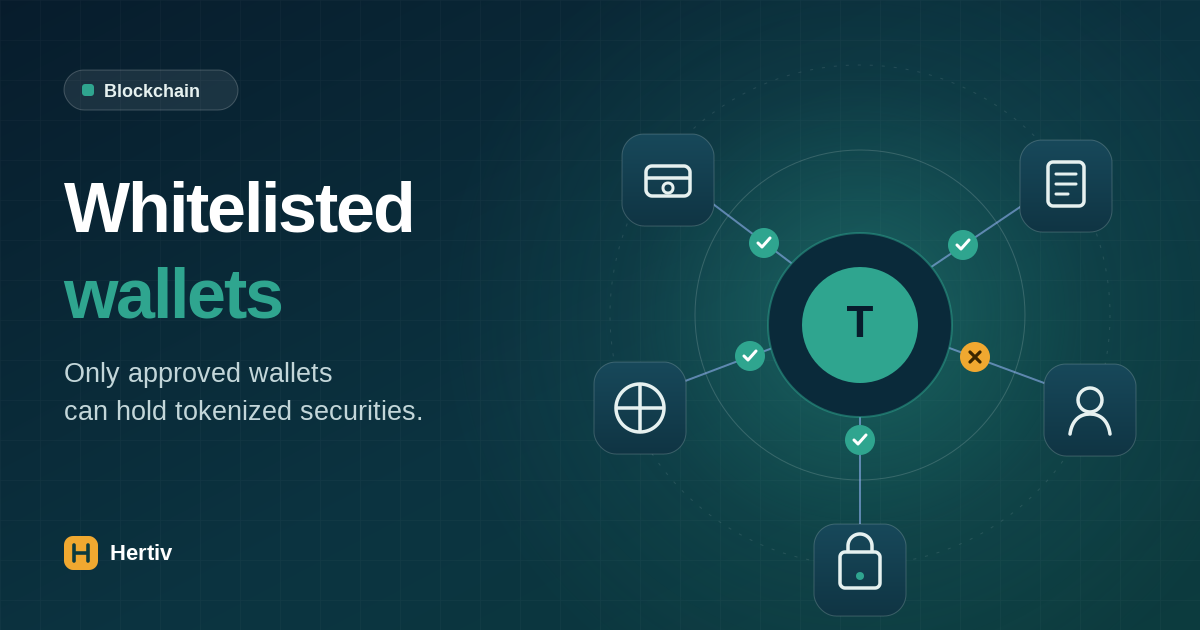
Wallet whitelisting limits tokenized securities to approved addresses, so only investors who passed identity and eligibility checks can hold or receive them.
On this page
Short answer
Wallet whitelisting is the practice of approving specific blockchain addresses before they may hold or receive tokenized securities. The token contract checks each transfer against the approved list and rejects transfers to addresses that are not on it, keeping a regulated asset inside its permitted investor base.
What is wallet whitelisting for tokenized securities?
Wallet whitelisting is the practice of approving specific blockchain wallet addresses before they are allowed to hold or receive tokenized securities. A tokenized security is a regulated financial asset, such as a share, a bond or a fund unit, represented as a token on a blockchain, and only wallets that have passed the issuer's checks can receive it.
The whitelist is enforced by the token's smart contract or by the transfer agent that controls issuance. When a transfer is attempted, the contract checks both the sender and the receiver against the list, and a transfer to an address that is not on it is rejected before it settles.
| Check | What it confirms |
|---|---|
| Identity | The wallet owner passed identity verification |
| Jurisdiction | The owner is in a country where the offer is permitted |
| Eligibility | The owner meets investor rules where they apply |
| Wallet control | The owner can sign with the wallet private key |
Whitelisting turns a permissionless ledger into a controlled market. The token can still move fast and settle on chain, but only between parties the issuer has approved, which is what securities rules require. The basic mechanics of turning an asset into a token are covered in our guide to how tokenization works.
Why do issuers whitelist wallets?
Issuers whitelist wallets because securities law controls who may hold a security, and a public blockchain has no such control by default. Without a whitelist, a token could be sold to anyone, including investors in restricted jurisdictions or people who never passed identity checks.
A whitelist gives the issuer three things. First, it keeps every transfer inside the permitted investor base, which is the core compliance requirement for a security token. Second, it creates a clear record of who held the token and when, which auditors and regulators ask for. Third, it lets the issuer act when something goes wrong, for example by removing a wallet after a lost key or a court order.
The alternative is to restrict trading to a closed venue, which defeats much of the point of tokenization. Whitelisting is the middle path: the token lives on an open ledger, but transfers are gated. For asset managers, this is the same control set used in RWA tokenization for real-world assets.
How does wallet whitelisting work?
Wallet whitelisting works as a gate on every transfer. The issuer collects investor details, runs the required checks, and records the approved wallet address in the token contract or in a registry the contract reads.
- Investor applies. The investor submits identity documents and, where needed, proof of eligibility through the issuer's onboarding portal.
- Checks run. The issuer or a compliance provider verifies identity, screens against sanctions lists and confirms jurisdiction and eligibility.
- Wallet is proven. The investor signs a message with the wallet to prove they control the private key.
- Address is added. The approved address is written to the whitelist in the token contract or registry.
- Transfers are checked. Every transfer checks sender and receiver against the list before it settles.
- Changes are recorded. Additions and removals are logged, so the issuer can show who was approved and when.
Some issuers add an expiry date to each approval, so investors must re-verify after a set period. Others tie the whitelist to a transfer agent that can freeze or force-transfer tokens in defined cases, such as a court order.
Whitelisting vs blacklisting vs open transfers
Whitelisting, blacklisting and open transfers are three different ways to control who can hold a token, and only whitelisting fits a regulated security in most cases.
| Approach | Who can hold the token | Fit for securities |
|---|---|---|
| Whitelisting | Only approved addresses | Yes, the standard choice |
| Blacklisting | Everyone except blocked addresses | Weak, new buyers are unchecked |
| Open transfers | Anyone with a wallet | No, no investor control |
Blacklisting stops known bad actors but does nothing about a buyer who has never been checked, which is the exact gap securities rules close. Open transfers suit utility tokens and collectibles, where anyone may hold them, but they leave a security issuer unable to show who its investors are.
A whitelist can also be combined with a blacklist for extra safety, for example to block an address after a hack even if it was approved before. The two lists serve different purposes and work well together.
Example (hypothetical): a property fund token pilot
Example (hypothetical): a property fund plans to issue 20,000 tokens to 40 investors, with each investor buying 500 tokens. Before launch, the fund collects identity documents and wallet addresses from all 40 investors and runs the required checks.
Two investors fail the checks: one cannot prove control of the wallet, and one is in a restricted jurisdiction. The fund approves the other 38 wallets and writes them to the whitelist. That is 38 out of 40 investors, or 95 percent of the planned buyers.
At issuance, the fund mints 19,000 tokens, which is 38 investors times 500 tokens each, and holds back 1,000 tokens for later sale. When one approved investor later sells 500 tokens to another approved investor, the transfer settles because both addresses are on the list. When a third party tries to buy tokens with an unapproved wallet, the contract rejects the transfer.
What are the common mistakes?
The most common whitelisting mistakes are treating approval as a one-time event, trusting a wallet address without proof of control, and forgetting that transfers have two sides.
- Never re-checking approvals. Investor status changes, so approvals should expire or be reviewed on a schedule.
- Skipping proof of control. An address on a list means nothing if the investor cannot sign with its private key.
- Checking only the buyer. The sender must be checked too, or tokens can leak out to unapproved wallets through a second sale.
- No removal process. If a wallet is compromised or an investor becomes ineligible, the issuer needs a tested way to remove it.
- Weak record keeping. Approvals, removals and rejected transfers should be logged, or the issuer cannot show compliance later.
How to set up whitelisting for a token offering
You set up whitelisting by deciding the rules first, then choosing the enforcement method, and finally testing transfers before any real investor money moves.
- Define who may hold the token. Write down the jurisdictions, investor types and documents required, with legal advice.
- Pick the enforcement point. Use the token contract, a registry contract, or a transfer agent, and decide who can add or remove addresses.
- Build the onboarding flow. Collect documents, run checks, and require a signed message that proves wallet control.
- Test with small transfers. Approve two test wallets, try a valid transfer and a transfer to an unapproved wallet, and confirm the second one fails.
- Plan for changes. Set approval expiry, a removal process and logging, then review the list on a schedule.
Before launch, have the contract reviewed by a specialist, since a bug in the transfer check can either block legitimate investors or let unapproved wallets through. A smart contract audit is the usual step before a regulated token goes live.
Key takeaways
- Wallet whitelisting limits tokenized securities to addresses that passed identity and eligibility checks
- The token contract rejects transfers to any address that is not on the approved list
- Proof of wallet control, approval expiry and a removal process are part of a working whitelist
- Whitelisting fits regulated securities; blacklisting and open transfers do not give the same control
- Test both valid and rejected transfers before launch, and log every approval and removal
Frequently asked questions
Can a whitelisted wallet send tokens to any other wallet?
No. The token contract checks both the sender and the receiver on every transfer. A transfer to an address that is not on the whitelist is rejected before it settles, even if the sender is approved.
Does whitelisting make the token less liquid?
It limits the buyer pool to approved investors, so the token cannot trade freely like a utility token. That is the trade-off securities rules require, and most issuers accept it in exchange for being able to offer a regulated asset on chain.
How long does a whitelist approval last?
It depends on the issuer's rules. Some approvals last until revoked, while others expire after a set period, such as one year, and require the investor to re-verify identity and eligibility before they can receive more tokens.
What happens if an investor loses the private key?
The issuer can remove the lost wallet from the whitelist and, if the token rules allow it, reissue the tokens to a new wallet the investor controls. This is why the offering documents should describe a recovery process before launch.
Is whitelisting the same as KYC?
No. KYC is the identity check the investor passes. Whitelisting is the on-chain result: the approved wallet address is recorded so the token contract can enforce the outcome of that check on every transfer.
Can whitelisting be added to an existing token?
It depends on the token design. Tokens built with a transfer hook or an upgradable registry can add whitelisting, but a simple token with no transfer control cannot be retrofitted without migrating holders to a new token.


