The Travel Rule Timeline: Key Dates Explained
From the FATF's 2019 rule to the EU's 2024 enforcement, this timeline explains when the Travel Rule arrived, what each step changed, and what firms must do next.
On this page
Short answer
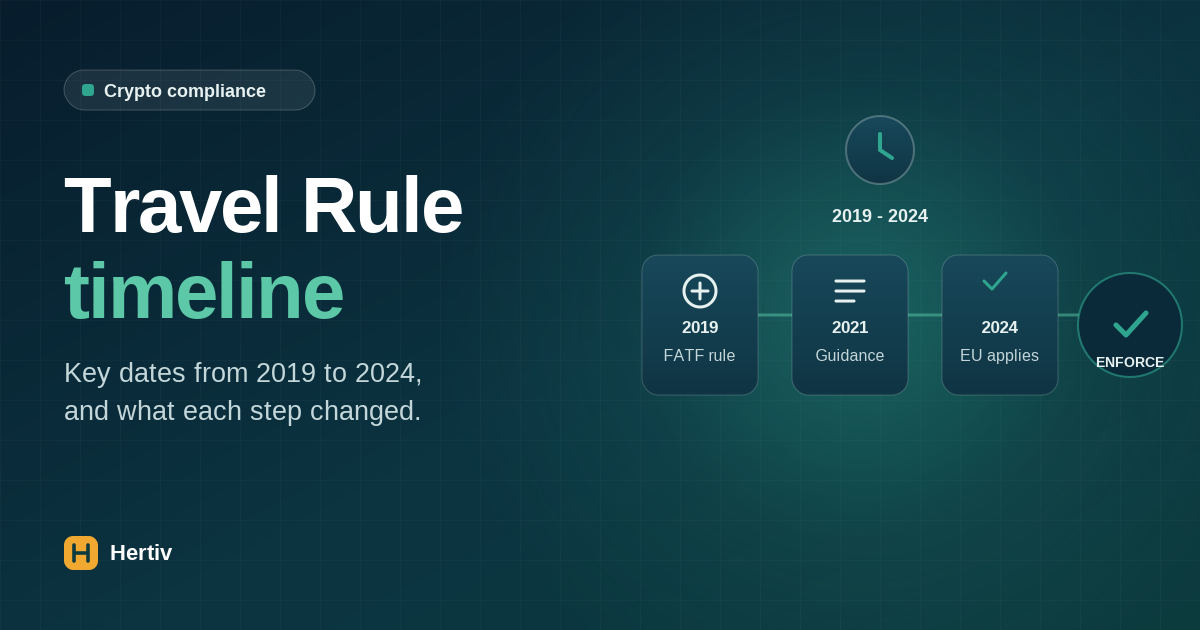
The Travel Rule timeline starts in June 2019, when the Financial Action Task Force extended its wire transfer rule to virtual assets. The FATF reviewed progress in June 2020, issued updated guidance in October 2021, and reported on implementation in 2023, while the European Union's transfer rules began to apply in December 2024. Today most large jurisdictions have the rule in law, and enforcement is widening year by year.
What is the Travel Rule timeline?
The Travel Rule timeline is the sequence of dates on which the rule for sharing sender and receiver details with crypto transfers was agreed, reviewed and put into law. It matters because a crypto business cannot plan compliance from the rule alone; it needs to know which deadlines apply in each country it serves.
The timeline below gives the turning points, and the rest of this article explains what each one changed in practice.
| Date | Event | What changed |
|---|---|---|
| June 2019 | FATF amends Recommendation 16 | Travel Rule extended to virtual assets |
| June 2020 | FATF 12-month review | Progress checked, gaps named |
| October 2021 | Updated FATF guidance | Clearer rules for DeFi and peer-to-peer |
| 2023 | FATF implementation reports | Slow progress called out publicly |
| December 2024 | EU transfer rules apply | Travel Rule enforced across the EU |
| 2025 and after | Enforcement widens | More countries move to active checks |
The rule itself is simple: when a customer sends crypto, the sending firm must pass the sender and receiver details to the receiving firm. The hard part has always been timing, because each country set its own deadline.
What happened in 2019 and 2020?
In June 2019 the Financial Action Task Force, the global body that sets anti-money-laundering standards, amended its Recommendation 16 so that virtual asset service providers had to follow the same travel rule as banks. A crypto exchange sending funds for a customer had to share the originator and beneficiary details with the receiving firm.
The FATF gave countries a year to start. In June 2020 it published a 12-month review that found progress was uneven: some countries had written the rule into law, many had not, and the technical tools for firms to exchange the details were still new. That review set the tone for the next few years, with the FATF returning to the topic again and again.
For firms, the 2019 decision was the starting gun. Even in countries that had not yet written the rule into local law, large exchanges began building the messaging tools, because they could see the direction of travel.
What changed with the 2021 guidance?
In October 2021 the FATF published updated guidance on virtual assets that explained how the Travel Rule should work in harder cases: transfers to self-hosted wallets, transactions involving decentralised finance, and peer-to-peer trades where no regulated firm sits in the middle.
The guidance said countries should apply the rule in a risk-based way, focusing first on the firms that handle the most volume. It also made clear that a firm cannot simply refuse to send the details; if the receiving side cannot take them, the firm must still record them and apply extra checks.
For a crypto business, the 2021 guidance turned a principle into a checklist: know which transfers need details attached, know which counterparties can receive them, and know what to do when they cannot. Firms that had waited for clarity now had it, and supervisors in many countries began asking for evidence.
What happened in 2023 and 2024?
In 2023 the FATF published reports on how far countries had actually implemented the virtual asset standards, and the picture was mixed. Many countries had the rule on paper but had not yet started supervising it, and the FATF named the gap plainly.
The biggest single deadline came in December 2024, when the European Union's transfer of funds rules began to apply. From that date, crypto firms operating in the EU had to collect and share travel rule details on transfers, with no minimum amount threshold for crypto transfers. That made the EU one of the strictest regions in the world on this rule.
Other regions moved at their own pace. The United Kingdom, Singapore, Japan, South Korea and Switzerland each set their own timetables, and the United States had long applied a funds travel rule to wire transfers, with crypto firms working out how it applied to them. The result is a patchwork, and a firm serving customers in several countries must track each one separately.
What does the timeline mean for a crypto business today?
Today the question is no longer whether the Travel Rule will arrive, but whether your firm can show it follows the rule in every country it serves. Supervisors now ask for records, not promises, and a firm that cannot show the details it sent and received will struggle at licence renewal.
- Map your countries. List every country where your customers sit and note whether the rule is in law, in guidance or only planned there.
- Pick a messaging standard. Choose a travel rule messaging protocol your main counterparties already use, so details actually reach the other side.
- Cover self-hosted wallets. Decide what you ask when a customer sends to a wallet you do not control, and write the process down.
- Record everything. Keep the details sent and received, the counterparty, and the time, so you can show a supervisor the full trail.
- Review the map twice a year. Deadlines move, and a country that only had guidance last year may have law this year.
Keep the review regular. A rule that changes every year needs a process that checks for changes every six months. For the background, what the Travel Rule is explains who has to follow it and why.
Example (hypothetical): a small exchange checks its travel rule load
Example (hypothetical): a small exchange handles 500 crypto withdrawals a day. About 100 of those go to other regulated firms, 300 go to self-hosted wallets, and 100 are internal moves between its own customers.
The 100 transfers to other firms need travel rule details sent with each one. If the team reviews 20 of those by hand each day at 10 minutes each, that is 200 minutes, or about 3 hours 20 minutes of review time a day. The 300 self-hosted transfers need a lighter check, at 2 minutes each, which adds 600 minutes, or 10 hours a day.
Adding the two together gives 800 minutes, or about 13 hours 20 minutes of work a day, which is more than one full-time person. That is why the exchange automates the routine cases and keeps manual review for the ones that fail a check, such as a missing detail or a counterparty it does not recognise. Automation is not a luxury here; it is the only way the numbers fit.
What are the common mistakes?
The most common mistakes are treating the rule as a single deadline, ignoring self-hosted wallets, and keeping no records of what was sent.
- Treating it as one deadline. The rule arrived on different dates in different countries. A firm that plans for one date will be late somewhere else.
- Ignoring self-hosted wallets. Transfers to wallets the firm does not control still need a process, even when no other firm is involved.
- No messaging standard. Without a shared protocol, details never reach the receiving firm, and the firm cannot show it tried.
- Keeping no records. A supervisor will ask what was sent, to whom and when. If the answer is in no system, the firm has a problem.
- Forgetting the sunrise issue. When one country enforces the rule and the other does not, transfers between them need a plan, not a shrug.
Key takeaways
- The Travel Rule timeline starts in June 2019 with the FATF's amendment to Recommendation 16
- The FATF reviewed progress in 2020, updated guidance in 2021 and reported on slow implementation in 2023
- EU transfer rules began to apply in December 2024, with no minimum amount for crypto transfers
- Each country set its own deadline, so firms must track a patchwork of dates
- Record what was sent, to whom and when, because supervisors now ask for evidence
- Review your country map every six months, since deadlines keep moving
Frequently asked questions
When did the Travel Rule start for crypto?
The FATF extended the Travel Rule to virtual assets in June 2019, when it amended Recommendation 16. Countries then had to write the rule into their own law, so the date it started in practice varies by country.
What is the FATF Travel Rule deadline?
There is no single global deadline. The FATF set the standard in 2019 and reviewed progress in 2020, but each country set its own timetable. The EU's rules began to apply in December 2024, while other countries moved earlier or later.
Does the Travel Rule apply to self-hosted wallets?
Yes, in most jurisdictions the rule still matters for transfers to self-hosted wallets. The sending firm must collect the details and apply extra checks, even when no regulated firm sits on the receiving side.
What details must be shared under the Travel Rule?
The sending firm must share the sender's name and account details, and the receiver's name and account details, with the receiving firm. The exact fields vary by country, so check the local rules for each market you serve.
What is the sunrise issue in the Travel Rule?
The sunrise issue is the gap between countries that enforce the rule and those that do not yet. A transfer from an enforcing country to a non-enforcing one still needs a process, such as extra checks or a record of the attempt.
How should a crypto firm prepare for Travel Rule checks?
Map every country you serve, pick a messaging standard your counterparties use, cover self-hosted wallets in writing, and keep records of every detail sent and received. Review the country map every six months.


