Traditional Database vs Blockchain: How to Choose
Use a database when one owner controls the data; use a blockchain when several parties must share one record without a middleman. It comes down to trust.
On this page
Short answer
A traditional database is the right choice when one organisation owns the data, changes it often and needs fast writes, while a blockchain fits when several organisations must share one record without trusting a single middleman. The deciding question is not which technology is newer, but who writes the data and who needs to trust it.
What is the difference between a traditional database and a blockchain?
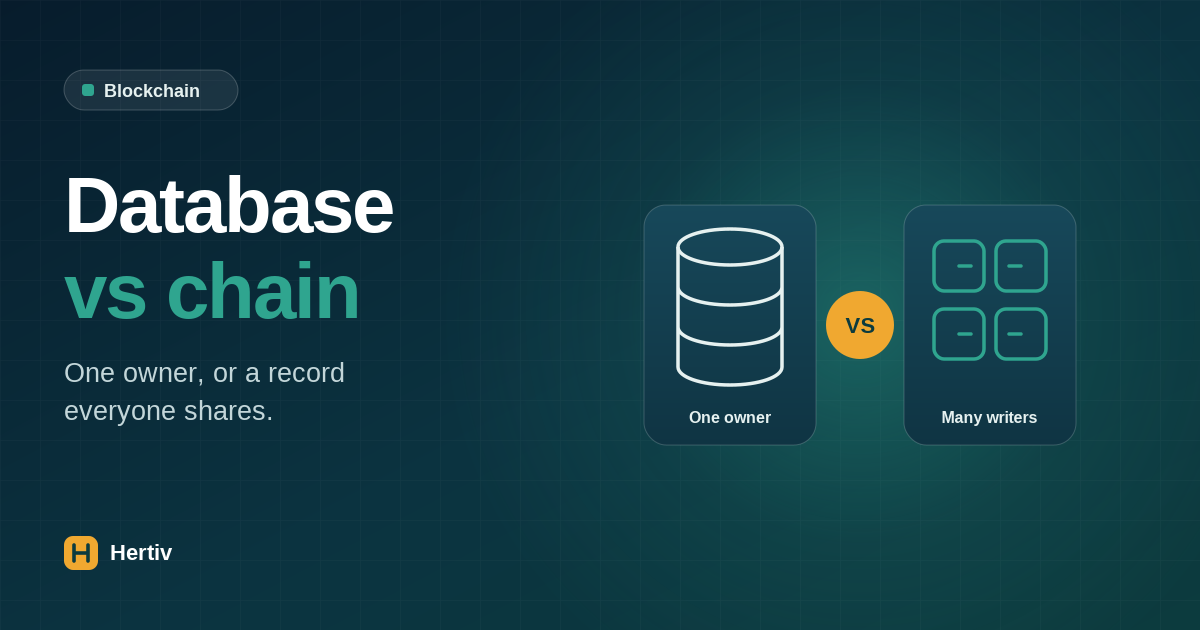
A traditional database is a system where one owner stores, changes and deletes records, and everyone else reads what the owner allows. A blockchain is a shared record where several parties each keep a copy, and new records are added only when the parties agree.
The core difference is trust. A database trusts the owner to keep records correct. A blockchain removes the single owner, so no one party can quietly rewrite history. That removal is the point, and it is also the cost: agreement takes time and effort.
Both store data. Only a blockchain makes the history of that data hard to change after the fact, and only a database gives one owner fast, cheap control over every record.
How do they compare?
A traditional database and a blockchain differ on control, speed, cost and how mistakes are fixed. The table below covers the points that matter most when choosing.
| Question | Traditional database | Blockchain |
|---|---|---|
| Who controls the data? | One owner or admin | Shared by several parties |
| Can records change? | Yes, with permission | Hard to change once written |
| How fast are writes? | Very fast, thousands per second | Slower, needs agreement |
| Who can read it? | Whoever the owner allows | Members of the network |
| What if data is wrong? | Fix it in place | Add a correcting record |
| Typical cost | Low, standard hosting | Higher, nodes and fees |
Speed is the clearest gap. A database can handle thousands of writes per second on modest hardware. A blockchain needs its members to agree on each new record, which is slower and more expensive per write.
Fixing mistakes is the second gap. In a database you correct the record. On a blockchain you cannot edit the past, so you add a new record that corrects the old one, and the mistake stays visible in the history.
When is a traditional database the right choice?
A traditional database is the right choice when one organisation owns the data and everyone else trusts that organisation to keep it correct. Most business software fits this case.
Use a database when records change often, when you need fast searches and reports, and when privacy rules require deleting or correcting personal data. A customer database, an inventory system and an internal dashboard are all database jobs.
A database is also the cheaper option. Hosting, backups and tooling are standard, and developers are easy to hire. If there is no trust problem between the parties using the data, a blockchain adds cost without adding value.
Reporting is another reason to pick a database. Fast searches, joins and aggregations are built into database engines, so dashboards and exports are quick to build. A blockchain makes reporting harder, because reading the ledger means scanning blocks rather than running a query.
When does a blockchain make sense?
A blockchain makes sense when several organisations must share one record and none of them fully trusts the others to keep it. The shared record replaces the middleman that would otherwise hold the data.
Typical cases include settlement between banks, provenance of goods moving through a supply chain, and registries where the history of ownership matters. In each case, the parties disagree about who should hold the truth, so they hold it together.
A blockchain also helps when the record itself is the product: a token, a certificate or a licence whose history must be checkable by anyone. If only one party ever writes and reads the data, a blockchain is the wrong tool. See how tokenization works for a case where shared records are the point.
Example (hypothetical): a supply chain record shared by three firms
Example (hypothetical): a coffee importer, a shipping firm and a retailer share one record of each shipment. Today each keeps its own spreadsheet, and disputes take days to resolve because the three copies disagree.
On a shared ledger, each firm writes its own events: the importer records the harvest, the shipper records loading and delivery, and the retailer records receipt. A dispute now takes minutes, because all three read the same record and the history cannot be rewritten.
The cost is real: three firms must run nodes, agree on rules and pay for each write. If the three firms trusted one of them to hold the record, a database would cost less.
The arithmetic is simple: 500 shipments a month at $2 per ledger write is $1,000 a month, against roughly 40 hours a month of dispute handling at $50 an hour, which is $2,000. The ledger wins only because the trust problem is real.
What are the common mistakes?
The most common mistakes are choosing a blockchain for a single-owner problem, ignoring the cost of agreement, and assuming a blockchain fixes bad data.
- Blockchain for one writer. If only your company writes and reads the data, a database is faster and cheaper.
- Ignoring write costs. Every ledger write costs time and money. High-volume data belongs in a database, with only key events on the ledger.
- Trusting the data, not the source. A blockchain proves a record was not changed; it cannot prove the record was true when written.
- Forgetting corrections. Wrong entries cannot be edited, so teams need a process for correction records.
- Skipping the exit plan. If the network stops, you still need your data in a readable form.
A shared record still needs clear rules about who can write what. The guide to what is Web3 explains how shared ledgers fit into wider decentralised systems.
How to decide in five steps
You decide between a traditional database and a blockchain by counting writers, checking trust, and testing the cost of agreement on real data.
- Count the writers. If one organisation writes the data, use a database.
- Check trust. If the parties do not trust a single holder, a shared record is worth considering.
- Count the writes. High-volume, fast-changing data belongs in a database; put only key events on a ledger.
- Check correction rules. If records must be edited or deleted, a database is the simpler choice.
- Run a small pilot. Put one shared workflow on a ledger for a month and compare dispute time and cost against the database version.
If the pilot shows the trust problem is real and the cost is lower than the disputes it removes, keep the ledger. If not, a database was the right answer all along. For teams building on a ledger, how to create a cryptocurrency covers the practical steps of launching a token on a chain.
Key takeaways
- A database trusts one owner; a blockchain removes the single owner
- Databases are faster and cheaper for data one organisation controls
- Blockchains fit shared records between parties that do not fully trust each other
- A blockchain cannot prove data was true when written, only that it was not changed
- Decide by counting writers, checking trust and piloting one shared workflow
Frequently asked questions
Is a blockchain a type of database?
A blockchain is a type of shared database, but it works differently from a traditional one. It stores records across many copies held by different parties, and new records are added only by agreement. A traditional database stores records in one place controlled by one owner.
Is blockchain faster than a traditional database?
No. A traditional database is far faster for writes and queries, because one owner can change data directly. A blockchain is slower because its members must agree on each new record before it is added, which takes time and computing effort.
Can data on a blockchain be deleted?
Practically no. Records on a blockchain are designed to stay, so mistakes are fixed by adding a correcting record rather than editing the old one. This makes blockchains a poor fit where privacy rules require deletion of personal data.
When should a startup use a blockchain?
Only when several parties must share one record without trusting a single holder. If the startup owns the data and its users trust it, a traditional database is faster, cheaper and easier to hire for. A blockchain adds value only when the trust problem is real.
Can I use both a database and a blockchain?
Yes, and most real systems do. High-volume data lives in a database, while key events such as payments, transfers or ownership changes are recorded on the ledger. This hybrid pattern keeps the system fast while keeping the important history checkable.
What does a blockchain cost compared with a database?
A blockchain usually costs more, because several parties run nodes and each write needs agreement. A database needs one hosted system and standard tooling. The extra cost is justified only when it removes disputes, middlemen or reconciliation work.


