Top White Label Tokenization Providers to Compare
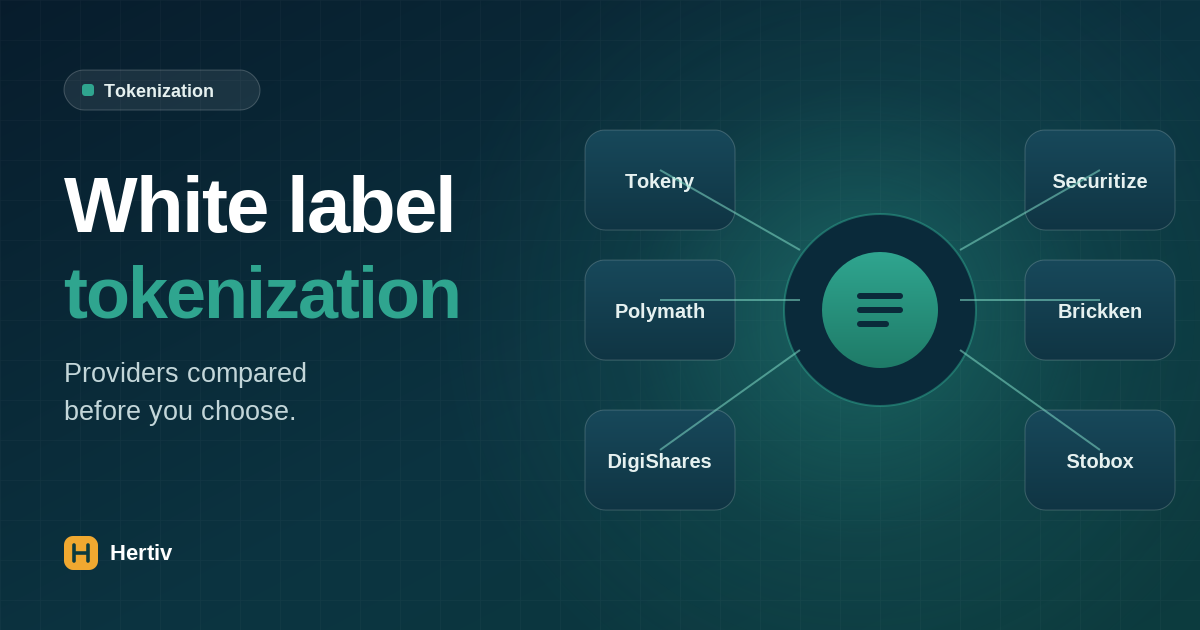
White label tokenization providers compared: Tokeny, Securitize, Polymath, Brickken, DigiShares and Stobox, and what to check before you choose one.
On this page
Short answer
White label tokenization providers are platforms that let a company issue tokens for real-world assets, such as property, funds or company shares, under its own brand, without building the tokenization technology from scratch. The best choice depends on the asset type, the countries you operate in, and how much of the compliance work the platform handles for you.
Which white label tokenization providers are worth comparing?
The white label tokenization providers worth comparing are the ones that cover your asset type, work in your countries, and handle the parts you cannot build yourself: token issuance, investor onboarding, compliance checks and the secondary market. A provider that is strong on real estate may be weak on funds, so match the platform to the asset first.
Use this comparison to shortlist. Prices and plans change, so check the vendor site for current pricing before deciding.
| Provider | Best for | Asset focus | White label |
|---|---|---|---|
| Tokeny | Regulated securities | Funds, shares, debt | Yes |
| Securitize | Fund tokenization | Funds, private equity | Yes |
| Polymath | Security tokens on Polymesh | Shares, funds | Yes |
| Brickken | Smaller asset owners | Real estate, equity | Yes |
| DigiShares | Real estate tokenization | Property, funds | Yes |
| Stobox | End-to-end issuance | Equity, real estate | Yes |
Shortlist two or three and ask each for a demo with your asset type and your countries. A generic demo tells you little; a demo with your use case tells you most of what you need.
1. Tokeny: best for regulated securities
1. Tokeny: best for regulated securities
Tokeny provides a white label platform for issuing and managing security tokens, with investor onboarding, identity checks and transfer rules built in. The platform is designed for regulated assets such as funds, shares and debt, where compliance is part of the product rather than an add-on.
Tokeny suits issuers who need strong compliance tooling and work mainly in Europe, where its standards-based approach fits the regulatory setup. Ask how transfer restrictions are enforced and which custodians the platform works with before signing.
Pros: compliance tooling is built in; works with regulated issuers; supports several asset types.
Cons: setup takes time and legal input; pricing is by quote, so check the vendor site; smaller issuers may find it heavy.
2. Securitize: best for fund tokenization
2. Securitize: best for fund tokenization
Securitize provides a platform for tokenizing funds and private equity, with issuance, investor onboarding and a marketplace for trading. It also acts as a transfer agent in the United States, which means it can handle the registry work that fund issuers otherwise do by hand.
Securitize suits fund managers who want an end-to-end route from issuance to secondary trading. Ask which countries the marketplace covers and what the onboarding process asks of your investors before committing.
Pros: end-to-end fund tokenization; transfer agent services; an existing marketplace for trading.
Cons: strongest in the United States; fees depend on deal size, so check the vendor site; onboarding is thorough and takes time.
3. Polymath: best for security tokens on Polymesh
3. Polymath: best for security tokens on Polymesh
Polymath builds tokenization tools on Polymesh, a chain designed for regulated assets, with identity, compliance and settlement features at the chain level. Issuers can create security tokens with transfer rules that are enforced by the network itself.
Polymath suits issuers who want the compliance logic on the chain rather than in a separate platform. Ask which wallets and custodians support Polymesh assets, since the ecosystem is smaller than the main general-purpose chains.
Pros: compliance features at chain level; purpose-built for regulated assets; token standards for securities.
Cons: smaller ecosystem than general chains; fewer custodians and exchanges; needs a partner for legal work.
4. Brickken: best for smaller asset owners
4. Brickken: best for smaller asset owners
Brickken provides a white label platform that lets smaller asset owners tokenize equity, real estate or other assets without building their own technology. The platform covers issuance, investor management and a dashboard under the issuer's own brand.
Brickken suits companies and property owners who want to test tokenization with a modest first deal. Ask what the platform charges per issuance and which countries the legal templates cover before starting.
Pros: accessible for smaller issuers; white label branding; covers issuance and investor management.
Cons: legal templates may not fit every country; secondary market depends on partners; check the vendor site for pricing.
5. DigiShares: best for real estate tokenization
5. DigiShares: best for real estate tokenization
DigiShares provides a white label platform for tokenizing real estate and funds, with issuance, investor onboarding, cap table management and a marketplace. Property owners can sell shares in a building to many investors and manage them from one dashboard.
DigiShares suits real estate firms that want a tested route for property tokenization. Ask how the platform handles property valuation data and which payment methods investors can use before choosing it.
Pros: strong real estate focus; cap table and investor tools included; white label under your brand.
Cons: property deals need legal work in each country; marketplace liquidity depends on the deal; pricing is by quote.
6. Stobox: best for end-to-end issuance
6. Stobox: best for end-to-end issuance
Stobox provides a white label platform plus advisory services for tokenizing equity and real estate, covering the legal structure, the token issuance and the investor platform in one package. It suits issuers who want help with the whole process rather than just the software.
Stobox suits first-time issuers who need guidance as well as technology. Ask which parts of the service are in-house and which are done by partners, and what the total fee covers, before signing.
Pros: technology plus advisory in one package; covers equity and real estate; white label platform.
Cons: advisory work adds cost and time; service quality depends on the team assigned; check the vendor site for pricing.
How to choose a white label tokenization provider
Choose a white label tokenization provider by the asset, the countries and the compliance work, not by the feature list. The platform is the easy part to compare; the legal and market fit decide whether the issuance works.
- Define the asset and the investor: a fund, a building or company shares each need different tooling.
- List the countries where investors and the asset sit, and ask each provider which of them it covers.
- Check who handles compliance: identity checks, transfer rules and reporting should be clear before you sign.
- Ask how investors buy and sell: a token with no secondary market is hard to sell.
- Run a demo with your asset type and your countries, and ask for the full fee schedule in writing.
For the companies angle, see RWA tokenization companies for startups to compare firms that build tokenization products.
For the fund side, what fund tokenization is explains how funds are structured as tokens.
What are the common mistakes?
The most common mistakes when choosing a tokenization provider are picking a platform before defining the asset, and assuming the platform handles the legal work.
- No clear asset. A platform cannot tokenize an asset whose ownership and legal structure are unclear.
- Ignoring the country list. A provider that works in one country may not cover your investors or your asset.
- Assuming legal is included. Most platforms provide software; the legal structure still needs a lawyer.
- No secondary market plan. Investors ask how they can sell, and a token with no buyer is a dead end.
- Comparing on price alone. The cheapest platform can cost more if it needs extra legal work or a separate marketplace.
Key takeaways
- Match the provider to the asset type and the countries first
- A provider that is strong on funds may be weak on real estate
- Compliance, custody and the secondary market matter more than the feature list
- Run a demo with your asset and your countries, not a generic one
- The platform is software; the legal structure still needs a lawyer
Frequently asked questions
What is a white label tokenization provider?
A white label tokenization provider is a company that supplies the software for issuing and managing tokens under your own brand. You provide the asset, the investors and the legal structure; the provider supplies the issuance platform, investor onboarding and the tools for managing token holders.
How much does white label tokenization cost?
Pricing varies widely by provider, asset type and deal size, and most providers quote per deal rather than publishing a fixed price. Ask for the full fee schedule in writing, including setup, issuance and any ongoing platform fees, and check the vendor site for current pricing.
Do I need a lawyer to tokenize an asset?
Yes. The provider supplies the technology, but the legal structure, the offering documents and the rules for your countries need a lawyer who knows securities law. Budget for legal work as a separate line, not as part of the platform fee.
Can tokenized assets be sold on a secondary market?
It depends on the asset, the countries and the platform. Some providers run their own marketplace, while others connect to partner exchanges. Ask the provider which markets your tokens can trade on before you issue them.
Which chain do white label providers use?
Providers use different chains, and some support several. The chain matters less than the compliance tooling, the custodians and the market access, so choose the provider first and check the chain fits your custodians and your investors.
Is tokenization the same as a crypto exchange listing?
No. Tokenization turns an asset such as a property or a fund share into a digital token with ownership records. An exchange listing is about trading a token on a public market, which is a separate step with its own rules and costs.


