Top 5 Upcoming Cryptocurrency ICOs: What to Watch
New token sales keep launching, but most are not worth your money. Here are five kinds of upcoming ICOs to watch, and the checks that matter.
On this page
Short answer
An initial coin offering, or ICO, is a public sale of a new crypto token, usually before the project is fully built. Buyers pay in an established coin and receive the new token in return. New ICOs keep appearing, but most fail, and some are outright frauds. The five categories below are the kinds of upcoming ICOs worth watching, with the checks that matter for each.
Upcoming ICOs at a glance
An ICO is how a new crypto project raises money before launch. The team publishes a plan, sets a price and a sale date, and sells tokens to the public. Buyers hope the token gains value as the project grows. The risk is that the project may never ship, the token may have no real use, or the sale itself may be a fraud.
| ICO category | What it offers | Main risk |
|---|---|---|
| DePIN networks | Tokens for sharing hardware | Rewards depend on real demand |
| Tokenised real assets | Tokens backed by property or funds | Legal title and redemption terms |
| AI agent platforms | Tokens that pay for agent work | Agents may not work as promised |
| On-chain gaming | Tokens for game items and rewards | Games may never attract players |
| Payment and remittance tokens | Tokens for cheap cross-border payments | Licensing and local rules |
The five categories below are types of ICOs, not named sales. For each one, the text explains what the project is trying to do and what to check before putting in money. The checks matter more than the category: a good project in a weak category beats a weak project in a hot one.
DePIN and tokenised real assets
1. DePIN networks: best for shared hardware
DePIN stands for decentralised physical infrastructure networks. These projects sell tokens to people who run hardware, such as wireless hotspots, sensors or storage drives, and pay them in tokens for the service. The idea is to build a network without a single company buying all the hardware.
The check that matters is demand: does anyone pay for the service in real money, or does the whole system run on new token buyers? A network that earns from real customers can last; one that only pays out tokens will run out of buyers. Look for published revenue, not just token price.
Pros: real service, clear use for the token, growing demand. Cons: token rewards can hide weak demand, and hardware costs fall on the user.
2. Tokenised real assets: best for property and fund tokens
Tokenised real-asset ICOs sell tokens backed by property, funds, bonds or commodities. The pitch is that a token lets small investors own a slice of an asset that used to need a large cheque. The token may pay rent, interest or a share of the income.
The check that matters is the legal link between the token and the asset. Who holds the title, what happens if the issuer fails, and how can a holder redeem? If those answers are vague, the token is a promise, not an asset. Read the legal documents, not just the website.
Pros: real backing, income potential, smaller ticket sizes. Cons: legal complexity, slow redemption, and rules that differ by country.
AI agents and gaming
3. AI agent platforms: best for paying for agent work
AI agent ICOs sell tokens that pay for work done by autonomous agents: research, support replies, data checks, or small tasks. The pitch is that agents will do more work every year, and the token is the currency they are paid in.
The check that matters is whether the agents work today, on real tasks, for real customers. A demo video is not proof. Ask for a live product, a list of paying customers, and the cost of one task in tokens. If the team cannot show a working agent, the token is funding a hope.
Pros: growing demand for agent work, clear token use. Cons: agents are early, and many teams overstate what theirs can do.
4. On-chain gaming: best for game items and rewards
Gaming ICOs sell tokens used inside a game: to buy items, earn rewards, or vote on changes. The pitch is that players should own what they earn, and that a good game can build an economy around its tokens.
The check that matters is the game itself. Is it fun without the token? Do players stay after the first rewards run out? A game that only works while token prices rise is not a game, it is a payout scheme. Play the game, or watch real players play it, before buying the token.
Pros: real ownership of items, strong communities. Cons: most games fail, and token rewards can distort play.
Payment tokens
5. Payment and remittance tokens: best for cheap cross-border payments
Payment ICOs sell tokens for cross-border payments and remittances, where bank wires are slow and costly. The pitch is a token that moves in seconds, settles in local currency, and charges less than a wire.
The check that matters is licensing and the payout network. Moving money across borders needs licences in each country, plus agents or banks that pay out local cash. A team without licences and partners cannot deliver, however good the token looks. Ask which licences it holds and which corridors already work.
Pros: clear problem, real demand, fast settlement. Cons: heavy licensing, and local rules can block a corridor overnight.
How to choose an ICO to watch
Most ICOs are not worth buying, and the ones that are worth watching share the same signs. Use these steps before putting in any money.
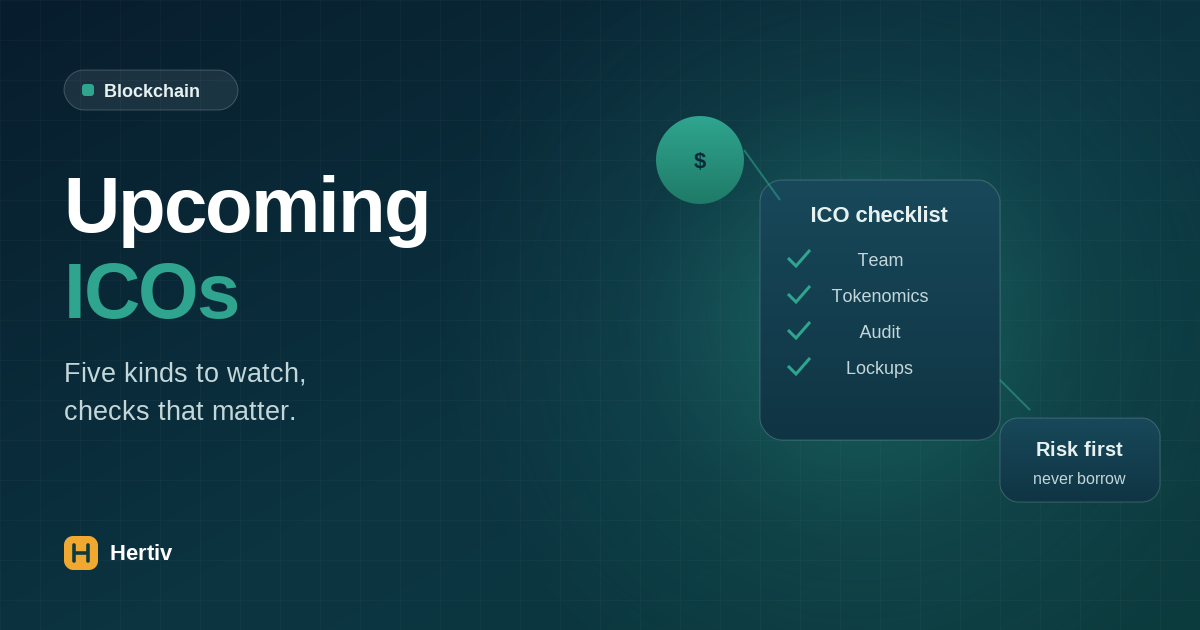
- Read the plan. A real project has a clear document that explains what it builds, who pays for it, and how the token is used. Vague plans are a warning.
- Check the team. Named people with a track record beat anonymous teams. Look for past work, not just social media followers.
- Read the tokenomics. How many tokens exist, who gets them, and when can insiders sell? A sale where insiders hold most of the supply is a bad sign.
- Look for an audit. The smart contracts should be audited by a known firm, and the audit should be public. No audit, no money.
- Start small. Never put in money you cannot afford to lose, and never borrow to buy a token. A real project will still be there after you have done the checks.
These steps will not find a guaranteed winner, because there is none. They will filter out most of the frauds and the projects that were never going to ship. For how ICOs are launched, see how to launch an ICO.
What are the common mistakes?
The most common mistake is buying on hype. A token that is trending on social media is usually already priced for the hype, and the people promoting it may be paid to do so. Hype is not a reason to buy; a working product is.
Another mistake is ignoring lockups. Many ICOs lock team and early-investor tokens for a year or more, and when the lock ends, a large supply can hit the market at once. Read the lockup schedule before buying, and check when the next large release happens.
Teams and buyers also skip the legal check. Some tokens are securities in some countries, which limits who can buy them and how they can be sold. Buying a token you are not allowed to hold can leave you unable to sell it. Check the rules where you live. For the costs of running a sale, see the cost of launching an ICO.
Key takeaways
- An ICO is a public sale of a new crypto token, usually before the project is fully built.
- Judge an ICO by its working product, team, tokenomics and audit, not by hype.
- Check the legal link between token and asset for tokenised real-asset sales.
- Read the lockup schedule: large unlocks can flood the market.
- Never put in money you cannot afford to lose, and never borrow to buy a token.
Frequently asked questions
What is an ICO?
An ICO, or initial coin offering, is a public sale of a new crypto token. A project publishes a plan, sets a price and a date, and sells tokens to buyers who pay in an established coin. The project uses the money to build, and buyers hope the token gains value as the project grows.
Are ICOs legal?
It depends on the country and the token. Some tokens are treated as securities, which brings rules about who can buy them and how they can be sold. Other tokens are treated as utility tokens with lighter rules. Check the rules where you live before buying, and be wary of sales that hide their legal status.
How do I tell a real ICO from a fraud?
Look for a named team with a track record, a clear plan, a public audit of the smart contracts, and a working product or prototype. Frauds usually have anonymous teams, vague plans, no audit, and heavy promotion with promises of high returns. No genuine project guarantees a return.
What is the difference between an ICO and an STO?
An ICO usually sells a utility token with no legal claim on the issuer, while an STO, or security token offering, sells a token that is legally a security, with rights defined in law. STOs face stricter rules but give holders clearer legal protections. For a fuller comparison, the guide on ICO vs STO explains the differences in detail.
Can I lose all my money in an ICO?
Yes. The project may never ship, the token may lose its value, the team may disappear, or the sale may be a fraud. ICOs are among the riskiest investments in crypto. Only use money you can afford to lose completely, and spread any risk across more than one asset.
Do I need a wallet to join an ICO?
Yes. You need a crypto wallet that you control, because the tokens are sent to your wallet address. Never send money from an exchange account, because the tokens may not arrive, and never share your wallet's secret phrase with anyone, including the project team.


