Top 10 Solana Ecosystem Tokens Worth Knowing
Solana hosts tokens for payments, trading, staking and more. Here are ten notable ecosystem tokens, what each does, and how to compare them before you look closer.
On this page
Short answer
The Solana ecosystem includes tokens for payments, decentralised trading, staking, oracles and community projects. The best-known are SOL itself, the stablecoins USDC and USDT, and trading tokens such as JUP and RAY. Each token serves a different role, so compare what it does, who runs it and where it is used before deciding it matters to you.
Which Solana ecosystem tokens are worth knowing?
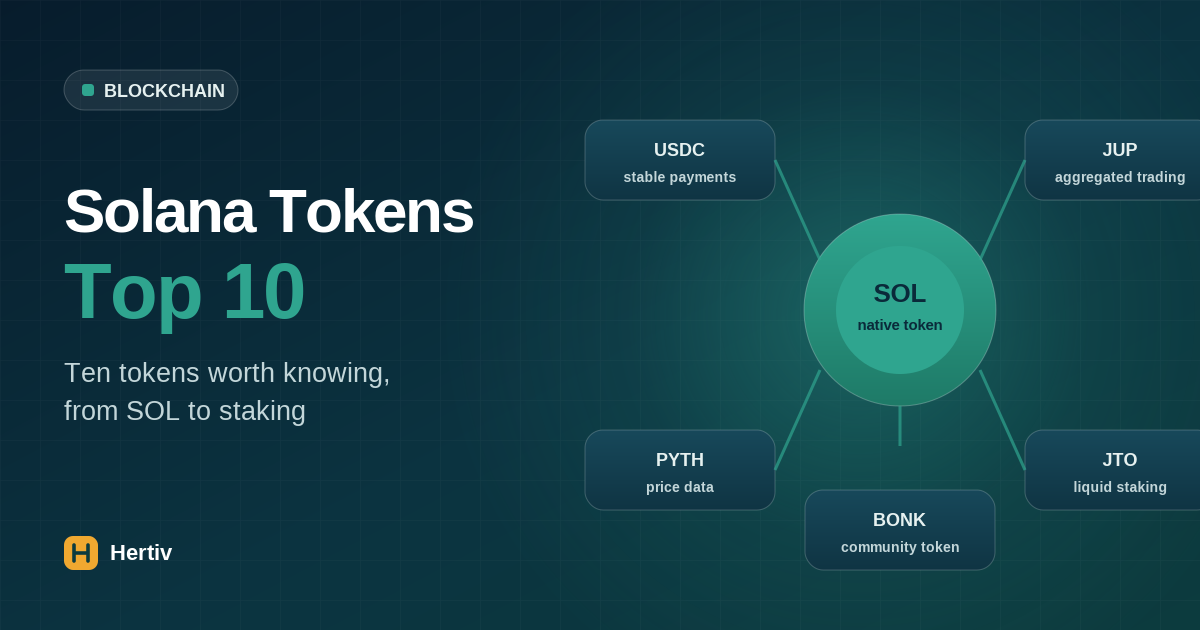
The Solana ecosystem tokens worth knowing are the ones that do real work on the network: paying fees, settling payments, trading, staking, pricing data and running community projects. This list covers ten of them, grouped by role, not ranked by price or size.
Use this comparison to see what each token does before you look closer at any of them.
| Token | Role | Used for |
|---|---|---|
| SOL | Native token | Fees, staking, governance |
| USDC | Stablecoin | Payments, trading pairs |
| USDT | Stablecoin | Payments, trading pairs |
| JUP | Aggregator token | Trading, governance |
| RAY | Exchange token | Trading, liquidity rewards |
| ORCA | Exchange token | Trading, governance |
| PYTH | Oracle token | Price data, governance |
| JTO | Staking token | Liquid staking, governance |
| BONK | Community token | Payments, community use |
| WIF | Community token | Community trading |
This is an explainer, not investment advice. Token prices move fast, and a token's role matters more than its recent price when you are trying to understand an ecosystem.
The native token and the stablecoins
1. SOL: best for understanding the network itself
SOL is the native token of Solana. It pays transaction fees, secures the network through staking, and is used in governance votes. Every action on Solana, from sending a token to running a program, needs SOL for fees.
Because it is the base token, its role is the easiest to understand and the hardest to replace. If you use Solana at all, you hold SOL for fees even if you never think of it as an investment.
Pros: required for fees, staking rewards, widely supported. Cons: price moves with the market, staking locks tokens up.
2. USDC and USDT: best for stable payments
USDC and USDT are stablecoins pegged to the US dollar, issued by Circle and Tether. On Solana they are used for payments, as trading pairs, and as a way to hold value without leaving the network.
The two differ mainly in issuer, reserves and where they are accepted. Both are widely used on Solana exchanges and payment apps, and both are redeemable through their issuers under their own terms.
Pros: stable value, fast settlement, widely accepted. Cons: centralised issuers, depend on the issuer's reserves and rules.
The trading tokens
3. JUP: best for aggregated trading
JUP is the token of Jupiter, Solana's main swap aggregator. Jupiter routes a trade across several exchanges to find the best price, and JUP holders vote on the platform's decisions. Traders use Jupiter without holding JUP, but holders take part in governance.
Its value comes from the platform's use: the more trading flows through Jupiter, the more the token matters to the people who run it.
Pros: governance over a heavily used platform, clear utility. Cons: value tied to one platform, governance participation is optional.
4. RAY and ORCA: best for decentralised exchange use
RAY is the token of Raydium and ORCA is the token of Orca, two of Solana's largest decentralised exchanges. Both let holders take part in governance and, in Raydium's case, earn rewards for providing liquidity.
They differ in design: Raydium combines an order book with liquidity pools, while Orca focuses on simple swaps with concentrated liquidity. Both are used by traders every day, and both tokens are a way to take part in how the exchange is run.
Pros: governance over real exchanges, liquidity rewards. Cons: tied to trading volume, rewards change over time.
The infrastructure tokens
5. PYTH: best for understanding price data
PYTH is the token of Pyth Network, an oracle that publishes price data to Solana and other chains. Applications that need a reliable price, such as lending and trading apps, read it from Pyth. PYTH holders vote on how the network is run and how data providers are rewarded.
Oracles matter because smart contracts cannot see prices on their own. A wrong price can liquidate a loan or misprice a trade, so the data feed is one of the most important parts of the ecosystem.
Pros: essential infrastructure, used by many apps. Cons: value depends on oracle adoption, governance is technical.
6. JTO: best for liquid staking
JTO is the token of Jito, a liquid staking protocol on Solana. Users stake SOL with Jito and receive a liquid token they can trade or use elsewhere, while Jito runs validators and shares the rewards. JTO holders govern the protocol.
Liquid staking solves the main drawback of staking: locked tokens cannot be used. With Jito, the staked position stays usable, though the protocol takes a fee and the liquid token's price can differ slightly from SOL.
Pros: staked SOL stays usable, extra rewards from validators. Cons: protocol fees, smart contract risk, price can drift from SOL.
The community tokens
7. BONK: best for community payments
BONK is a community token on Solana, launched as a free distribution to Solana users and developers. It is used for tips, payments in community apps, and as a reward in games and social projects across the ecosystem.
Its role is social rather than technical: it is a way for the community to reward participation. Its price is volatile, and it has no revenue or staking yield behind it, so it should be understood as a community token, not an infrastructure one.
Pros: wide distribution, used across many apps. Cons: no underlying revenue, very volatile, driven by sentiment.
8. WIF: best for seeing how community tokens spread
WIF, short for dogwifhat, is a community token known for its dog mascot. It spread through social media and listings on exchanges, and it is traded mostly as a community asset rather than for any technical function.
It is a useful example of how fast a community token can spread on Solana, and how fast it can fall. It has no governance or yield, so its interest comes entirely from the community around it.
Pros: strong community, easy to understand. Cons: no utility beyond trading, very volatile.
How to choose which tokens to follow
Choose Solana tokens to follow by role, not by price movement. A token that does something you need is worth understanding; a token that only moved recently is worth watching from a distance.
- Start with SOL, because every action on Solana needs it for fees.
- Add the stablecoins you would actually use for payments or trading.
- Look at the trading and infrastructure tokens for the apps you use.
- Check who runs each token: a company, a foundation, a DAO, or nobody in particular.
- Read the token's own documentation before trusting a summary, including this one.
For background on the network itself, what is Solana explains how it works.
To see how it compares with the largest smart contract chain, read Solana vs Ethereum.
What are the common mistakes?
The most common mistakes with Solana ecosystem tokens are buying on price movement alone, confusing a community token with an infrastructure token, and trusting a list without checking the token's own documentation.
- Buying on price alone. A token that rose fast can fall just as fast. Role and use matter more than recent movement.
- Confusing roles. A community token and a staking token are different things, even if both trade on the same exchange.
- Skipping the documentation. Every token on this list has its own docs. Read them before deciding it matters to you.
- Ignoring the issuer. Stablecoins depend on their issuer's reserves and rules. Know who that is.
- Treating a list as advice. This article explains what tokens do. It is not a recommendation to buy any of them.
If you are building on Solana rather than just following tokens, what is blockchain covers the basics that every chain shares.
Key takeaways
- SOL pays fees and secures the network; every other token builds on top of it
- Stablecoins are for payments and trading pairs, not for growth
- Trading, oracle and staking tokens each serve one clear role
- Community tokens run on sentiment and have no underlying revenue
- Compare role, issuer and use before price, and read the token's own docs
Frequently asked questions
What is the Solana ecosystem?
The Solana ecosystem is the set of applications, tokens and services built on the Solana blockchain: exchanges, wallets, payment apps, games, oracles and staking protocols. SOL is the native token, and the other tokens on this list serve specific roles inside that ecosystem.
Is SOL the same as a Solana ecosystem token?
SOL is the native token of Solana itself. Ecosystem tokens are the other tokens built on top of Solana, such as JUP, RAY and PYTH. SOL pays fees and secures the network; ecosystem tokens serve the apps built on it.
Are Solana ecosystem tokens a good investment?
This article does not give investment advice. Tokens differ widely in role, risk and volatility, and prices move fast. If you are considering buying any token, read its documentation, understand its role, and consider advice from a licensed adviser.
Where can I see which tokens are on Solana?
Token lists on Solana explorers and exchange sites show which tokens exist and where they trade. Check the token's own site and documentation for current facts, because lists go out of date and new tokens appear often.
What is the difference between JUP and RAY?
JUP is the token of Jupiter, a swap aggregator that routes trades across exchanges. RAY is the token of Raydium, a decentralised exchange with its own pools and order book. Both relate to trading, but they belong to different platforms.
Do I need SOL to use other Solana tokens?
Yes, in practice. Every transaction on Solana needs SOL to pay the fee, even if the transaction itself moves another token. Keep a small amount of SOL in any wallet you use on Solana.


