Top Metaverse Trends Shaping the Future: 10 to Watch
The metaverse is shifting from hype to practical products in work, shopping and training. These ten trends show where the real activity is and what to watch next.
On this page
Short answer
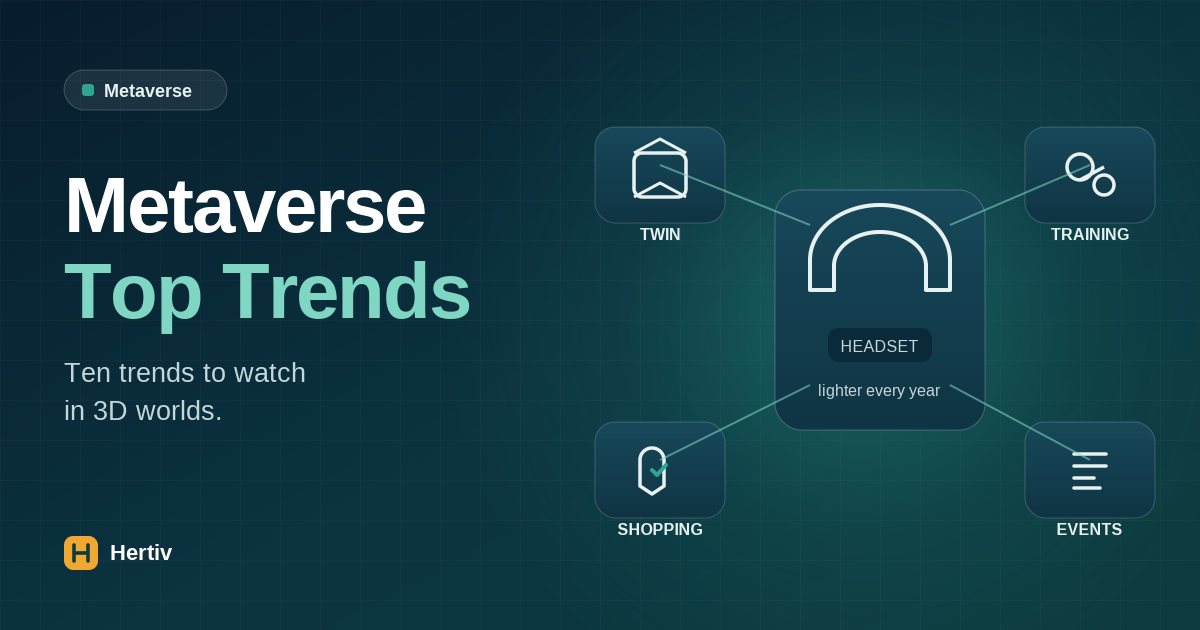
The top metaverse trends shaping the future are enterprise digital twins, AI-generated worlds, lighter headsets, virtual shopping, workplace training, creator economies, interoperability, spatial computing on phones, live events and persistent identity. Together they move the metaverse from a single virtual world toward useful 3D experiences inside work, retail and entertainment.
Which metaverse trends matter most?
The metaverse is no longer one place or one product. It is a set of 3D experiences showing up inside work, shopping, training and entertainment, and the trends that matter are the ones with paying users rather than the ones with the loudest demos. The ten below are the ones to watch.
They share a direction: less hype about a single virtual world, more focus on useful experiences that fit into what people already do. The table gives the quick view; the sections after it explain each trend and what it means for a team deciding where to invest.
| Trend | What is changing | Who it affects |
|---|---|---|
| Enterprise digital twins | Factories and buildings mirrored in 3D | Manufacturing, energy, logistics |
| AI-generated worlds | Worlds built by prompts, not by hand | Creators, studios, marketers |
| Lighter headsets | Smaller, cheaper, more comfortable | Every headset user |
| Virtual shopping | Try before you buy, in 3D | Retailers and brands |
| Workplace training | Practice in simulation, not on the job | Employers and trainers |
| Creator economies | Creators sell worlds and items | Artists, developers, platforms |
| Interoperability | Items and identity move between worlds | Users and platform builders |
| Spatial computing on phones | 3D experiences without a headset | Everyday users |
| Live events | Concerts and launches inside 3D spaces | Entertainment and events teams |
| Persistent identity | One avatar and profile across worlds | Users and brands |
Not every trend matters to every team. A retailer should watch virtual shopping and phones; a manufacturer should watch digital twins and training. Pick the two or three that touch your users, and ignore the rest until they do. For the basics, start with what the metaverse is if the term itself is still fuzzy.
Enterprise digital twins and AI-generated worlds
1. Enterprise digital twins: best for factories and buildings that need a live mirror
A digital twin is a live 3D copy of a real place or machine, fed by sensor data, that lets a team see, test and plan without touching the real thing. Factories use twins to plan layouts and spot problems before they stop a line; building managers use them to track energy and maintenance. The metaverse angle is the shared 3D view: several people can walk the same virtual factory and discuss the same problem.
The work is in the data, not the graphics. A twin is only useful if the sensor data is fresh and the model matches the real place. Teams that already have good sensor and CAD data get value fastest; teams without it should fix the data first.
Pros
- Problems are found before they stop real work
- Remote teams can inspect the same space together
Cons
- Needs clean sensor and model data to be useful
- Expensive to build for a site with poor data
2. AI-generated worlds: best for creators who need content fast
AI tools can now generate 3D spaces, objects and textures from text prompts, which cuts the time and cost of building a virtual world. A small team can sketch a store, a showroom or a training scene in hours rather than weeks, then refine it by hand. This matters because content was the bottleneck: building worlds by hand is slow and expensive.
The quality is uneven, and generated worlds still need human review for layout, branding and safety. But the direction is clear: creation gets cheaper, so more worlds get built, and the ones that win are the ones with a clear purpose rather than the most polygons.
Pros
- Worlds and scenes can be built far faster
- Small teams can compete with large studios
Cons
- Generated content needs human review
- Quality varies and can look generic
Lighter headsets and virtual shopping
3. Lighter headsets: best for everyone who found headsets too heavy
Headsets are getting lighter, cheaper and more comfortable, and that matters more than any single new feature. The main reason people stop using VR is discomfort, not a lack of content. Each generation of hardware removes a little more friction: less weight, better lenses, longer battery life and easier setup.
For teams building headset experiences, the trend means planning for a wider audience than the early enthusiasts. Design for short sessions, for glasses wearers and for people who have never used VR. The hardware will keep improving; the experiences that last are the ones that respect the user's comfort.
Pros
- More people can use VR for longer sessions
- Lower prices widen the audience
Cons
- Hardware still varies a lot between devices
- Comfort is better, not solved
4. Virtual shopping: best for retailers who want try-before-you-buy
Virtual shopping lets customers see products in 3D, try them on a virtual body or place them in a virtual room before buying. Furniture, fashion and beauty lead the way, because those are the purchases where seeing the product in context changes the decision. Early results point to fewer returns and more confident buyers.
The work is in the product models: each item needs an accurate 3D model, which costs time and money to produce. Retailers should start with their best sellers, measure returns and conversion, and expand only where the numbers justify it.
Pros
- Customers buy with more confidence
- Returns fall when the fit is clear in advance
Cons
- Accurate 3D models cost time to produce
- Only pays off for products where fit matters
Workplace training and creator economies
5. Workplace training: best for skills that are costly to practise for real
Training in a virtual space lets people practise dangerous, rare or expensive situations safely: a factory fault, a medical emergency, a difficult customer. The trainee can fail, repeat and get feedback without real consequences, and the trainer can see exactly what they did. This is the metaverse use case with the clearest return, because the alternative is often no practice at all.
The catch is content cost: a good training simulation needs careful design, not just a 3D room. Teams should start with one high-value scenario, measure whether trainees perform better afterwards, and build the next one only if the first works.
Pros
- Safe practice for risky or rare situations
- Every session can be measured and reviewed
Cons
- Good simulations cost real money to build
- Needs proof that training transfers to the job
6. Creator economies: best for artists and developers who build worlds
Platforms are paying creators for the worlds, items and experiences they build, through sales, tips and revenue shares. This is how virtual worlds get content at scale: instead of one company building everything, thousands of creators build what their audiences want. The best-known examples are the marketplaces inside games and social worlds.
For creators, the trend means treating world-building as a business: pricing, audience and quality matter as much as the craft. For platforms, it means the tools and the revenue share decide who builds there. The top metaverse startups list shows which platforms are investing most in creators.
Pros
- Creators can earn from what they build
- Platforms get content at a scale they could not build alone
Cons
- Income is uneven and platform-dependent
- Platform rule changes can hurt creators fast
Interoperability and spatial computing on phones
7. Interoperability: best for users tired of starting over in each world
Interoperability means an avatar, an item or an identity that works across more than one virtual world, instead of being locked inside one platform. Users want it because rebuilding an identity in every world is tedious; builders want it because it makes each world more useful. Progress is slow, because platforms benefit from lock-in, but open standards and shared formats are gaining ground.
For a team building a world, the practical step is to use open formats for avatars and items where possible, and to avoid custom systems that trap users. Full interoperability is years away, but the worlds that use open standards will be easier to connect later.
Pros
- Users keep their identity and items across worlds
- Open formats make worlds easier to connect
Cons
- Platforms resist it because lock-in pays
- Standards are still incomplete
8. Spatial computing on phones: best for reaching people without headsets
Most people will first meet the metaverse on a phone, not in a headset. Phones can already show 3D spaces, place virtual objects in a real room and run shared experiences through a browser or an app. This matters because the phone audience is thousands of times larger than the headset audience.
For teams, the lesson is to build for the phone first and the headset second. A 3D experience that works on a phone reaches real users today; a headset-only experience reaches a smaller group and waits for hardware to catch up.
Pros
- Reaches the audience headsets cannot yet reach
- No extra hardware for the user to buy
Cons
- Phone 3D is less immersive than a headset
- Small screens limit complex scenes
Live events and persistent identity
9. Live events: best for entertainment that wants a bigger room
Concerts, product launches and sports watch parties inside 3D spaces let far more people attend than any physical venue, and let them interact in ways a video stream cannot. Artists and brands use them to reach global audiences, and fans attend as avatars with friends. The best events feel like a place, not a broadcast.
The risk is an empty room: a virtual event with few attendees feels worse than a small real one. Organisers should build the audience first, keep the event short, and give people a reason to stay beyond the main act.
Pros
- Global audience with no venue limit
- Fans can attend together as avatars
Cons
- Small audiences feel emptier than in real life
- Production quality decides whether people return
10. Persistent identity: best for users and brands that want one presence
Persistent identity means one avatar, profile and reputation that follows a user across worlds and experiences, instead of a fresh account everywhere. For users it means their friends, items and history travel with them; for brands it means a customer relationship that survives a platform change.
The work is in trust: identity systems need to handle privacy, safety and fraud, and no single system has won yet. Teams should let users bring an identity they already have, rather than forcing a new one, and keep the data they collect to what the experience actually needs. A look at digital twins in the enterprise metaverse shows how persistent 3D identity works in a business setting.
Pros
- Users keep friends, items and history across worlds
- Brands keep a customer relationship across platforms
Cons
- No single identity system has won yet
- Privacy and safety need careful handling
How to choose which trends to follow
Follow the trends that touch your users, not the ones that get the most headlines. A trend is worth your time when it changes what your users can do, what they expect, or what it costs you to serve them.
- Start from your users. List the two or three trends that change something for your actual customers, and ignore the rest for now.
- Look for paying use cases. Training, shopping and digital twins have buyers today. A trend without a buyer is a demo, not a market.
- Test small. Build one scene, one product model or one training scenario, and measure whether users come back.
- Build for the phone first. If the experience works on a phone, it reaches real users now; headset-only can wait.
- Revisit every six months. Hardware, standards and prices move fast. A trend that was too early last year may be ready now. The metaverse apps that pioneered VR show how early bets played out over time.
Write the shortlist down and review it twice a year. Trends move, and a team that checks its list regularly spends less time chasing the wrong one.
What are the common mistakes?
The most common metaverse trend mistakes are building for the hype, ignoring the phone, and confusing a demo with a product.
- Building a world nobody asked for. A virtual space without a clear user need is an expensive demo. Start from a real problem.
- Headset-only thinking. Most users do not own a headset. If the experience only works there, most users never see it.
- Chasing every trend. Ten trends need ten teams. Pick two or three and do them well.
- Skipping the content cost. Worlds, models and simulations cost real money to build and maintain. Budget for it.
- Ignoring measurement. If you cannot say whether users return, you cannot say whether the trend worked for you.
Key takeaways
- The metaverse is splitting into useful 3D experiences, not one single world
- Digital twins, training and virtual shopping have paying users today
- AI-generated worlds cut creation cost, but still need human review
- Phone-first 3D reaches far more users than headset-only experiences
- Pick two or three trends that touch your users and ignore the rest
Frequently asked questions
What is the metaverse, in simple terms?
The metaverse is a set of shared 3D experiences on the internet: virtual worlds, games, workspaces, shops and events that people enter as avatars. There is no single metaverse; there are many platforms and experiences, and the useful ones are the ones that solve a real problem.
Is the metaverse only about VR headsets?
No. Many metaverse experiences run on phones and computers, and most users will meet them there first. Headsets give the most immersive version, but phone and browser access is how the audience grows, because almost everyone already has a phone.
Which metaverse trend is most useful for business?
Digital twins and workplace training have the clearest business case today, because they save money or reduce risk in measurable ways. Virtual shopping is close behind for retailers whose products benefit from seeing them in 3D before buying.
What is a digital twin?
A digital twin is a live 3D copy of a real place, machine or system, fed by sensor data. Teams use it to watch, test and plan without touching the real thing, for example by planning a factory layout or tracking a building's energy use in a shared 3D view.
Do I need to build my own virtual world?
Usually not. Most teams do better by building an experience inside an existing platform or by adding 3D features to what they already have. Building a whole world from scratch is expensive, and the audience has to be built from zero too.
How do I start with the metaverse as a small team?
Pick one trend that touches your users, build the smallest useful version, and measure whether people return. A single 3D product viewer, one training scenario or one virtual event is enough to learn from, and it costs far less than a full world.


