Top 10 Crypto Exchange Clone Scripts Worth Watching
A crypto exchange clone script is ready-made software modelled on a live exchange. These ten cover spot, P2P and decentralised trading, with the checks first.
On this page
Short answer
A crypto exchange clone script is pre-built software that copies the core features of an existing exchange, such as Binance or Uniswap, so a team can launch faster than building from scratch. The ten scripts below cover centralised spot trading, peer-to-peer trading and decentralised swaps. Which one fits depends on the trading model, the licence path and how much of the code your team can audit.
Which crypto exchange clone scripts are worth watching?
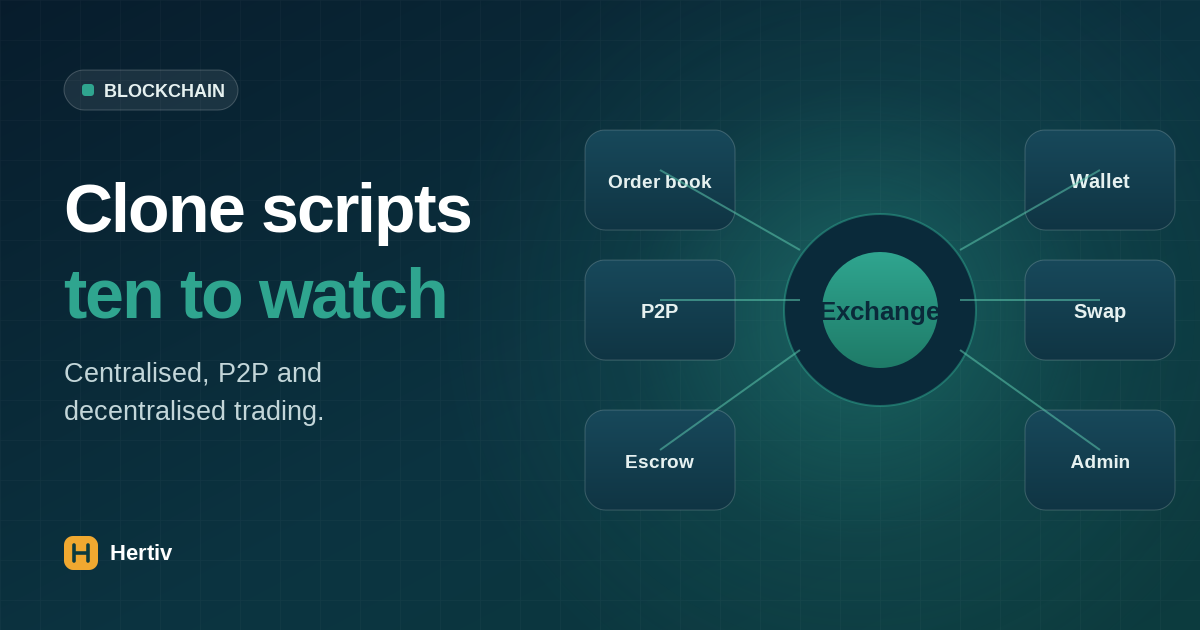
A crypto exchange clone script gives a team the standard parts of an exchange, such as user accounts, wallets, an order book, a trading engine and an admin panel, without writing them from zero. The script is a starting point, not a finished product: the team still has to configure it, audit it, connect payment rails and meet the rules where it operates.
Use the table to shortlist. Prices change often and depend on the licence and the features included, so check the vendor site for current plans.
| Script | Model | Best for | Starting point |
|---|---|---|---|
| Binance clone script | Centralised spot trading | Full-featured spot exchange | See vendor site |
| Coinbase clone script | Centralised retail trading | Beginner-friendly retail trading | See vendor site |
| Paxful clone script | Peer-to-peer trading | P2P trades with many payment methods | See vendor site |
| LocalBitcoins clone script | Peer-to-peer trading | Escrow-based P2P trades | See vendor site |
| Uniswap clone script | Decentralised swaps | Token swaps without order books | See vendor site |
| PancakeSwap clone script | Decentralised swaps | Low-fee swaps and yield features | See vendor site |
| Kraken clone script | Centralised spot trading | Security-first spot and margin trading | See vendor site |
| Remitano clone script | Peer-to-peer trading | P2P trading in local currencies | See vendor site |
| WazirX clone script | Peer-to-peer trading | P2P trading with local payment rails | See vendor site |
| Bitstamp clone script | Centralised spot trading | A simple, long-running exchange model | See vendor site |
Shortlist by trading model first, then by licence and audit. A script that matches the wrong model will cost more to reshape than a script that matches the right one from the start.
Binance and Coinbase clone scripts
1. Binance clone script: best for full-featured spot trading
A Binance clone script copies the feature set of a large spot exchange: order books, spot and margin trading, wallets, an admin panel and a KYC module. It suits teams that want a broad exchange rather than a single trading pair, and it usually needs the most configuration of the scripts on this list.
The trade-off is scope. More features mean more to test, more to secure and more to keep updated. A small team should plan to launch with a few pairs and add markets later.
Pros:
- Wide feature set, including spot and margin trading
- Admin tools for pairs, fees and users
- Familiar layout for traders who use large exchanges
Cons:
- Large codebase to audit and maintain
- Needs a licence plan before launch in most markets
- Margin features add risk and compliance work
2. Coinbase clone script: best for beginner-friendly retail trading
A Coinbase clone script copies the simpler retail model: buy and sell with fiat, a clean wallet view and a short onboarding flow. It suits teams targeting first-time buyers rather than active traders, and it keeps the interface light.
The trade-off is depth. Advanced traders will miss order types and charts, so this script fits a retail product, not a pro trading desk. For teams building this, crypto exchange development covers the build and compliance steps in more depth.
Pros:
- Simple onboarding and fiat on-ramp
- Clean interface that suits new buyers
- Smaller feature set, so faster to test
Cons:
- Few advanced order types
- Fiat rails need banking partners
- Less suited to high-volume traders
Paxful and LocalBitcoins clone scripts
3. Paxful clone script: best for peer-to-peer trading
A Paxful clone script copies the peer-to-peer model: buyers and sellers post offers, pay with gift cards, bank transfer or mobile money, and an escrow holds the crypto until both sides confirm. It suits markets where bank access is uneven and traders prefer local payment methods.
The trade-off is trust. P2P exchanges live or die on dispute handling, so the escrow, reputation and support flows matter more than the trading screen.
Pros:
- Many payment methods, including local options
- Escrow protects both sides of a trade
- Works where card rails are limited
Cons:
- Dispute handling needs real staff
- Slower trades than an order book
- Fraud risk needs constant monitoring
4. LocalBitcoins clone script: best for escrow-based P2P trades
A LocalBitcoins clone script copies the classic escrow P2P model: a seller locks coins in escrow, a buyer pays, and the coins release when payment is confirmed. It suits teams that want a narrow, proven P2P flow rather than a full marketplace.
The trade-off is that the model is simple, so the product stands or falls on trust signals: verified sellers, clear dispute rules and fast support. The crypto exchange development process explains the steps from scope to launch.
Pros:
- Simple escrow flow that traders already understand
- Low trading infrastructure needs
- Clear dispute and release rules
Cons:
- Depends on seller reputation to work
- Limited to P2P, no order book trading
- Needs staff for disputes and fraud review
Uniswap and PancakeSwap clone scripts
5. Uniswap clone script: best for decentralised token swaps
A Uniswap clone script copies the automated market maker model: liquidity pools replace order books, and anyone can swap tokens or add liquidity. It suits teams launching a token or a community exchange where users hold their own keys.
The trade-off is that there is no central operator to reverse a bad trade or freeze a stolen wallet. Smart contract audits and clear pool rules are the safety net, and they are not optional.
Pros:
- No order book or custody to run
- Anyone can list a token by adding liquidity
- Transparent on-chain trades
Cons:
- Smart contract risk needs a professional audit
- No support desk to reverse trades
- Price swings on thin pools can be large
6. PancakeSwap clone script: best for low-fee swaps and yield features
A PancakeSwap clone script copies the low-fee swap model with added features such as staking, farming and lotteries. It suits teams building on a low-fee chain where users expect cheap swaps and extra ways to earn.
The trade-off is complexity. Each added feature is another contract to audit and another surface for bugs, so a team should launch the swap first and add yield features only after the core is stable.
Pros:
- Low fees on the right chain
- Staking and farming add reasons to stay
- Community features build activity
Cons:
- More contracts to audit
- Yield features need clear token economics
- Depends on chain fees staying low
Kraken and Remitano clone scripts
7. Kraken clone script: best for security-first spot and margin trading
A Kraken clone script copies the security-first exchange model: cold storage, layered verification, margin trading and a deep order book. It suits teams that want to compete on trust and reliability rather than on the number of listed coins.
The trade-off is cost. Security operations, cold storage procedures and compliance checks are ongoing work, not one-time setup, and they need staff who know what they are doing.
Pros:
- Strong security posture as a selling point
- Margin trading for advanced users
- Clear verification levels for different limits
Cons:
- Higher running costs for security and compliance
- Slower onboarding for new users
- Margin adds liquidation and support work
8. Remitano clone script: best for P2P trading in local currencies
A Remitano clone script copies the P2P model built around local currency trades: sellers list offers in local money, buyers pay through local methods, and escrow holds the crypto until payment clears. It suits teams serving one region with its own payment habits.
The trade-off is reach. A regional P2P exchange grows slowly outside its home market, so the team should pick the region first and build the payment methods that region actually uses.
Pros:
- Built for local currency and local payment methods
- Escrow protects both sides
- Simple model, easy to explain to new users
Cons:
- Growth is limited to the chosen region
- Needs local payment partners
- Dispute handling needs staff who know the region
WazirX and Bitstamp clone scripts
9. WazirX clone script: best for P2P trading with local payment rails
A WazirX clone script copies the P2P model paired with a spot exchange: users trade peer-to-peer with local payment methods and can also trade on an order book. It suits teams that want both models in one product instead of choosing between them.
The trade-off is that two models mean two sets of flows to build, test and support. A team should launch one model first and add the second only when the first is stable. The white-label crypto exchange launch steps cover the sequence in more detail.
Pros:
- P2P and spot trading in one product
- Local payment methods for the target market
- More ways for users to trade
Cons:
- Two models to build and support
- Needs banking and payment partners
- Compliance covers both models
10. Bitstamp clone script: best for a simple, long-running exchange model
A Bitstamp clone script copies the simple exchange model: a small set of pairs, a clear fee table, bank transfers for fiat and a focus on reliability over features. It suits teams that want a steady exchange rather than a feature race.
The trade-off is that simplicity can look thin next to larger exchanges. The pitch is reliability and clear pricing, so the team has to deliver both, every day.
Pros:
- Simple model, easy to run and explain
- Bank transfers for fiat on and off
- Clear, predictable fees
Cons:
- Few features to stand out with
- Needs banking partners for fiat rails
- Small pair list limits trader interest
How to choose a clone script
Choose a clone script by trading model, licence path and audit, in that order. The model decides the product, the licence decides where it can operate, and the audit decides whether it is safe to launch.
- Pick the trading model. Spot, P2P or decentralised swaps each need different code, so decide before shortlisting.
- Check the licence path. Ask a lawyer what the product needs in each market where it will operate, and whether a clone script helps or hurts that case.
- Read the code before you pay. Ask for a demo, a code sample and the list of third-party parts, then have an engineer review them.
- Plan the audit. Budget for a smart contract audit on decentralised scripts and a security review on centralised ones.
- Price the running costs. Hosting, wallets, KYC checks, support and compliance are monthly costs, not one-time fees.
Do not pick on price alone. A cheap script with no audit and no support costs more in the first incident than a pricier script with both. See the top decentralised crypto exchanges for how the decentralised model compares.
What are the common mistakes?
The most common mistakes with clone scripts are skipping the audit, ignoring the licence, and launching with more features than the team can support.
- Skipping the audit. A clone script is still someone else's code, and it needs a security review before it holds real money.
- Ignoring the licence. Running an exchange without the right licence can end the business before it starts.
- Launching every feature at once. A narrow launch is easier to test, secure and support.
- Trusting the demo. A demo shows the happy path, not the edge cases, the load limits or the failure modes.
- Forgetting custody. Wallet security and key management need a plan, not a default setting.
- No support plan. Disputes, failed trades and locked accounts need staff from day one.
Key takeaways
- Clone scripts save build time, but they do not remove the audit, licence or custody work
- Pick the trading model first: spot, P2P or decentralised swaps need different code
- Centralised scripts need a security review; decentralised scripts need a smart contract audit
- P2P scripts live or die on escrow, reputation and dispute handling
- Launch narrow, then add pairs and features once the core is stable
Frequently asked questions
What is a crypto exchange clone script?
A crypto exchange clone script is pre-built software that copies the core features of an existing exchange, such as wallets, order books and an admin panel. A team buys or licences it, configures it, audits it and launches faster than building the same features from scratch.
Is it legal to run an exchange from a clone script?
The software itself is a starting point, but running an exchange is a regulated activity in most markets. The team needs legal advice on licences, KYC, AML checks and tax rules for each market where it operates, before launch.
How much does a clone script cost?
Prices vary widely by vendor, licence type and included features, and they change often. Check the vendor site for current pricing, and budget separately for the audit, hosting, KYC checks, support and compliance work.
Do clone scripts include a licence?
No. A clone script is software only. Licences, banking partners and payment rails are separate, and they usually take longer to arrange than the software setup. Budget time for them alongside the software work.
Are clone scripts safe to use?
They can be, if the code is reviewed and audited before launch. Unreviewed code can carry bugs or backdoors, so a security review or smart contract audit is part of the launch budget, not an optional extra.
What is the difference between a clone script and a white-label exchange?
A clone script copies a specific exchange's feature set, while a white-label exchange is a ready-made platform a team brands as its own. Both need configuration, audit and licensing, but white-label products usually include more of the running infrastructure.


