Crypto Exchange Development: 7 Steps That Work
Building a crypto exchange takes seven steps, from the business model to launch and monitoring. Here is what each step covers, and what to get right.
On this page
Short answer
The crypto exchange development process is the sequence of steps that turns an exchange idea into a working platform where users can deposit, trade and withdraw. It covers the business model, the law, the matching engine, wallets, security, testing and launch. Skipping a step does not save time; it moves the failure to launch week, when it costs the most.
What are the steps to build a crypto exchange?
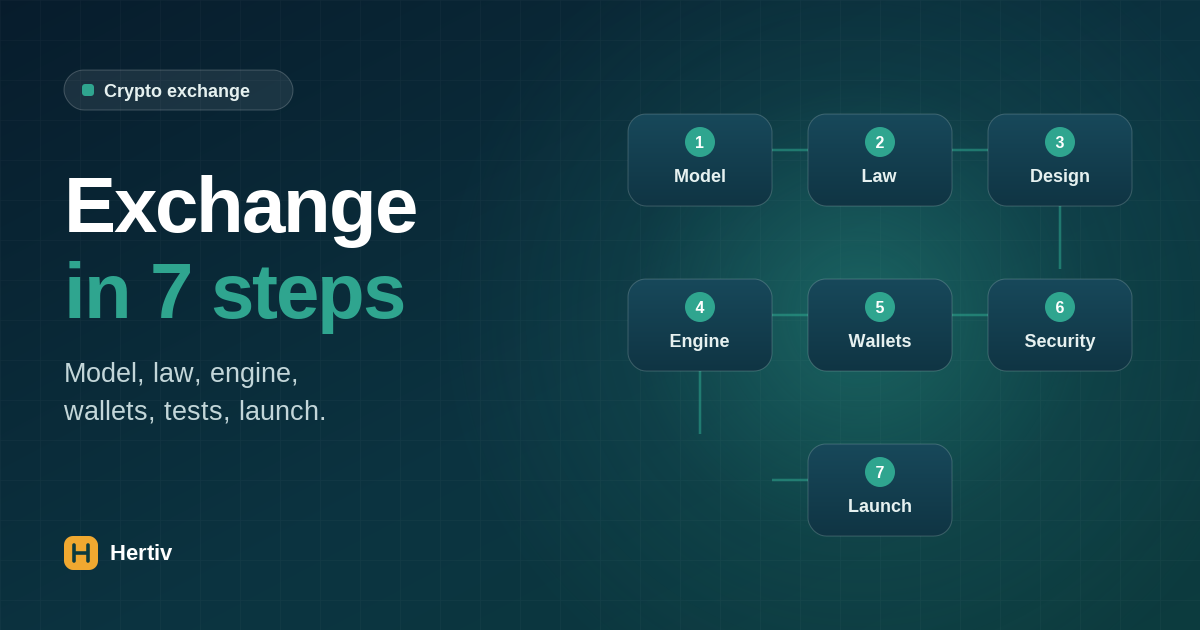
The steps below take an exchange from an idea to a live platform. Each step builds on the one before it, and the table gives a quick view of what each one produces.
| Step | What it covers | What it produces |
|---|---|---|
| 1. Business model | Users, markets, fees | A written model and fee plan |
| 2. Legal and licensing | Rules, licences, checks | A licence plan and legal sign-off |
| 3. Architecture | Engine, wallets, data | A system design and tech choices |
| 4. Matching engine | Orders, trades, liquidity | A working order book |
| 5. Wallets and custody | Deposits, withdrawals, keys | Safe wallet flows |
| 6. Security and testing | Reviews, audits, load tests | A tested, reviewed platform |
| 7. Launch and monitoring | Go-live, support, alerts | A live exchange with a watch team |
An exchange is not one product but several: a trading engine, a wallet system, a compliance system and a support operation, all of which must work on day one. For the service side of this work, crypto exchange development covers what a build partner usually handles.
<h3>1. Business model: decide who the exchange serves</h3>
The business model decides who the exchange serves, what it lists, and how it earns money. A retail exchange that lists many tokens needs a different design from a professional exchange that serves a few large traders, or a regional exchange that serves one country.
Write down the target users, the pairs to list at launch, the fee structure, and how the exchange earns money when volume is low. Liquidity is the hardest part of the model: without buyers and sellers, the order book is empty and no one trades. Plan how liquidity arrives, whether from market makers, shared liquidity, or a slow build of real users.
<h3>2. Legal and licensing: get the rules right first</h3>
Legal and licensing work decides where the exchange can operate and what it must check about its users. Crypto rules differ by country, and they change often, so this step needs a lawyer who works in the target market, not a general template.
Typical work includes choosing the company structure, applying for the licences the market requires, and setting up identity checks, anti-money-laundering checks and transaction monitoring. These checks must be built into the product, not added after launch, because regulators ask how they work before granting a licence.
<h3>3. Architecture: design the system before building it</h3>
Architecture is the design of the whole system: the matching engine, the wallets, the user accounts, the admin tools and the data flows between them. A good design keeps the parts separate, so a failure in one part does not take down the rest.
Decide early what to build and what to buy. A matching engine is hard to build well and is often the core of the project, while charting, email and analytics can come from existing tools. The design should also cover how the exchange scales when volume spikes, because a launch that works at low volume can fail on the first busy day.
<h3>4. Matching engine: build the order book</h3>
The matching engine is the part of the exchange that takes buy and sell orders, matches them, and records the trades. It must be fast, fair and correct: orders must match in the right order, balances must update exactly, and no trade may be lost or duplicated.
Test the engine with real order patterns, not just simple cases. Partial fills, cancelled orders, and orders that arrive at the same moment are where bugs hide. The engine also needs limits: maximum order sizes, circuit breakers for wild price moves, and a clear record of every trade for the team and the regulators.
<h3>5. Wallets and custody: keep user funds safe</h3>
Wallets and custody cover how the exchange holds user funds, takes deposits and pays withdrawals. Most exchanges keep most funds in cold wallets that are offline, and a small amount in hot wallets for daily withdrawals, with clear rules for moving funds between them.
Key management is the heart of this step. Decide who can sign, how many signatures are needed, and what happens if a key is lost. Every deposit and withdrawal must be checked against the user's balance before it is processed, and every movement must be logged. A mistake here is a loss of funds, not a bug report.
<h3>6. Security and testing: review everything before launch</h3>
Security and testing is the step where the exchange is attacked, reviewed and broken on purpose, so that it does not break in production. It includes a security review of the code, an audit of the smart contracts if any are used, and penetration testing of the live system.
Testing should cover more than happy paths. Test with bad inputs, with the database down, with a wallet service offline, and with ten times the expected load. Every finding needs an owner and a fix, and the launch decision should be a written sign-off, not a feeling. For the security side in detail, ways to secure a cryptocurrency exchange covers the controls that matter most.
<h3>7. Launch and monitoring: go live with a watch team</h3>
Launch and monitoring is the step where the exchange opens to real users, with a team watching every part of it. Launch in stages: a small group of invited users first, then a wider opening once deposits, trades and withdrawals all work in production.
Monitoring must cover trades, balances, wallets, logins and support tickets, with alerts that reach a person at any hour. The first weeks need a daily review of what broke, what users asked for, and what the support team could not answer. An exchange that launches without a watch team finds its problems from its users, which is the most expensive way to learn.
How to run the seven steps without stalling
Running the seven steps well is mostly about order and ownership. A team that starts building before the legal work is done will rebuild, and a team that launches before the security review will fix problems in public.
- Put one person in charge of each step. Every step needs a named owner who can say whether it is done.
- Do the legal work before the build. A licence decision can change the product, so it comes before the architecture, not after it.
- Build in small, testable parts. Ship the engine, then the wallets, then the admin tools, and test each part as it lands.
- Freeze the launch scope early. New pairs and features after the freeze go to the next release, not into launch week.
- Write the launch decision down. A short sign-off that lists what was tested, what is still open, and who is watching the launch keeps the decision honest. For the audit part, what a smart contract audit covers is useful when the exchange uses contracts.
The most common mistakes are starting the build before the legal work, skipping the load test, and launching without a monitoring team. Each one looks like saved time until launch week, when it costs far more than the step would have.
Key takeaways
- An exchange is four products at once: engine, wallets, compliance and support
- Legal work comes before the build, because a licence decision can change the product
- The matching engine must be tested on partial fills, cancellations and simultaneous orders
- Most funds belong in cold wallets, with clear signing rules and a small hot balance
- Launch in stages, with a team watching trades, balances and support from day one
Frequently asked questions
How long does it take to build a crypto exchange?
A small exchange with a narrow scope usually takes six to twelve months from a written model to a live launch, with legal work and security reviews taking a large share of that time. A broad exchange with many pairs, markets and licences takes longer. The timeline follows the scope and the licence path, not the code alone.
Do I need a licence to run a crypto exchange?
In most markets, yes, and the licence depends on the country and the services offered. The rules differ widely and change often, so the answer needs a lawyer in the target market. Building without a licence plan is the fastest way to rebuild the product later.
What is the hardest part of building an exchange?
Liquidity is usually the hardest part. Without buyers and sellers, the order book is empty and no one trades. The second hardest part is security, because an exchange holds user funds and is a visible target. Both need a plan before the build starts.
Should I build my own matching engine?
It depends on what makes the exchange different. If speed and order types are the selling point, a custom engine may be worth it. If they are not, a proven engine or a white-label platform is faster and safer. The engine is the hardest part to get right, so do not build it just to own it.
How much does it cost to build a crypto exchange?
It varies with scope, licences and team, and the legal and security work is a large share of the cost. A narrow exchange with one market and a small team costs far less than a multi-market exchange with several licences. Price the scope and the licence path first, and check vendor sites for tool prices.
What happens after launch?
The work shifts to monitoring, support, new listings and fixes. The team watches trades, balances, wallets and tickets, and reviews every incident the same day. Most exchanges also plan the next release before launch, so new features arrive on a schedule instead of in a rush.


