Top AI Service Providers Worth Shortlisting
Six AI service providers build chatbots, copilots and data products for businesses. Compare what each does best, then check their Clutch reviews before you call.
On this page
Short answer
The AI service providers worth shortlisting are firms that build and run AI products for clients, not just advise on them. The six below cover custom AI development, data engineering, computer vision and voice agents, and all of them list verified client reviews on Clutch. Pick by the kind of product you need, the evidence of past work, and how the team will hand the product over to you.
Which AI service providers should you shortlist?
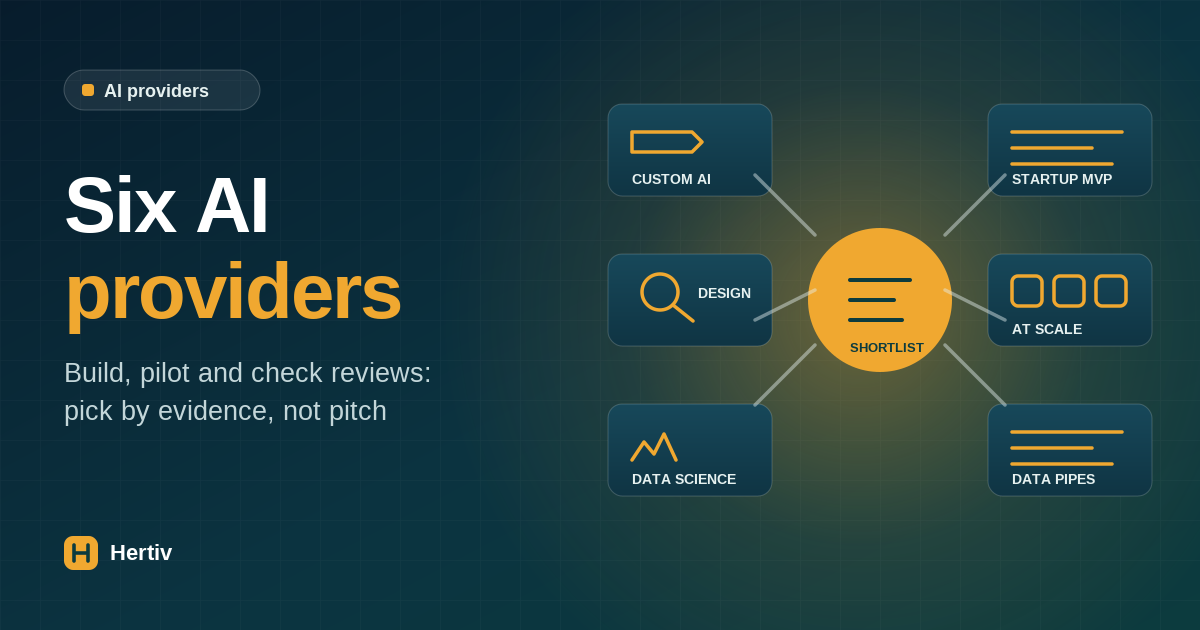
The providers below build and run AI products for clients, from chatbots and copilots to data platforms and computer vision. All of them list verified client reviews on Clutch, which is the fastest way to check what past clients actually say. The table gives a quick comparison; the sections after it explain what each provider does best.
| Provider | Best for | Main services | Typical client |
|---|---|---|---|
| LeewayHertz | Custom AI products | Generative AI, agents, apps | Mid-size businesses |
| Markovate | AI MVPs for startups | MVPs, copilots, integrations | Early-stage startups |
| 10Clouds | AI products with design | Product design, AI apps | Product-led companies |
| SotaTek | AI at scale | AI, data, outsourcing | Large companies |
| Deeper Insights | Data science and AI strategy | Data science, ML, analytics | Data-rich companies |
| DataRoot Labs | Data engineering for AI | Data pipelines, ML ops | Companies with messy data |
Prices are not listed here because AI work is priced per project. Ask each provider for a quote based on your scope, and check the vendor site for current service details. For a wider view of consulting firms, top data AI consulting companies covers firms that focus on advice and data work.
<h3>1. LeewayHertz: best for custom AI products</h3>
LeewayHertz is a US-based AI development company that builds custom AI products, including generative AI apps, AI agents and enterprise software. Its teams work across industries such as healthcare, finance and manufacturing, and they take projects from discovery through to launch and support.
It suits a business that wants a product built around its own workflows rather than a ready-made tool. The work usually starts with a discovery phase, then a pilot, then a full build. The company also publishes case work on its site, which makes it easier to judge fit before a first call.
Pros:
- Product built around the business, not a template
- Experience across several industries
- Support after launch
Cons:
- Custom work costs more than a ready platform
- Discovery phase adds time before building
<h3>2. Markovate: best for AI MVPs for startups</h3>
Markovate is an AI development company that works mainly with startups, building minimum viable products that use AI to solve one clear problem. Its teams cover chatbots, copilots, recommendation features and integrations with existing tools.
It suits a founder who needs a working product fast to test with real users. The focus is on a narrow first version, then learning from use before adding more. That pace fits startups, but a larger company may want a provider with more enterprise process.
Pros:
- Fast first version for testing
- Startup-friendly pricing and pace
- Focus on one clear problem
Cons:
- Less suited to large enterprise rollouts
- Smaller team than the biggest firms
<h3>3. 10Clouds: best for AI products with strong design</h3>
10Clouds is a software company based in Poland that builds AI-powered products with a strong design team. Its work covers product design, mobile and web apps, and AI features such as document processing and personalisation.
It suits a company that cares how the product feels, not just what it does. The design team works alongside engineers, so the interface and the AI feature are built together rather than one after the other.
Pros:
- Design and engineering in one team
- Strong product design track record
- Good for user-facing apps
Cons:
- Premium pricing for design-led work
- May be more than a simple internal tool needs
<h3>4. SotaTek: best for AI at scale</h3>
SotaTek is a large software company based in Vietnam that builds AI, blockchain and enterprise software for clients around the world. Its size lets it staff bigger projects and run several workstreams at once.
It suits a larger company that needs a provider able to scale a team quickly and keep delivery steady over a long project. The trade-off is that a small project may get less senior attention than it would at a smaller firm.
Pros:
- Large team that can scale fast
- Experience across many technologies
- Competitive rates for large projects
Cons:
- Small projects may get less senior attention
- Time zone overlap needs planning
<h3>5. Deeper Insights: best for data science and AI strategy</h3>
Deeper Insights is a data science company that helps businesses use their data with machine learning and AI. Its work covers forecasting, analytics, computer vision and natural language processing, with a focus on measurable business results.
It suits a company that has data but is not sure what to do with it. The team starts by finding the use cases that pay, then builds the models and the dashboards to run them. It is less suited to a company that wants a consumer app built from scratch.
Pros:
- Strong focus on measurable results
- Good for companies with messy data
- Covers strategy and build
Cons:
- Less focused on consumer apps
- Projects start with analysis, which takes time
<h3>6. DataRoot Labs: best for data engineering for AI</h3>
DataRoot Labs is a data and AI company that builds the data pipelines and machine learning systems that AI products run on. Its teams work on data engineering, ML ops and applied AI for companies in retail, finance and logistics.
It suits a company whose AI plans are held back by messy data. The team cleans, connects and pipelines the data first, then builds the models on top. A business that only needs a chatbot may find this heavier than it needs.
Pros:
- Strong data engineering behind the AI
- Good for retail, finance and logistics
- ML ops included, not just models
Cons:
- Heavier than a simple chatbot project needs
- Data work takes time before results show
How to choose an AI service provider
Choose an AI service provider by the evidence, not the pitch. The steps below give a shortlist you can defend.
- Define the product. Write down the one job the AI must do and how you will know it works.
- Check Clutch reviews. Read verified client reviews and look for projects like yours.
- Ask for similar work. Ask each provider to show a project in your industry or with your kind of data.
- Test with a small pilot. A short paid pilot shows how the team works before you commit to a full build.
- Agree the handover. Decide who owns the code, the models and the data, and how support works after launch.
A pilot is the step most buyers skip, and the one that saves the most trouble. How to build an AI proof of concept shows how to scope one that gives a clear answer.
If your product is agent-based, AI agent development companies in the USA is a useful cross-check before you sign.
What are the common mistakes?
The most common mistakes when choosing an AI service provider are picking on price alone, skipping the pilot, and signing before the handover is agreed.
- Picking the cheapest quote. A low price often means less senior time or a cut scope. Compare what is included, not just the total.
- Skipping the pilot. A pilot shows how the team communicates and delivers. Without it, you learn that after signing.
- No handover terms. If you do not own the code and the models, switching provider later is painful.
- Trusting a demo. A polished demo may use clean sample data. Ask to see the product on data like yours.
- Ignoring the data work. Most AI projects fail on data, not models. Make sure the provider covers data engineering.
Key takeaways
- Shortlist providers that build AI products, not just advise on them
- Check verified Clutch reviews for projects like yours
- A small paid pilot shows how a team works before you commit
- Agree code, model and data ownership before signing
- Most AI projects fail on data, so check the provider's data engineering
Frequently asked questions
What is an AI service provider?
An AI service provider is a company that builds and runs AI products for clients, such as chatbots, copilots, data platforms and computer vision systems. It differs from a consultant, which mainly advises. A provider takes responsibility for building the product and, often, for running it after launch.
How do I check an AI service provider on Clutch?
Search for the provider on Clutch and read the verified client reviews, which Clutch collects by interviewing clients. Look for reviews from companies like yours, check the services listed, and note the project sizes. A provider with several detailed reviews is easier to trust than one with a single short review.
How much does an AI service provider cost?
It depends on the scope, the team and the region, and prices vary by vendor, so check the vendor site. Most providers price per project or per team per month. Ask for a quote based on your scope, and compare what is included, not just the total price.
Should I hire an AI service provider or build in-house?
Hire a provider when you need to move fast or lack the skills in-house, and build in-house when AI is core to your product and you can hire the team. Many companies start with a provider for the first product, then hire in-house once they know what they need.
What should I ask before signing with an AI provider?
Ask who owns the code and the models, how the handover works, what happens if the project fails, and who will support the product after launch. Ask for two client contacts you can call, and for a project like yours that you can see running.
Do AI service providers work with small companies?
Yes, many providers work with startups and small companies, often on a first product or a pilot. Smaller providers and startup-focused firms are usually a better fit than large firms, which may need bigger budgets. A short paid pilot is a good way to start.


