Top Data AI Consulting Companies Worth Shortlisting
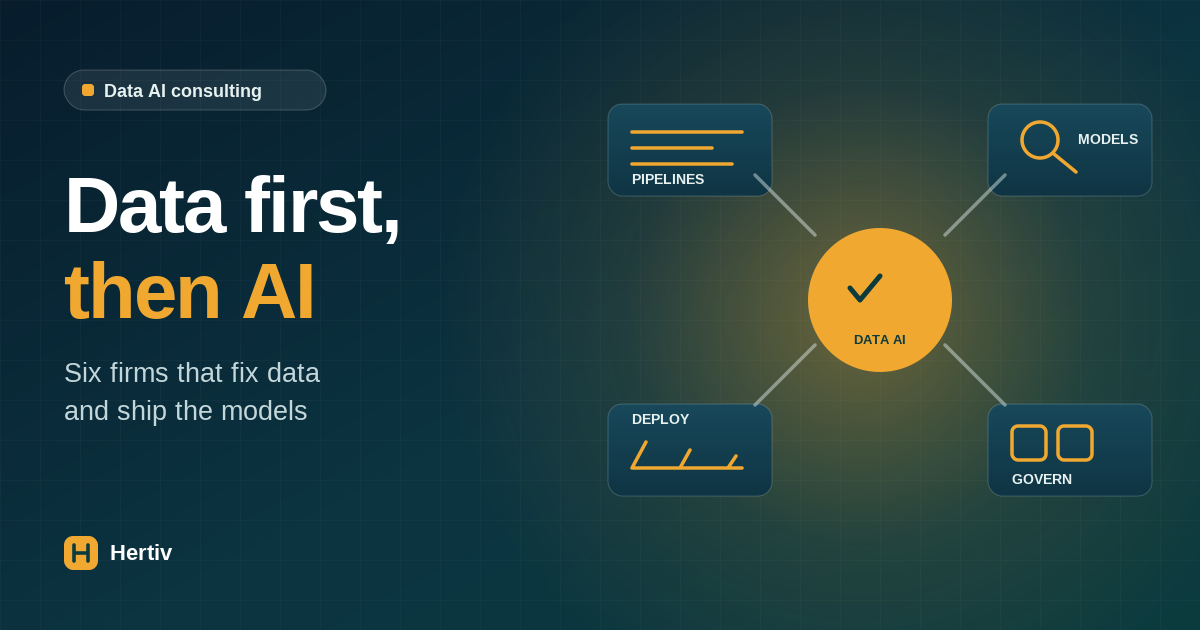
Data AI consulting companies build data pipelines, governance and models that let a business use AI. These six firms are worth a shortlist for data-first AI work.
On this page
Short answer
Data AI consulting companies help a business turn its own data into working AI: they clean and connect the data, build the models, and put the result into daily use. The best firms do the data work first, because a model built on messy data gives messy answers. This list covers six firms that do both the data engineering and the AI delivery, with what each one is best for.
Which data AI consulting companies are worth a shortlist?
A data AI consulting company is judged on two things at once: whether it can fix the data, and whether it can ship the AI. A firm that only builds models will struggle if the data is scattered across five systems. A firm that only moves data will never get a model into production.
| Firm | Data strength | AI strength | Best for |
|---|---|---|---|
| Accenture | Large data platforms | Full AI delivery | Big programmes |
| Deloitte | Governance and reporting | Applied AI | Regulated industries |
| Fractal | Analytics and pipelines | Decision AI | Retail and finance |
| Tiger Analytics | Cloud data platforms | Machine learning | Mid-size teams |
| Tredence | Data engineering | Industry AI | Fast pilots |
| Mu Sigma | Data cleaning and prep | Decision science | Experiment-led work |
The six firms below were picked because they do both halves of the job: the data engineering that makes AI possible, and the AI delivery that makes it useful. Prices are not listed here, because these firms price by project; see vendor site for current rates. For a wider view of firms that work with data, data analytics companies covers the analytics-only side of the same market.
<h3>1. Accenture: best for big data AI programmes</h3>
Accenture is the largest firm on this list, and it is the one to call when the work spans many countries, many systems and many teams. It builds data platforms, moves old systems to the cloud, and then builds AI on top of them, with teams that stay through the whole programme.
Its data strength is scale: it has done the same platform work for banks, retailers and manufacturers, so it brings patterns that a smaller firm would have to invent. The trade-off is cost and pace, because a large programme takes longer to start than a small pilot.
- Pros: Deep bench across data and AI; proven on very large programmes; global delivery teams.
- Cons: High cost; slower to start; small projects get less attention.
<h3>2. Deloitte: best for regulated industries</h3>
Deloitte suits banks, insurers and healthcare organisations, where the data work must pass audits and the AI must be explained to a regulator. Its teams combine data governance, risk and AI delivery, which matters when the model touches customer money or patient records.
Its data strength is governance: who can see which data, how it is stored, and how a decision made by a model can be traced back. That work is slow, but in a regulated industry it is the work that decides whether the project ships at all.
- Pros: Strong governance and audit practice; trusted in regulated sectors; wide industry coverage.
- Cons: Premium pricing; projects can be heavy on process.
<h3>3. Fractal: best for retail and finance decisions</h3>
Fractal focuses on decisions rather than dashboards. Its teams build the data pipelines, then the models that price products, forecast demand or score risk, and then the tools that let managers act on the answer. Retail and finance are its strongest sectors.
Its data strength is analytics engineering: turning raw sales, stock and customer records into clean tables that a model can learn from. That is the unglamorous half of AI work, and it is where most projects stall.
- Pros: Strong on decision-making AI; good retail and finance record; pragmatic delivery.
- Cons: Smaller global footprint than the big four; less known outside its core sectors.
<h3>4. Tiger Analytics: best for mid-size teams</h3>
Tiger Analytics builds cloud data platforms and machine learning for companies that are too big for a freelancer and too small for a global consultancy. Its teams are usually a mix of data engineers and data scientists who stay on the project from the first pipeline to the first model in production.
Its data strength is modern cloud platforms: it builds the warehouse, the pipelines and the monitoring, then adds models for forecasting, pricing or customer behaviour. Mid-size teams get senior people on the work, which is not always true at larger firms.
- Pros: Senior teams on mid-size work; strong cloud data platforms; clear focus on machine learning.
- Cons: Less suited to very large programmes; narrower industry spread.
<h3>5. Tredence: best for fast pilots</h3>
Tredence is built around short, industry-shaped pilots: a team arrives with a data engineering kit and a set of AI use cases for a sector, and aims to show a working result in weeks rather than months. Retail, manufacturing and healthcare are its main sectors.
Its data strength is speed of setup: pre-built connectors and pipelines that cut the time spent joining data from different systems. The pilot proves the value, and the team then helps turn the pilot into a production system.
- Pros: Fast to a working pilot; industry-shaped use cases; practical data engineering.
- Cons: Pilot-to-production handover needs care; smaller than the global firms.
<h3>6. Mu Sigma: best for experiment-led work</h3>
Mu Sigma works on decision science: it cleans and prepares the data, then runs experiments that show what actually changed a result, rather than what merely moved with it. Its teams are often embedded with the client's analysts, so the client keeps the skill when the project ends.
Its data strength is preparation: the cleaning, joining and checking that turns scattered records into a dataset a model can trust. That work is slow and rarely visible, but it is what makes the later analysis worth reading.
- Pros: Strong on data preparation and experiments; embedded working style; honest about uncertainty.
- Cons: Less focus on building products; delivery can feel academic.
How to choose a data AI consulting company
Choosing comes down to three checks: can the firm fix the data, can it ship the AI, and will it stay until the result is in daily use. The steps below run in order.
- Ask for a data audit first. A good firm starts by looking at the data, not by pitching a model. If the data is not ready, the audit says so.
- Check for production work, not demos. Ask which models are running in daily use today, and who maintains them. A demo is easy; a model that runs for a year is the real test.
- Match the firm to the size of the work. A global firm suits a multi-country programme; a mid-size firm suits a single team. The wrong size costs more and moves slower.
- Ask who does the data work. If the firm subcontracts the pipelines, the quality is out of its hands. The firm should own the data engineering itself.
- Agree the handover up front. The project should end with the client's team able to run, retrain and retire the model, with the firm gone.
Price is the last check, not the first, because the cheapest firm that cannot fix the data is the most expensive one in the end. For firms that focus on the engineering side of this work, data engineering companies for startups lists specialists that pair well with a smaller AI team.
What are the common mistakes?
The most common mistakes when hiring a data AI consulting company are buying the model before the data, and judging the firm by its slides instead of its production work.
- Starting with the model. A model built on scattered, dirty data gives answers nobody trusts. Fix the data first, then build the model.
- Believing the demo. A demo runs on clean sample data. Ask to see the same model running on a client's messy, real data, in production.
- No owner on the client side. If nobody inside the business owns the data and the result, the project drifts and dies when the firm leaves.
- Skipping governance. Personal data, customer records and financial data all have rules about who can see them. Sorting that out late can stop a project entirely.
- Paying for hours, not outcomes. A contract that pays by the hour rewards slow work. Agree milestones tied to working results, such as a model in daily use.
Before signing, talk to a past client in a similar industry, and ask what went wrong as well as what went right. For the US-focused side of this market, AI consulting companies in the USA lists firms that work mainly with American clients.
Key takeaways
- A data AI consulting firm must do both halves: fix the data, then ship the AI
- Accenture suits big programmes; Deloitte suits regulated industries
- Fractal, Tiger Analytics, Tredence and Mu Sigma suit mid-size, fast or experiment-led work
- Check for production models on real data before signing, not just demos
- Agree the handover up front so the client's team can run the model alone
Frequently asked questions
What does a data AI consulting company do?
It cleans and connects a business's data, builds the models that use it, and puts the result into daily use. The data work comes first, because a model built on messy data gives messy answers, and the firm should own both halves of the job.
How much does a data AI consulting project cost?
It depends on the size of the data work and the number of models, and firms price by project rather than by a fixed rate. A small pilot costs far less than a multi-country programme. Ask for a data audit first, because that sets the real scope.
What is the difference between AI consulting and data consulting?
Data consulting fixes the data: pipelines, warehouses and governance. AI consulting builds the models that use the data. A data AI consulting company does both, which matters because most AI projects fail on the data half, not the model half.
Which firm is best for a small business?
A mid-size firm such as Tiger Analytics or Tredence usually fits better, because the team gets senior people and the project starts faster. A global firm is built for large programmes and can be slow and costly for a small scope.
Should the firm stay after the model launches?
Yes, for a short handover period, and no longer. The firm should help the client's team learn to run, retrain and retire the model, then leave. A project that needs the firm forever was never handed over properly.
What should I ask a data AI consulting company first?
Ask which models it runs in production today, on real client data, and who maintains them. Then ask for a data audit before any model work starts, because the audit shows whether the data is ready and what the project will really cost.


