AI Agent Development Companies in the USA: How to Choose
An AI agent development company builds software that plans, uses tools and acts inside set limits. Here is how to judge US firms on proof, safety and fit.
On this page
Short answer
An AI agent development company in the USA designs, builds and runs AI agents, which is software that plans a task, calls tools and data, and takes actions within limits a person sets. The right firm shows working agents in production, explains how it tests and controls them, and prices the work in clear stages, starting with a small proof of concept.
What is an AI agent development company?
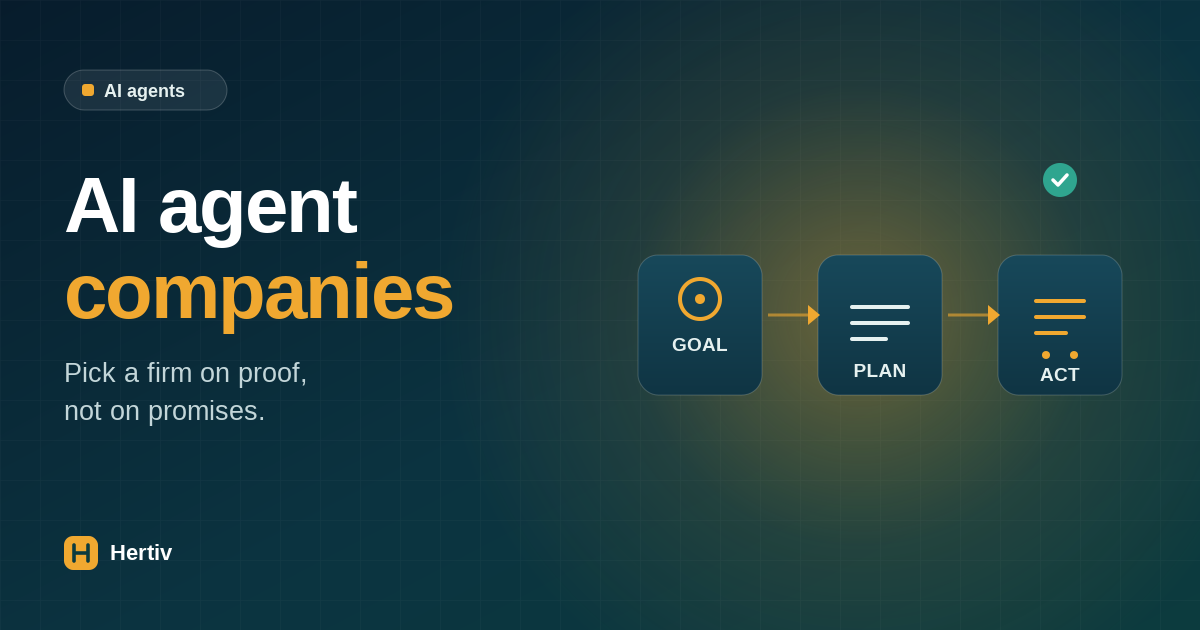
An AI agent development company is a firm that builds AI agents for other businesses. An AI agent is software that takes a goal, works out the steps, uses tools such as search, databases and other software, and takes actions within limits set by a person.
That is different from a chatbot, which only answers messages. An agent can check a system, change a record, send a message or raise a ticket, and it can do several steps in a row without being asked each time. The company designs the agent, connects it to the business systems, tests it, and runs it in production with monitoring and controls.
US firms in this field range from small teams that build one kind of agent to large consultancies that run whole programmes. The size of the firm matters less than its proof: working agents in production, in a field close to yours, with the controls that keep them safe. A firm that only shows demos has not yet proved it can run an agent that real customers depend on.
What do these companies actually build?
Most agent work falls into a few clear types. A support agent reads customer messages, checks the order system, and resolves the common cases while passing the hard ones to a person. A sales agent researches leads, drafts outreach and updates the CRM. An operations agent watches a system, spots a problem and takes the first fix, such as restarting a service or raising a ticket.
Other agents work inside a company: a finance agent that chases invoices, an HR agent that answers policy questions from the staff handbook, or a research agent that reads documents and writes a short brief. The pattern is the same in each case: a repeated task with clear rules, a set of tools the agent can call, and a person who checks the results. AI agent development covers the full range of these builds.
| Agent type | What it does | Typical first use |
|---|---|---|
| Support agent | Answers and resolves customer messages | Order status and returns |
| Sales agent | Researches leads and drafts outreach | Lead lists and follow-up |
| Operations agent | Watches systems and takes first fixes | Alerts and ticket triage |
| Internal agent | Answers staff questions from company docs | HR and finance questions |
| Research agent | Reads documents and writes briefs | Market and competitor notes |
Ask a firm which type it has shipped most often. A company that has built ten support agents will know the failure modes of support work; a company that has built none will learn them on your project.
How do you judge a company?
Judge a firm on proof, safety and fit, in that order. Proof means working agents in production, not demos: ask to see one running, ask how long it has run, and ask what broke and how it was fixed. A firm that cannot show a live agent is selling a plan, not a product.
Safety means the firm can explain its controls in plain words. An agent that can change records or send messages needs limits: which tools it may call, which actions need a person to approve, how its work is logged, and how it is stopped. If the firm cannot describe those controls, it is not ready to build an agent that acts on your systems.
Fit means the firm understands your field and your systems. An agent for a bank needs different controls from an agent for a shop, and an agent that must talk to your CRM needs a team that has done that integration before. Ask for a reference customer in a similar size and sector, and talk to them about what went wrong, not just what went well.
- Ask for a live agent. See one running in production and ask what broke.
- Ask about controls. Which actions need approval, how is work logged, how is it stopped?
- Ask about testing. How are agents tested before launch and checked after?
- Check the field fit. Ask for a reference customer in your sector and size.
- Check the team. Who will build it, and have they shipped agents before?
What should the first project look like?
The first project should be a small proof of concept that takes about four weeks and covers one task with clear rules. Pick a task that repeats daily, has a clear right answer, and can be checked in minutes: answering order-status questions, triaging support tickets, or drafting lead research are all good first tasks.
The proof of concept should end with numbers, not a demo. How many cases did the agent handle on its own, how often was it right, and how much time did it save? Those three numbers decide whether the next stage is worth funding. A firm that wants a large contract before any numbers exist is asking you to take the risk it should take itself.
Agree the scope in writing before work starts: the task, the systems the agent may touch, the actions that need approval, and the measures that count as success. AI proof of concept development follows this pattern, with a fixed four-week shape and a clear go or no-go decision at the end.
Example (hypothetical): a support agent pilot
Example (hypothetical): a company gets 400 support tickets a day, and each one takes an agent about 6 minutes to read and answer. That is 400 times 6, which is 2,400 minutes, or 40 hours of agent time a day.
The pilot agent is allowed to resolve tickets that match a clear pattern, such as order status and returns, and it must pass the rest to a person. In the pilot it resolves 40% of tickets on its own. That is 160 tickets times 6 minutes, which is 960 minutes, or 16 hours of agent time saved a day.
At a cost of $45 per agent hour, 16 hours a day is $720 a day, or $3,600 in a five-day week. Those numbers are invented to show the arithmetic, not a promise. The real question is whether the agent keeps its accuracy up when the ticket mix changes, and whether the 60% it passes on are handled well by the people who receive them.
Common mistakes when hiring an agent company
Common mistakes when hiring an agent company start with buying a demo. A polished demo shows what an agent could do in a perfect case, not what it does when the data is messy, the customer is angry, or the system it calls is down. Ask for a live agent and a reference customer instead.
A second mistake is giving the agent too much freedom too soon. An agent that can change records, send messages or spend money without approval will make a costly error sooner or later. Start with read-only actions and drafts, then add actions one at a time, each with its own approval rule.
A third mistake is skipping the testing plan. Agents fail in ways that ordinary software does not: they can take a wrong step that looks reasonable, or repeat a step that should only run once. The firm should test with real cases from your business, not only with the cases it wrote itself, and it should keep testing after launch as the work changes.
A fourth mistake is forgetting the people. An agent changes how a team works: someone must check its output, handle the cases it passes on, and fix it when it goes wrong. If nobody owns that job, the agent slowly stops being checked, and errors grow until a customer finds one first.
What does it cost, and how is it priced?
Cost depends on the task, the systems the agent must connect to, and how much control and testing the work needs. A small proof of concept is usually priced as a fixed fee for a few weeks of work, while a production agent is priced in stages: build, launch, then a monthly run cost that covers monitoring, fixes and model use.
Ask for the price in stages, with a clear stop point after each one. The first stage should end with numbers from a real pilot, and you should be able to stop there without paying for the full build. Ask what is included in the monthly run cost, and what counts as extra work, so the bill does not surprise you later.
Do not accept a single price for the whole programme before the pilot has run. The pilot exists to find out what the real work is, and the price should follow that finding, not come before it. For a rough sense of the range, how much AI agent development costs sets out the main drivers.
A readiness assessment can tell you whether your data and systems are ready for an agent at all, before you spend money on a build.
Key takeaways
- An AI agent plans, uses tools and acts inside limits a person sets.
- Judge a firm on live agents in production, not on demos.
- Safety controls are part of the build, not an extra to add later.
- Start with a four-week proof of concept that ends in numbers.
- Price the work in stages, with a stop point after each one.
Frequently asked questions
What is an AI agent?
An AI agent is software that takes a goal, works out the steps, calls tools such as search, databases and other software, and takes actions within limits a person sets. It differs from a chatbot, which only answers messages, because an agent can change records, send messages and raise tickets on its own.
How is an AI agent different from a chatbot?
A chatbot answers messages in a conversation, while an agent plans and acts across several steps and systems. An agent can check an order, update a record and send a message in one run, where a chatbot would need a person to do each of those steps.
How long does it take to build an AI agent?
A small proof of concept usually takes about four weeks and covers one task with clear rules. A production agent that connects to several systems and runs with full controls takes longer, and the time depends on how many systems it must touch and how strict the approval rules are.
What should an agent never do on its own?
An agent should never take an action that cannot be undone or checked, such as sending money, deleting records or making a promise to a customer, without a person approving it. The safe pattern is to start with drafts and read-only actions and add actions one at a time.
How do you test an AI agent?
Test it with real cases from your business, including the messy ones, and measure how often it is right and how often it needs a fix. Keep testing after launch, because the work changes over time and an agent that was right last month can drift as the data and the systems change.
What does an AI agent development company cost?
Cost depends on the task, the systems involved and the controls needed, so there is no single price. A proof of concept is usually a fixed fee for a few weeks, and production work is priced in stages with a monthly run cost for monitoring and fixes. See vendor site for current pricing.


