Top AI Development Companies in Germany: 8 to Shortlist
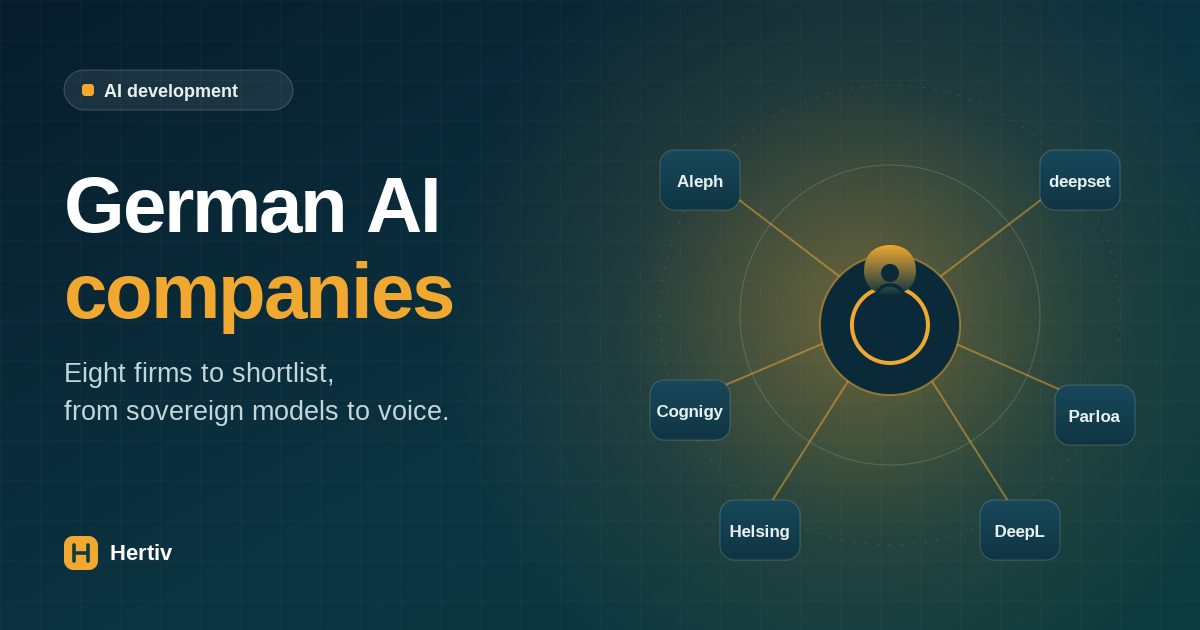
Germany's AI builders range from sovereign model makers to voice-agent teams. Here are eight firms to shortlist, with what each one does best and where it fits.
On this page
Short answer
Germany has a strong set of AI development companies, from sovereign language model builders in Heidelberg to voice-agent teams in Berlin and conversational AI firms in Düsseldorf. This listicle compares eight of them so you can shortlist the right fit for your project.
Which AI development companies in Germany lead the field?
Germany has a strong bench of AI development companies, from sovereign model builders in Heidelberg to voice-agent teams in Berlin and conversational AI firms in Düsseldorf. The eight below were picked because they build AI products and services for other businesses, not just their own.
| Company | Best for | Headquarters | Known for |
|---|---|---|---|
| Aleph Alpha | Regulated industries | Heidelberg | Sovereign language models |
| deepset | Document AI and search | Berlin | Haystack framework |
| Cognigy | Contact centre AI | Düsseldorf | Voice and chat agents |
| Parloa | Voice agents at scale | Berlin | Phone-based AI agents |
| Helsing | Defence and security AI | Munich | Sensor and decision software |
| Merantix | Applied AI ventures | Berlin | AI venture studio |
| DeepL | Translation AI | Cologne | Neural translation |
| Black Forest Labs | Image generation | Freiburg | FLUX image models |
Prices change often and depend on scope and team size, so see vendor site for current pricing. The comparison below focuses on what each company builds and where it fits. For the wider picture, see top AI development companies in the USA.
<h3>1. Aleph Alpha: best for regulated industries</h3><h3>2. deepset: best for document AI and search</h3>
Aleph Alpha builds sovereign language models and the PhariaAI platform for businesses and public bodies that need their data to stay under European control. Its stack covers model hosting, assistants, search and tools for building AI applications on governed data. It fits banks, insurers, manufacturers and public-sector teams that must show where data lives and how a model reached an answer.
Pros:
- European data residency and control
- Full stack from model to application
- Built for regulated work
Cons:
- Aimed at large organisations
- Less suited to small, quick pilots
deepset is the Berlin company behind Haystack, an open-source framework for building search and question-answering systems over documents. Its platform lets teams build, run and govern retrieval-based agents and assistants. It fits teams with large document sets, such as contracts, manuals or research files, that want answers grounded in their own content.
Pros:
- Open-source framework with a large community
- Strong grounding in your own documents
- Governance tools for production use
Cons:
- Needs engineering effort to get the best from it
- Less of a fit for simple chatbots
<h3>3. Cognigy: best for contact centre AI</h3><h3>4. Parloa: best for voice agents at scale</h3>
Cognigy, based in Düsseldorf, provides an enterprise conversational AI platform for customer and employee support. Its agents handle voice and chat conversations, hand over to people when needed, and work across the channels a contact centre already uses. It fits large support operations that take thousands of calls and messages a day and need consistent answers in several languages.
Pros:
- Voice and chat in one platform
- Built for high-volume support
- Human handover built in
Cons:
- Enterprise pricing and setup
- Overkill for a small support team
Parloa is a Berlin company that builds AI agents for phone-based customer service. Its agents answer calls, resolve routine requests and pass complex cases to people, with tools for testing, monitoring and improving the agents over time. It fits businesses where the phone is still the main support channel, such as insurers, banks and travel companies.
Pros:
- Purpose-built for phone conversations
- Testing and monitoring included
- Handles millions of calls
Cons:
- Voice-first, so chat is secondary
- Needs real call data to train well
<h3>5. Helsing: best for defence and security AI</h3><h3>6. Merantix: best for applied AI ventures</h3>
Helsing is a Munich company that builds AI software for defence and security, combining sensor data from radar, cameras and signals into a single picture for human decision makers. It also builds autonomous systems for surveillance and reconnaissance. It fits government and defence buyers, not general business users, and shows that Germany's AI strength extends into safety-critical systems where reliability matters more than speed to market.
Pros:
- Strong record in safety-critical AI
- Combines many sensor types
- Backed by large public contracts
Cons:
- Not a vendor for commercial projects
- Little public detail on methods
Merantix is a Berlin venture studio and research lab that builds AI companies in healthcare, industry and other applied fields. Rather than selling one product, it creates and backs new teams that turn research into working products. It fits founders and corporate partners who want to build an AI venture with a team that has done it before.
Pros:
- Deep research and engineering bench
- Track record of building AI ventures
- Strong ties to Berlin research
Cons:
- Not a straightforward hire-a-team vendor
- Focus is on ventures, not one-off projects
<h3>7. DeepL: best for translation AI</h3><h3>8. Black Forest Labs: best for image generation</h3>
DeepL, based in Cologne, builds neural machine translation used by businesses to translate documents, support tickets and internal content across many languages. Its models are known for handling nuance and tone better than generic translation tools. It fits teams that work across languages every day, such as support, legal and product teams in international companies.
Pros:
- High-quality translation across languages
- Easy to add to existing workflows
- Strong in European languages
Cons:
- Translation only, not general AI development
- Quality varies by language pair
Black Forest Labs is a Freiburg company behind the FLUX family of image generation models, used by agencies, product teams and media companies to create commercial imagery from text prompts. It fits teams that need fast, controllable image generation for marketing, product visuals and creative work.
Pros:
- Strong image quality and text rendering
- Used by creative and media teams
- Fast generation for commercial use
Cons:
- Image generation only
- Needs care around licensing and rights
How do you choose an AI development company in Germany?
You choose by matching the company's strength to your problem, then checking data handling, language support and delivery record before you sign.
- Write down the problem in one sentence, and the data it touches.
- Shortlist firms whose core product matches that problem, not generalists.
- Ask where data is stored and processed, and how EU rules are met.
- Check German and English language quality in a real test, not a demo.
- Ask for a small paid pilot with a clear success measure before a larger deal.
German firms often score well on engineering quality and data control. The trade-off is that some are built for large, regulated buyers, so a small team should check fit early. For a broader shortlist, see AI development companies for startups.
What are the common mistakes?
The most common mistakes are picking a famous name over a good fit, ignoring data residency, and skipping a pilot.
- Choosing on brand alone. A well-known model maker may not be the best builder for your use case.
- Ignoring where data lives. Regulated teams need this answered in writing before work starts.
- Skipping the pilot. A demo on clean data proves little; test on your own documents and calls.
- Underestimating language needs. German-language quality varies a lot between vendors.
- No owner on your side. Without someone senior owning the project, delivery drifts.
Start with the problem, not the vendor list. The right German firm is the one whose strength matches your data, your language needs and your budget. For enterprise-scale buyers, AI development companies for enterprises covers the larger vendors.
Key takeaways
- Germany's AI strength runs from sovereign models to voice agents and image generation
- Aleph Alpha and deepset suit regulated and document-heavy work; Cognigy and Parloa suit contact centres
- Helsing and Merantix serve defence and venture building, not general commercial projects
- Check data residency, German language quality and delivery record before signing
- Run a small paid pilot on your own data before committing to a larger deal
Frequently asked questions
Which German AI company is best for regulated industries?
Aleph Alpha is the strongest fit for regulated work, because its PhariaAI stack is built around European data control and governed access. Banks, insurers and public bodies that must show where data lives and how answers were reached will find its approach matches their requirements.
Do German AI companies work in English as well as German?
Yes, most of the firms on this list work in both languages, since their customers are international. Still, test German-language quality on your own documents and calls, because quality varies between vendors and use cases.
Is DeepL an AI development company?
DeepL is an AI product company focused on translation rather than a general development vendor. It belongs on this list because many businesses hire it as a translation partner, but it will not build a custom AI product for you.
What does an AI development company in Germany typically cost?
Costs vary widely by scope, team size and project length, and most firms quote per project rather than publishing fixed prices. See vendor site for current pricing, and ask for a small paid pilot before a larger commitment.
Should a small team hire a German AI company?
It depends on the firm. Some on this list, such as deepset and Parloa, work with mid-sized teams, while others are built for large enterprises. Check the minimum project size early so you do not waste weeks on a vendor that cannot take small work.
Why does Germany have so many AI companies?
Germany combines strong engineering research, large industrial buyers and strict data rules, which push companies to build careful, governed AI. Berlin, Munich, Heidelberg and Düsseldorf each host a different cluster, from research labs to contact-centre AI.