Top AI Development Companies in Canada: 8 to Shortlist
Canadian AI firms worth shortlisting range from Toronto language-model builders to Vancouver robotics teams. Compare eight, then check recent work first.
On this page
Short answer
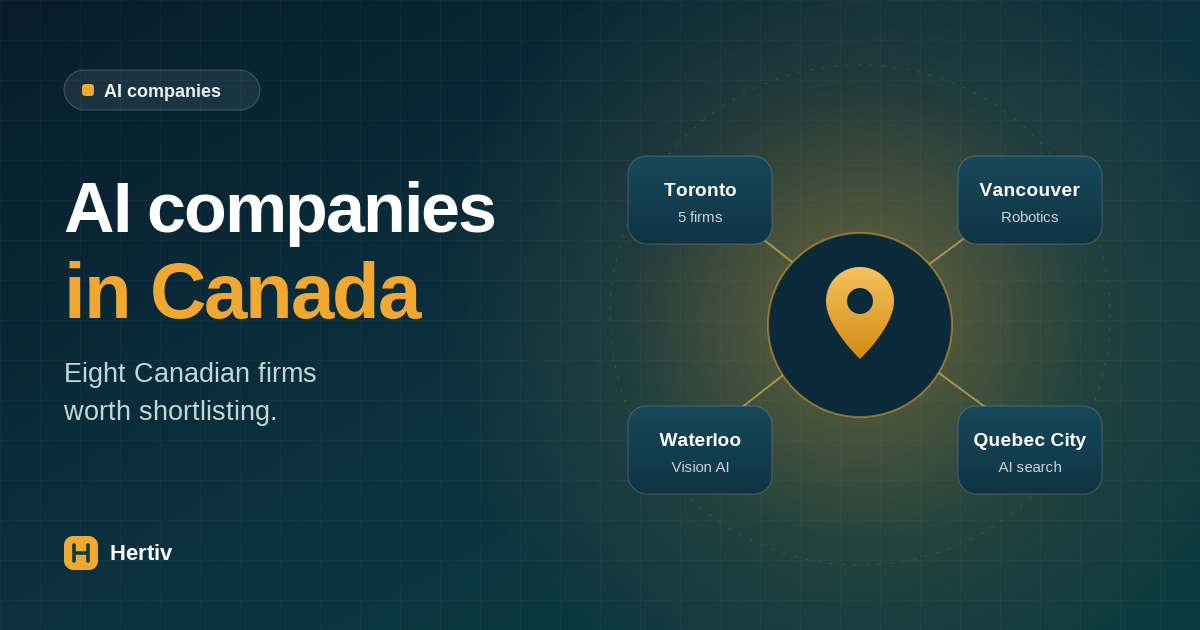
The AI development companies in Canada worth shortlisting are the ones with real products and recent delivery in your domain: Toronto's language-model and customer-service builders, Waterloo's industrial vision teams, Vancouver's robotics firms and Quebec City's search specialists. Shortlist two or three, then check their recent work and ask to speak with a past client.
Which AI development companies in Canada are worth shortlisting?
The Canadian AI firms worth shortlisting range from Toronto language-model builders to Vancouver robotics teams. Canada's strength is depth: the Toronto-Waterloo corridor has produced several of the world's best-known AI companies, and Montreal, Vancouver and Quebec City add their own specialisms.
Use this comparison to shortlist. All eight firms below are headquartered in Canada, and none appears in the other regional shortlists on this blog.
| Company | Best for | Headquarters | Typical focus |
|---|---|---|---|
| Cohere | Enterprise language models | Toronto | LLMs, RAG, agents |
| Ada | Customer service automation | Toronto | AI agents, support |
| Borealis AI | Banking and finance AI | Toronto | Research, platforms |
| Waabi | Autonomous driving AI | Toronto | Generative simulation |
| Deep Genomics | AI drug discovery | Toronto | Genomics, therapies |
| Sanctuary AI | Humanoid robotics | Vancouver | Embodied AI, robots |
| DarwinAI | Industrial vision AI | Waterloo | Inspection, quality |
| Coveo | AI search and relevance | Quebec City | Search, recommendations |
Shortlist two or three firms, then check their recent work in your domain before you talk price. A firm's home city matters less than whether it has shipped something like your project.
<h3>1. Cohere: best for enterprise language models</h3><h3>2. Ada: best for customer service automation</h3>
Cohere builds large language models for enterprises, with a focus on retrieval-augmented generation and agents that run inside a customer's own environment. Founded in Toronto in 2019, its North platform is designed for businesses that need models behind their own firewall, and it suits teams whose project centres on language: document search, summarisation, or agents that answer from their own content.
Pros: enterprise-grade models with deployment inside your own cloud; strong retrieval and agent tooling for grounded answers; Toronto base with Canadian data residency options. Cons: best suited to language work, not vision or robotics; enterprise pricing is by quote, so ask early.
Ada builds an AI-native customer service automation platform that resolves conversations across messaging, voice and email. Founded in Toronto in 2016, it handles routine enquiries while handing complex cases to human staff, and it suits businesses drowning in repeat questions about orders, accounts and returns.
Pros: purpose-built for support, with handoff rules and analytics included; works across messaging, voice and email; long track record with large support teams. Cons: narrower than a general consultancy for custom builds; needs a clean help centre to answer well.
<h3>3. Borealis AI: best for banking and finance AI</h3><h3>4. Waabi: best for autonomous driving AI</h3>
Borealis AI is the AI research institute of the Royal Bank of Canada, with teams in Toronto, Montreal, Vancouver and other Canadian cities. It builds enterprise data and AI platforms for banking, including trading systems and customer-facing tools, and it suits large organisations that want a partner used to regulated environments and bank-grade governance.
Pros: deep research bench, including more than 100 PhDs across its teams; experience inside one of Canada's largest banks; strong on governance and model risk. Cons: built for large financial institutions, less suited to small pilots; engagement is by discussion, not off-the-shelf pricing.
Waabi develops self-driving technology for commercial trucks, using generative AI simulation to train its driving system. Founded in Toronto in 2021 by a former Uber self-driving lead, it raised one of the largest funding rounds in Canadian history, and it suits projects involving autonomous vehicles or large-scale simulation.
Pros: leading generative simulation approach to autonomous driving; Toronto-based team with deep self-driving experience; clear commercial focus on trucking. Cons: highly specialised, not a general AI partner; long-horizon technology, not a quick pilot.
For the US picture, compare with AI development companies in the USA, where several firms also work on autonomous systems.
<h3>5. Deep Genomics: best for AI drug discovery</h3><h3>6. Sanctuary AI: best for humanoid robotics</h3>
Deep Genomics uses AI to find new genetic therapies, building models that predict how genetic variants affect biology. Founded in Toronto in 2014, it is one of the earliest companies to apply deep learning to genomics, and it suits research teams that need models grounded in genomic data for target discovery or therapy design.
Pros: deep expertise in genomics and AI combined; platform built for real drug programmes, not demos; Toronto base in a strong life-sciences cluster. Cons: highly specialised to life sciences; drug programmes move slowly, so results take years.
Sanctuary AI builds general-purpose humanoid robots powered by AI, designed to do physical work in manufacturing, automotive and logistics. Based in Vancouver and founded in 2018, its Phoenix robot and Carbon cognitive architecture aim at jobs that are dull, dirty or dangerous for people.
Pros: general-purpose humanoid platform, not a single-task machine; backed by Canadian government innovation funding; clear focus on industrial work. Cons: humanoid robotics is still early technology; deployment needs on-site integration work.
<h3>7. DarwinAI: best for industrial vision AI</h3><h3>8. Coveo: best for AI search and relevance</h3>
DarwinAI builds AI for manufacturing quality, specialising in defect detection for electronics such as printed circuit boards. Based in Waterloo and co-founded by University of Waterloo researchers, it helps manufacturers cut scrap by catching faults early and reducing the data needed to train inspection models.
Pros: specialised in industrial inspection with proven defect detection; reduces the training data inspection models need; University of Waterloo research roots. Cons: focused on manufacturing vision, not general AI builds; best for teams with existing production lines to instrument.
Coveo builds AI search and relevance platforms that help customers and employees find what they need across websites, support centres and commerce sites. Headquartered in Quebec City, it combines search, recommendations and generative answers, and it suits teams that want relevance without building search from scratch.
Pros: strong AI search and recommendation platform; works across commerce, support and workplace search; Quebec City base with a large Canadian team. Cons: platform pricing is by quote — see vendor site for current terms; best for search use cases, not custom model builds.
If you are comparing with the UK market, see AI development companies in the UK for a similar shortlist.
How to choose an AI development company in Canada
Choose by fit with your project, not by the size of the sales deck. A short, honest comparison of two or three firms beats a long list you never check.
- Write down the workflow, the data and the success metric before you talk to anyone.
- Shortlist firms with recent work in your domain, not just in AI generally.
- Ask to speak with a past client and to see how the firm tests its models.
- Confirm who owns the code, the models and the data, and what support costs after launch.
- Run a short paid trial on one workflow before signing the full project.
Canadian data residency is worth asking about explicitly. Several of these firms can run inside Canadian cloud regions or on your own infrastructure, which matters if your data must stay in the country.
If you are an early-stage team rather than an enterprise, AI development companies for startups is the better comparison, since those firms are set up for smaller budgets and faster pilots.
What are the common mistakes?
The most common mistakes are choosing on price alone, skipping reference checks, and signing before the data question is answered. AI projects fail more often on data and scope than on model choice.
- Picking the cheapest quote without checking the team that will do the work
- Skipping past-client references and model-testing questions
- Starting before the data is available and clean enough to use
- Leaving code, model and data ownership unclear in the contract
- Budgeting for the build but not for support and retraining after launch
- Choosing a generalist when your project needs a specialist, or the reverse
For help scoping the work before you approach firms, AI consulting can turn a vague idea into a funded plan with a clear success metric.
Key takeaways
- Canada's AI strength is the Toronto-Waterloo corridor, plus Montreal, Vancouver and Quebec City
- Cohere, Ada and Borealis AI lead on language, support and finance; Waabi and Sanctuary AI on driving and robotics
- DarwinAI and Coveo are the specialist picks for industrial vision and AI search
- None of the eight appears in the other regional shortlists on this blog
- Shortlist two or three firms, check recent work, and run a paid trial before signing
Frequently asked questions
Are Canadian AI companies cheaper than US ones?
Not automatically. Rates vary more by firm size and specialism than by country. Canadian firms can be good value for Toronto and Waterloo talent, but get quotes from two or three firms and compare scope, not just the headline price.
Which Canadian city has the most AI companies?
Toronto has the largest cluster, with Cohere, Ada, Borealis AI, Waabi and Deep Genomics all based there. Waterloo adds industrial AI, Vancouver adds robotics, Montreal adds research depth, and Quebec City adds search through Coveo.
Do Canadian AI firms work with US clients?
Yes, most of them do. Several have US offices or clients, and cross-border work is common. Ask about data residency and time-zone coverage in the first call, since both affect delivery.
What is the difference between Cohere and Ada?
Cohere builds language models and agent platforms for enterprises, while Ada builds a customer service automation platform. Cohere suits language-heavy custom builds; Ada suits teams that want support automation without a custom project.
Can a Canadian AI firm help a small business?
Yes, but pick the right kind of firm. Platform companies like Ada and Coveo work well for small teams, while research-heavy firms like Borealis AI are built for large organisations. A short paid trial is the safest way to test fit.
How do I check an AI development company before signing?
Ask for recent work in your domain, speak with a past client, check how they test their models, and confirm who owns the code, models and data. Run a short paid trial on one workflow before committing to the full project.