How Much Does Tokenomics Cost to Design?
Tokenomics design usually costs a planning range of $20,000 to $60,000 for a small project, covering design, audit and legal review.
On this page
Short answer
Tokenomics is the design of a token's supply, distribution and incentives. The cost of designing it is not one number: it is the sum of the design work, the security audit, the legal review and the tools needed to run the token after launch.
What does tokenomics cost mean?
Tokenomics cost is the money spent designing, checking and running a token's economy. It covers the design of the supply and distribution, the audit that checks the code, the legal review that checks the rules, and the tools that track the token after launch.
The cost matters because tokenomics is hard to fix later, and the same is true of how tokenization works in practice.
A token's supply schedule and distribution are written into its contracts, and changing them after launch can be slow, expensive or impossible, much like the shares in how to tokenize a fund.
That is why teams budget for tokenomics before they launch. A team that spends too little on design often pays far more later, fixing an economy that gives away too many tokens or rewards the wrong behaviour.
| Cost item | What it covers | Typical range |
|---|---|---|
| Design | Supply, distribution, incentives | $5,000 to $20,000 |
| Security audit | Code review of token contracts | $10,000 to $40,000 |
| Legal review | Rules, disclosures, jurisdiction | $5,000 to $20,000 |
| Tools and tracking | Dashboards, analytics, vesting | $1,000 to $5,000 a year |
| Running costs | Fees, rewards, maintenance | Ongoing, varies widely |
What does the design work cost?
Design work is the thinking: how many tokens exist, who gets them, when they are released, and what they can be used for. A small project with a simple token can be designed in a few weeks by one or two people.
A complex token takes longer. Tokens with staking, governance, multiple reward pools or a burn mechanism need more modelling, because each feature changes how the supply behaves over time.
Teams usually pay for design in one of two ways: an in-house team member who already knows the product, or an outside adviser who has designed tokens before. An adviser costs more per hour but often finishes faster and spots problems the team would miss.
A useful planning range for design is $5,000 to $20,000 for a small project. Larger projects with several token features can cost more, because the modelling and the review take more time.
What does the audit and legal review cost?
A security audit is a review of the token's code by specialists who look for bugs and exploits. The price depends on the size of the code and the reputation of the firm, and audit prices vary widely, so teams should get quotes rather than rely on a single figure.
A legal review is a separate cost. A lawyer checks whether the token is a security in the markets where it will be sold, what disclosures are needed, and which jurisdictions the team should avoid. This review is often the step teams skip, and it is often the one that causes trouble later.
Both reviews should happen before launch. An audit after launch can still find bugs, but fixing them may mean redeploying contracts and moving holders to a new token, which is far more expensive than fixing the code first.
Planning ranges used by teams are $10,000 to $40,000 for an audit and $5,000 to $20,000 for a legal review, but both vary with the project's size and the firms chosen. Treat these as starting points for quotes, not as fixed prices.
What are the running costs after launch?
Running costs start on launch day. The network charges a fee for every transaction, including token transfers, claims and votes. Those fees are small per transaction but add up when thousands of holders act.
Rewards are the largest running cost. Tokens paid out as staking rewards, liquidity incentives or community grants are value leaving the project, and the team needs income or reserves to cover them.
Tools add a smaller but steady cost. Vesting platforms, analytics dashboards and holder communication tools usually charge a monthly or annual fee, and those fees grow as the holder base grows.
Maintenance is the last cost. Token contracts need monitoring, and the economy needs tuning as the project grows. A team that budgets nothing for maintenance often finds its token economy drifting away from the original plan within a year.
Example (hypothetical): a token launch budget
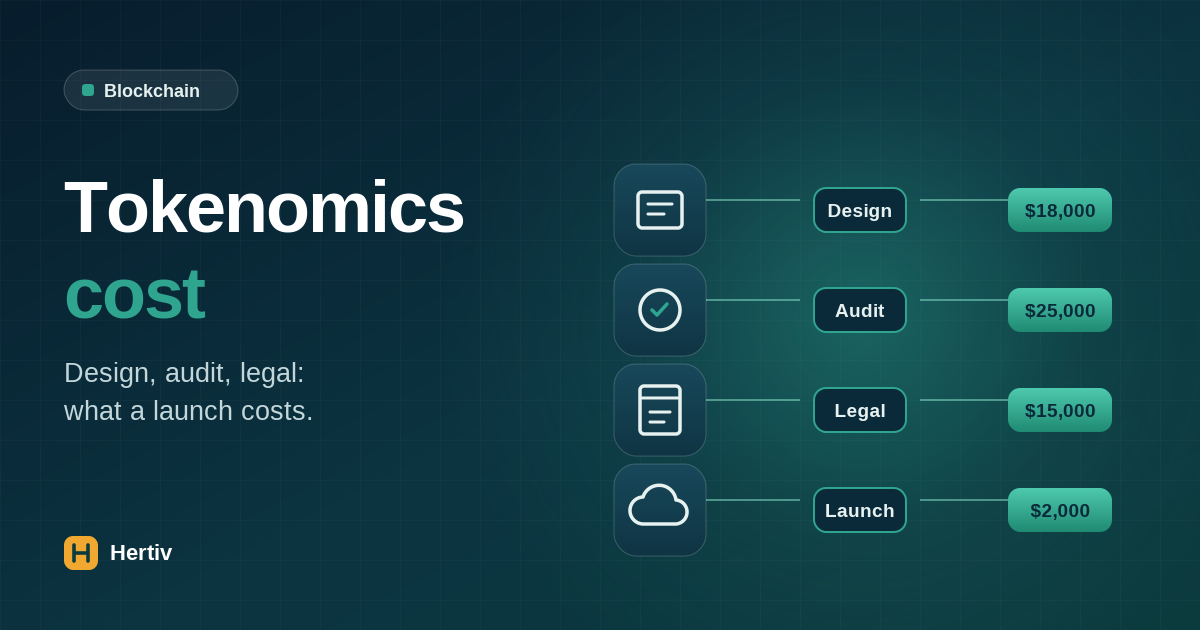
Example (hypothetical): a small team plans a token launch. Design takes 120 hours at $150 an hour, which is $18,000. A security audit is quoted at $25,000, and a legal review at $15,000. Tools and dashboards cost $2,000 for the first year.
The total is $18,000 + $25,000 + $15,000 + $2,000 = $60,000. That covers the launch, but not the running costs. The team also sets aside a reserve of tokens for rewards, so the first year's payouts do not come from selling the team's own holding.
If the team skips the audit to save $25,000, the launch costs $35,000 instead. But a single exploit in an unaudited contract can drain the token's value entirely, which is why most teams treat the audit as a fixed cost, not an optional one.
The lesson is that the cheapest launch is rarely the cheapest token. Spending on design and checks before launch is usually far cheaper than fixing an economy that was built wrong.
What are the common mistakes?
The first mistake is giving away too many tokens early. A team that hands out large rewards to early users can run out of tokens for later growth, and the supply schedule becomes a problem within months.
The second mistake is locking nothing. If the team and early investors can sell everything on day one, holders have no reason to trust that the team will stay. Vesting schedules, where tokens are released over time, are the usual answer.
A third mistake is designing incentives for the wrong behaviour. A token that rewards holding and punishes selling will be held, but a token that rewards only trading will be traded and never used. The incentives should match what the project actually needs.
A fourth mistake is budgeting only for the launch. A token economy needs attention for years, and a team that spends its whole budget before launch has nothing left to run the economy it built.
How do you budget tokenomics in stages?
Budget tokenomics in stages, not as one lump sum. The first stage is design: pay for the thinking, the modelling and the review before any code is written. That stage is the cheapest to fix.
The second stage is checks: the audit and the legal review. These should be booked early, because good audit firms have waiting lists, and a late audit can delay the launch by weeks.
The third stage is launch: the tools, the distribution and the first rewards. This stage should have its own budget, separate from design, so that spending on launch does not eat into the money set aside for running the token.
The fourth stage is running: fees, rewards and maintenance, reviewed every quarter. A team that reviews its token economy four times a year can adjust rewards and supply before small problems become large ones.
Key takeaways
- Tokenomics cost is the sum of design, audit, legal review and running costs.
- A small project usually budgets a planning range of $20,000 to $60,000 for launch.
- The audit and legal review should happen before launch, not after.
- Running costs include network fees, rewards, tools and maintenance.
- Budget in stages and review the token economy every quarter.
Frequently asked questions
What is tokenomics?
Tokenomics is the design of a token's supply, distribution and incentives. It decides how many tokens exist, who gets them, when they are released and what they can be used for.
How much does tokenomics cost?
A small project usually budgets a planning range of $20,000 to $60,000 for design, audit and legal review. The exact cost depends on the token's complexity and the firms chosen.
What is the most expensive part of tokenomics?
The security audit is usually the largest single cost, often quoted between $10,000 and $40,000. The legal review and the design work are usually smaller, but both vary widely. Prices vary by firm, so teams should get several quotes before choosing.
Can tokenomics be changed after launch?
Sometimes, but it is slow and expensive. Supply schedules and distribution are written into token contracts, so changing them may mean redeploying contracts and moving holders to a new token.
What is vesting in tokenomics?
Vesting is a schedule that releases tokens over time instead of all at once. It stops the team and early investors from selling everything on day one and gives holders a reason to trust the project.
Do you need a lawyer for tokenomics?
Yes, in most cases. A lawyer checks whether the token is a security in the markets where it will be sold, what disclosures are needed, and which jurisdictions to avoid. Skipping this step is a common cause of trouble later.


