How Tokenizing Resort Properties Works for Owners
Tokenizing a resort property turns shares of a hotel or villa into digital tokens investors can buy and trade. Here is how it works and what to check first.
On this page
Short answer
Tokenizing a resort property means turning shares of a hotel, villa or resort into digital tokens on a blockchain, so many investors can own small parts of it instead of one buyer taking it whole. Each token records a defined share, and income from the property is shared among holders in proportion to what they own.
What does tokenizing a resort property mean?
Tokenizing a resort property means turning shares of a hotel, villa or resort into digital tokens on a blockchain, so investors can buy, hold and trade small parts of the property instead of buying it whole. Each token represents a defined share of the asset, recorded on a ledger that every holder can check.
The idea is a specific case of real estate tokenization, applied to hospitality. A resort earns income from rooms, food and events, and that income can be shared among token holders in proportion to what they own. Token holders do not run the resort; an operator still manages it, while the tokens record who owns what and who is owed what.
| Feature | Traditional resort ownership | Tokenized resort ownership |
|---|---|---|
| Minimum investment | Usually a whole property or a large share | One token, often a small amount |
| Ownership record | Paper deeds and a registry | Tokens on a shared ledger |
| Transfer | Slow, through lawyers and agents | Token transfer, subject to rules |
| Income | Paid to the owner on a schedule | Shared among holders by token count |
| Stay rights | Owner decides | May be included as a token benefit |
The appeal is access. A resort that would need millions from a single buyer can instead be owned by hundreds of smaller investors, and those investors can sell their tokens without selling the building. How to tokenize real estate covers the general process this builds on.
Which resort assets can be tokenized?
Almost any income-earning resort asset can be tokenized, but the cleanest cases are single properties with clear income: a boutique hotel, a villa complex, a beach resort or a set of holiday apartments. The asset needs a valuation, a legal owner and a record of what it earns, because tokens are only as sound as the property behind them.
Some projects tokenize the property itself, giving holders a share of the building and its income. Others tokenize only the revenue, so holders receive a share of room income without owning the bricks. A third pattern tokenizes stay rights, where tokens can be used to book nights, which suits resorts that want loyal repeat guests more than outside investors.
Timeshare-style arrangements are the closest older model. The difference is that tokens can be split into smaller pieces, traded more easily and tracked on a ledger, while a traditional timeshare week is hard to resell and hard to value. That flexibility is the point, but it also means the legal and tax treatment needs checking in each country before launch.
How does the tokenization process work?
You tokenize a resort property by valuing the asset, setting up a legal structure that holds it, issuing tokens that represent shares, and then managing income and trading under clear rules. Each step needs a professional, and skipping one creates problems that are hard to fix later.
- Value the property and its income. Get an independent valuation and a record of past room income, occupancy and costs.
- Choose the legal structure. A company or trust holds the property, and tokens represent shares or claims against that entity.
- Decide what each token represents. Set the total token supply, the price per token, and what holders receive: income, stay nights, voting rights or a mix.
- Build and audit the smart contract. The contract issues tokens, splits income and enforces transfer rules such as holding periods.
- Offer the tokens under the right rules. Work with lawyers on which investors can buy, what disclosures are needed and where the offer is legal.
- Run the property and pay holders. The operator runs the resort, reports income, and the contract or the manager distributes each holder's share.
The smart contract is only one part of the work. The legal structure, the valuation and the operator agreement matter at least as much, because they decide what a token is actually worth. Real-world asset tokenization use cases shows how other assets have been handled.
What do token holders actually get?
Token holders get whatever the offer documents promise, which is usually a mix of income, a share of any sale proceeds, and sometimes stay nights or voting rights. The exact mix varies widely, so the offer document matters more than the marketing page. Read it before buying anything.
Income is the most common benefit. When the resort earns money from rooms and services, a share is distributed to holders in proportion to their tokens, usually after the operator takes its fee and costs are paid. Some projects pay monthly, others quarterly, and the amount moves with occupancy, so it is not a fixed return.
Stay rights are a second benefit in some projects. Holders may be able to book nights at a discount or use tokens to pay for a stay, which suits people who also want to visit. Voting rights are usually limited to major decisions, such as changing the operator or selling the property, rather than day-to-day management. Resale depends on whether a market exists for the tokens, which is not guaranteed.
Example (hypothetical): a 40-villa resort becomes tokens
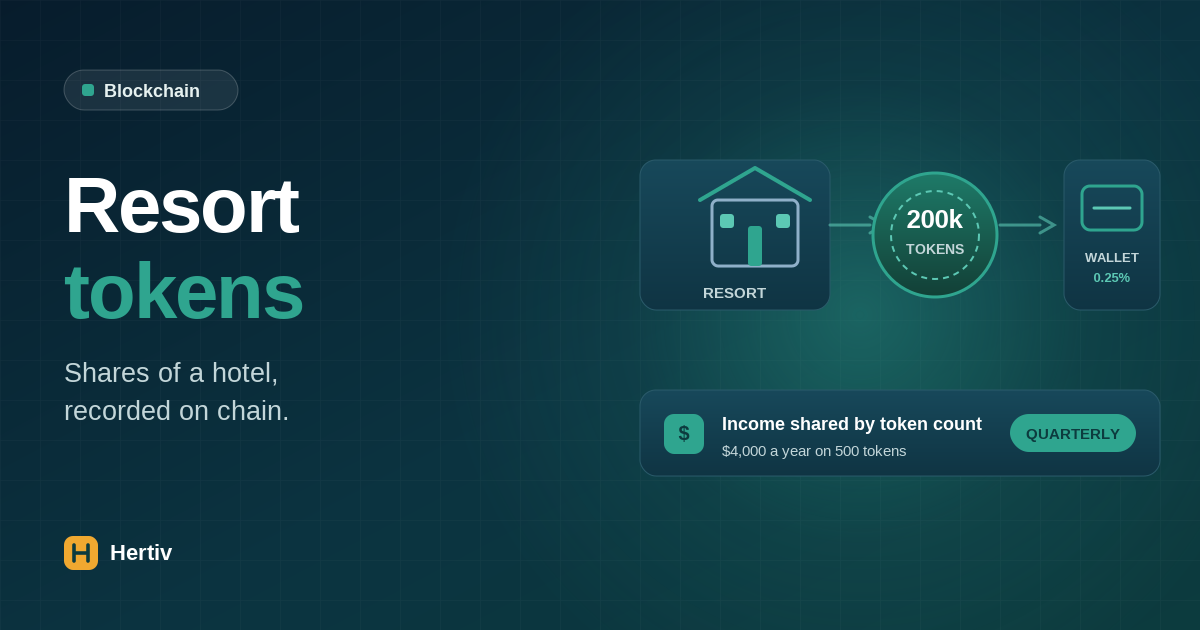
Example (hypothetical): a resort with 40 villas is valued at $20,000,000. The owner decides to tokenize it, issuing 200,000 tokens at $100 each, so 200,000 times $100 equals $20,000,000, the full value of the resort.
An investor buys 500 tokens for $50,000. That is 500 out of 200,000 tokens, which is 0.25% of the resort. In a year the resort earns $1,600,000 in net income after the operator fee and costs. The investor's share is 0.25% of $1,600,000, which is $4,000 for the year, paid in four quarterly payments of $1,000 each.
If the investor later sells 100 of the 500 tokens at $110 each, they receive $11,000 and keep 400 tokens, which is 0.2% of the resort and a smaller share of future income. The arithmetic is simple, but the real question is whether the resort earns what the plan assumes, and whether buyers exist when the investor wants to sell.
What are the risks and legal questions?
The main risks are regulation, low liquidity, valuation disputes and dependence on the operator. A token that looks like a security in one country may be treated differently in another, and an offer that ignores local rules can be stopped after launch. Legal advice before launch is not optional.
Liquidity is the second risk. Tokens are easier to transfer than a whole property, but that only helps if buyers exist. Many tokenized properties trade rarely, so an investor who needs to sell quickly may have to accept a low price or wait. Valuation is related: the token price should track the property value, but thin trading can push it far above or below it.
Operator dependence is the quiet risk. The resort's income depends on the team running it, so a bad operator, a closed season or a damaged reputation cuts income for every holder. Holders should check the operator's record, the fee structure and what happens if the operator is replaced. Blockchain development teams can build the token system, but they cannot fix a weak property or a bad operator.
What are the common mistakes?
The most common mistakes are treating tokens as a quick sale, promising fixed returns, and ignoring the legal work. Each of these is easy to make and expensive to fix once tokens are in other people's hands.
- Promising a fixed return. Resort income moves with occupancy and seasons, so a promised percentage is a claim the project may not be able to keep.
- Skipping the legal structure. Tokens without a clear legal claim on the property or its income are hard to value and hard to defend.
- Ignoring the operator. The token system does not run the resort; a weak operator means weak income whatever the technology.
- Assuming a resale market exists. Tokens can be transferable and still hard to sell if no buyers are watching.
- Overstating occupancy. Past occupancy is evidence; a forecast is not, and buyers should be shown the difference.
- Forgetting costs. Legal work, audits, platform fees and operator fees all come out of the project before holders are paid.
Resort tokenization works best as a slow, well-documented way to widen ownership of a real asset. Carbon credit tokenization follows a similar pattern of putting a real-world claim on chain, with the same need for clear records.
Key takeaways
- Tokenizing a resort turns shares of a hotel or villa into tradable digital tokens
- Holders usually receive income, a share of sale proceeds and sometimes stay nights
- The legal structure and the operator matter at least as much as the token system
- Resort income moves with occupancy, so returns are never fixed
- Tokens can be transferable and still hard to sell without buyers
Frequently asked questions
What does it mean to tokenize a resort?
It means turning shares of a resort property into digital tokens on a blockchain. Each token represents a defined share of the property or its income, and holders can buy, hold and trade those tokens instead of buying the whole resort.
Can token holders stay at the resort?
Sometimes. Some projects include stay nights or booking discounts as a token benefit, while others offer only income and a share of sale proceeds. The offer document states exactly what holders receive, so read it before buying.
How do token holders get paid?
When the resort earns income from rooms and services, a share is distributed to holders in proportion to their tokens, usually monthly or quarterly and after the operator fee and costs are paid. The amount moves with occupancy.
Is tokenizing a resort the same as a timeshare?
No, although they share the idea of splitting use and ownership. Tokens can be split into smaller pieces, traded more easily and tracked on a ledger, while a traditional timeshare week is hard to resell and hard to value.
What are the main risks of resort tokens?
Regulation, low liquidity, valuation disputes and dependence on the operator. An offer may be treated as a security in one country and not another, and tokens can be hard to sell if no buyers are watching.
Do I need a lawyer to tokenize a resort?
Yes. The legal structure, the investor rules and the disclosures all need professional advice in each country where tokens are offered. The token system cannot replace that work, so get advice early, before tokens are offered to anyone.


