How Tokenized Rental Income Reaches Global Investors
Tokenized rental income lets investors abroad buy shares of a rented property and receive part of the rent. Here is how the income flows, and what to check first.
On this page
Short answer
Tokenizing rental income means splitting the rent from a property into digital tokens, so investors in other countries can buy a small share and receive their part of the rent as it is paid. The property stays in one place, while the income stream is divided among many holders through a token and a payment system.
What is tokenized rental income?
Tokenized rental income is the rent from a property that has been split into digital tokens, where each token gives its holder a claim on a share of the rent the property earns. A building that earns rent each month is held by a legal entity, and tokens represent a share of that entity or of the income it receives.
The idea is simple. A single rented flat or building is expensive to buy outright, and buying property in another country adds paperwork, currency exchange and local tax rules. Tokenization breaks the income into small pieces, so an investor can buy a share worth a few hundred dollars instead of a whole property. The rent is then shared out in proportion to the tokens each person holds.
Tokens do not change the property itself. The tenant still pays rent, the building still needs repairs, and empty months still mean less income. What changes is who can take part and how the money moves. For the wider idea, how to tokenize real estate explains the steps a property goes through before tokens are issued.
How does the rent reach an investor?
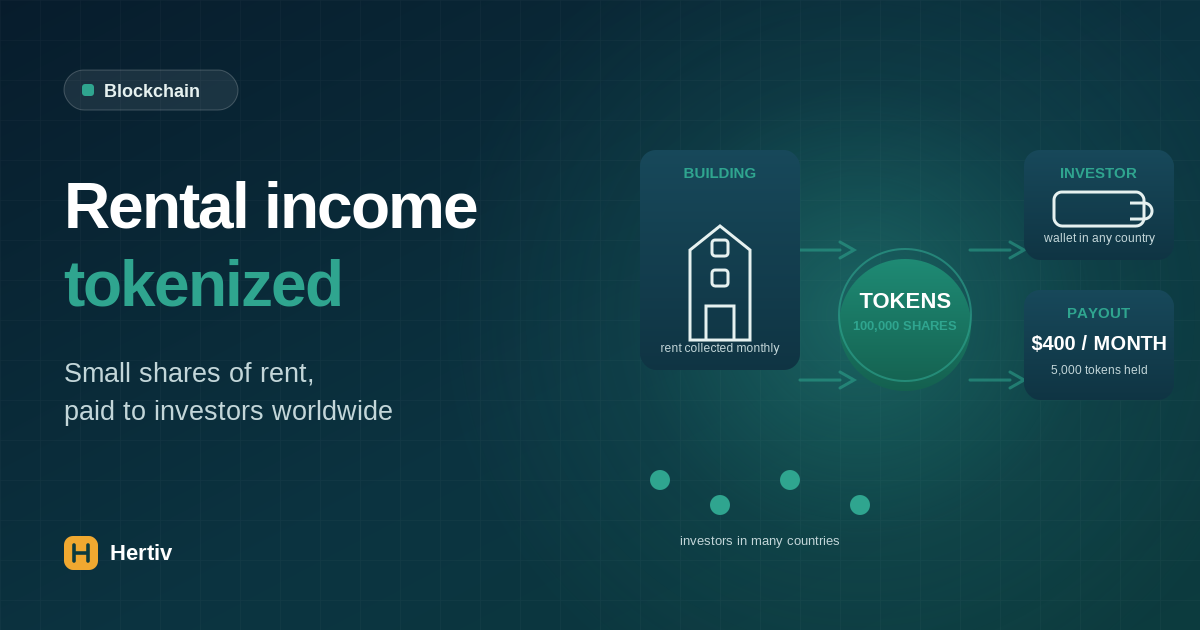
The rent reaches an investor through a short chain: tenant pays, the managing entity collects, the income is split by token holding, and each holder is paid in the currency or token the platform supports.
A typical flow looks like this:
- The tenant pays rent to the property manager or the legal entity that owns the building, in the local currency.
- Costs are taken out first. Management fees, maintenance, insurance and taxes are deducted before any distribution.
- The net rent is split in proportion to the tokens each holder owns, using a record of who holds what at the payout date.
- Each holder is paid to a wallet or bank account, often as a stablecoin or a bank transfer, depending on the platform.
- The payment is recorded so holders can see what was paid, when, and what was deducted.
The part investors care about most is step three. The split is only as fair as the record of holdings, so the platform must keep an accurate list of token holders at each payout date. If tokens change hands mid-month, the rules for who receives that month's rent should be written down before anyone buys.
What changes for a global investor?
For a global investor, tokenization changes three things: the minimum amount needed, the paperwork involved, and how fast income arrives.
| Buying a property abroad | Buying rental income tokens | |
|---|---|---|
| Minimum amount | The full price of a property | One token, often a small sum |
| Paperwork | Local lawyers, title checks, bank accounts | Identity check and platform account |
| Income timing | Rent arrives after local deductions | Rent is split and paid on a set schedule |
| Spread of risk | One building, one tenant, one city | Small shares across several properties |
| Exit | Selling a whole property takes months | Selling tokens depends on buyers existing |
Spreading a small sum across several properties in different cities is the main attraction. A single empty flat then costs an investor a small share of one payout, not the whole income. That said, spreading across properties does not remove the risks of the property market itself, and a downturn can reduce rent across many buildings at once.
The paperwork does not disappear either. Token holders still need to pass identity checks, and the rules on who may invest differ by country. Some offerings are open only to investors who meet a local definition of a professional or accredited investor, which limits who can take part.
What does the property owner get?
The property owner gets access to a wider group of buyers and a way to raise money without selling the whole building.
An owner who wants to raise money for repairs or a new purchase can sell a share of the future rent instead of taking a loan or selling the property. The tokens represent a claim on the income, not on the building itself, although the exact legal shape varies.
In some setups the tokens represent shares in the company that owns the building; in others they represent a contract right to a share of the rent. Either way, the token is a claim on income, and the documents say exactly what that claim covers.
Owners also get a record that is easy to audit. Every token holder, every payout and every deduction is listed in one place, which makes reporting to accountants and tax advisers simpler than a paper trail spread across banks and agents. That record is one reason real world asset tokenization use cases often start with rental property, where the income is regular and easy to measure.
There is a cost to this. Setting up the legal structure, the token and the payment system takes time and money, and the owner must keep reporting to token holders for as long as the tokens exist. For a single small flat, those fixed costs can eat most of the benefit, which is why most rental income tokens cover larger buildings or groups of properties.
Example: a building with 40 token holders
Example (hypothetical): a company owns a small apartment building that earns 10,000 dollars a month in rent. It decides to tokenize the rental income, issuing 100,000 tokens at 10 dollars each, so the total token value is 1,000,000 dollars.
Each month, the manager collects 10,000 dollars. Costs of 2,000 dollars for management, maintenance and insurance leave 8,000 dollars to distribute. Each token therefore earns 8 cents that month, because 8,000 divided by 100,000 is 0.08 dollars.
An investor who holds 5,000 tokens receives 400 dollars that month, since 5,000 times 0.08 is 400. Over a year at the same rent and costs, that investor receives 4,800 dollars on a 50,000 dollar holding. The arithmetic adds up: 5,000 tokens cost 50,000 dollars at 10 dollars each, and 400 dollars a month is 4,800 a year.
If one flat stands empty for a month and rent falls to 8,000 dollars, the net after 2,000 dollars of costs is 6,000 dollars, so each token earns 6 cents and the same investor receives 300 dollars. The example shows why vacancy matters more than the token design: the income follows the rent, not the technology.
What are the risks and limits?
The main risks are vacancy, weak demand for the tokens, legal uncertainty and the platform itself failing.
- Vacancy and arrears. If tenants leave or stop paying, the rent falls and so does every payout. Tokens cannot create income that the property does not earn.
- Thin resale markets. Selling tokens later depends on other buyers wanting them. Many tokenized properties trade rarely, so an investor may have to wait or accept a lower price.
- Legal shape. The rights a token gives depend on the offer documents and local law. A token that looks like ownership in one country may be treated as a security in another, with different rules.
- Platform risk. If the platform that runs the payouts stops operating, holders may need to rely on the legal entity and its records rather than the software.
- Currency and tax. Rent paid in one currency and received in another can lose value in conversion, and tax rules apply in both the property's country and the investor's country.
The honest limit is that tokenization does not make a bad property good. A building in a weak rental market earns weak rent whether or not it is tokenized. Investors should judge the property first — the rent, the tenants, the costs and the location — and treat the token as a way to access it, not as a source of return on its own.
What are the common mistakes?
The most common mistakes are buying for the token rather than the property, ignoring the documents, and assuming the tokens will be easy to sell.
- Skipping the offer documents. The documents set out the rights, the fees, the payout schedule and what happens on a sale. A token is only as good as those terms.
- Ignoring the fee stack. Platform fees, custody fees and management fees all come out of the rent before holders are paid. A high fee stack can leave little income to distribute.
- Assuming easy resale. Many buyers plan to sell tokens quickly, then find few buyers. Treat tokenized rental income as a long-term holding unless a real trading record exists.
- Forgetting tax. Rental income is usually taxable where the investor lives, and sometimes where the property sits too. Get tax advice before buying, not after the first payout.
- Trusting the headline yield. A yield quoted from a full building at full occupancy is not what holders receive after costs and vacancies. Ask for the net figure after all deductions.
Key takeaways
- Tokenized rental income splits a property's rent into small shares that global investors can buy
- Rent is collected, costs are deducted, and the net amount is shared in proportion to tokens held
- Small holdings let an investor spread money across several properties instead of one building
- The legal documents, not the token, decide what rights a holder actually has
- Vacancy, fees and thin resale markets are the main risks, not the technology itself
- Judge the property's rent and costs first, and treat the token as access, not a return
Frequently asked questions
What is tokenized rental income?
It is the rent from a property split into digital tokens, where each token gives its holder a claim on a share of that rent. A legal entity holds the property, collects the rent, deducts costs and pays the rest to token holders in proportion to what they hold.
How much money do I need to start?
That depends on the offering, but many tokenized rental properties sell tokens for small sums, sometimes a few hundred dollars. The minimum is set by the platform and by local rules on who may invest, so check the offer documents before planning an amount.
How often is rental income paid to token holders?
Most platforms pay monthly or quarterly, after the rent for that period has been collected and costs deducted. The schedule should be written in the offer documents, along with the rules for who receives a payout when tokens change hands mid-period.
Do I own part of the property?
Usually not directly. In most setups the tokens represent shares in the company that owns the building, or a contract right to a share of the rent. The exact rights depend on the legal structure, so read the documents rather than assuming ownership.
Can I sell my tokens later?
It depends on whether other buyers exist. Some platforms run a marketplace for the tokens, while others do not. Trading in tokenized property is often thin, so plan to hold for the long term unless the platform can show a real record of trades.
Is tokenized rental income taxed?
Yes, in most cases. Rental income is usually taxed where the investor lives, and may also be taxed where the property sits. The platform may report payouts, but it does not settle your tax bill, so get advice from a tax adviser who knows both countries.


