How Tokenized Commodities Improve Supply Chain Efficiency
Tokenized commodities can cut settlement times, paperwork and disputes in a supply chain by putting ownership, quality checks and payment on one shared record.
On this page
Short answer
Tokenized commodities improve supply chain efficiency by replacing paper documents with a shared digital record of ownership, quality and payment. Goods move faster because buyers, sellers, warehouses and banks all see the same facts, so checks are done once, payment is released on delivery confirmation, and disputes can be settled from one record instead of many.
How do tokenized commodities improve supply chain efficiency?
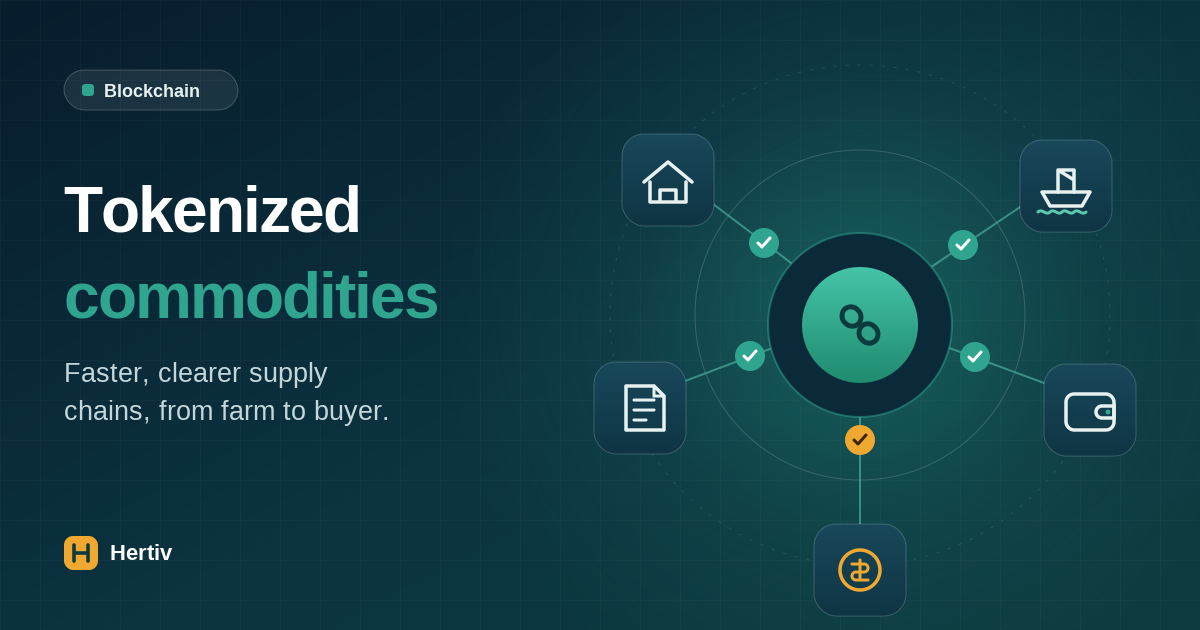
A tokenized commodity is a physical good, such as coffee, grain, oil or gold, that is represented by a digital token on a blockchain. Each token stands for a fixed amount of the good, and the token carries a record of where the good came from, who owns it and what checks it has passed.
When that record is shared by everyone in the chain, buyers, sellers, warehouses and banks can all see the same facts. Fewer steps need to be repeated or checked by hand, so goods move faster and disputes are easier to settle.
| Step | Traditional way | With tokenization |
|---|---|---|
| Prove ownership | Paper bills of lading, posted or couriered | Token held in a wallet, transferable in minutes |
| Track the goods | Phone calls, emails and spreadsheets | Shared record updated at each handover |
| Get paid | Bank transfer days after delivery | Payment released when delivery is confirmed |
| Settle disputes | Paper trail assembled after the fact | One record seen by every side |
Where does time go in a traditional commodity supply chain?
Most delays in a commodity supply chain do not come from moving the goods. They come from the paperwork and the waiting between steps. A single shipment can need a bill of lading, a certificate of origin, quality inspection reports, customs forms and insurance papers, and each document is checked by a different party.
Payment is another slow point. A seller often waits days or weeks after delivery before the money arrives, because banks check documents, convert currencies and clear funds in sequence. While the money is in transit, the seller cannot use it to buy the next shipment, so working capital sits idle.
Disputes add more delay. When a buyer says the goods arrived damaged or short, the two sides must gather their own copies of the same documents and compare them. Weeks can pass before anyone agrees on what happened, and the goods may sit in storage while the argument runs.
How does tokenization improve tracking and provenance?
Tokenization links each batch of goods to a token at the point of origin, and every handover is written to the same shared record. A buyer can check the origin, the quality certificate and the chain of custody before paying, instead of asking the seller for documents and waiting for copies to arrive. How tokenized commodities work explains the mechanics in more detail.
This matters most for goods where origin decides the price, such as single-origin coffee, certified timber or conflict-free minerals. A token that carries the certificate with it is harder to fake than a paper copy, and a buyer who finds a problem can trace it back to the exact batch in minutes rather than days.
Warehouses also benefit. When a warehouse receipt is a token, the warehouse can confirm what it holds without issuing new paper for each buyer, and a lender can check the stock behind a loan in minutes. That makes it easier to borrow against goods that are already in storage.
How does tokenization change payment and settlement?
When ownership is a token, payment can be tied to a clear event, such as delivery confirmation at a port. The buyer locks the payment in escrow when the shipment leaves, and the funds are released when the delivery is confirmed on the shared record. Neither side has to chase the other, and the seller is paid in hours instead of weeks.
Tokens can also be split, so a large shipment can be owned by several buyers at once. Each buyer holds tokens for their share and can sell those tokens on if their plans change, which gives the seller more buyers to choose from and gives buyers a way out before the goods arrive.
Faster payment also lowers the cost of finance. A seller who is paid in a day instead of a month needs less borrowing to cover the gap, and a buyer who can see the goods on the shared record has less reason to hold back payment until every document has been checked by hand. Real-world tokenization use cases show how this works for other asset types too.
What does it take to tokenize a commodity shipment?
Tokenizing a shipment is a process, not a single step. Each stage has to be done in order, because a token is only as good as the checks behind it. Real-world asset tokenization covers the same pattern for other asset types.
- Agree what one token stands for, such as one kilogram of coffee or one gram of gold, and write it into the token's terms.
- Have the goods inspected and certified by an approved inspector, and store them in a certified warehouse.
- Issue the tokens to the seller, with the inspection certificate and storage receipt attached to the record.
- Record each handover on the shared record as the goods move from warehouse to port to buyer.
- Set the payment terms in advance, including the delivery event that releases the funds.
- Plan how tokens are redeemed, so a holder can claim the goods or sell the tokens on.
Example (hypothetical): a coffee shipment from farm to roaster
A coffee cooperative ships 20 tonnes of green coffee to a roaster. The coffee sells for $4 per kilogram, so the shipment is worth $80,000. The cooperative issues 80,000 tokens at $1 each, and four buyers take 20,000 tokens each, worth $20,000 per buyer.
Under the old process, the roaster paid 10 days after delivery, and the cooperative paid $1,200 in bank and document fees. With tokens, payment is released the day delivery is confirmed, so the cooperative is paid 9 days sooner and the fees fall to $300, saving $900 on one shipment. Over 10 shipments a year, that is $9,000 saved and 90 days of waiting removed.
Common mistakes
Tokenization removes some delays, but it does not remove the need for checks. These are the mistakes that cause the most trouble.
- Tokenizing goods before they are inspected, so the token stands for goods that may not match the certificate.
- Treating the token as the goods themselves, and forgetting that someone still has to store, insure and move the physical stock.
- Skipping the legal terms, so it is unclear who can redeem a token or what happens if the warehouse fails.
- Choosing a system with no plan for redemption, which leaves token holders with no way to claim their goods.
Key takeaways
- A tokenized commodity is a physical good represented by a token that carries its origin, ownership and quality record.
- A shared record means each check is done once, instead of being repeated by every party in the chain.
- Payment can be released on delivery confirmation, cutting settlement from days or weeks to hours.
- Splitting a shipment into tokens lets several buyers share one load and trade their share.
- Tokens only work if the goods are inspected, certified and stored properly first.
Frequently asked questions
What is a tokenized commodity?
A tokenized commodity is a physical good, such as coffee, gold or oil, that is represented by digital tokens on a blockchain. Each token stands for a fixed amount of the good, and the token's record shows its origin, who owns it and which checks it has passed.
Do tokenized commodities replace paper documents?
They can replace many of them, because the shared record holds the ownership, inspection and delivery facts that paper documents used to carry. Some paper is still needed, such as customs forms and insurance papers, which depend on the rules of each country and port.
How does tokenization help small producers?
Small producers can sell shares of one shipment to several buyers instead of waiting for a single large buyer. They are also paid sooner when payment is released on delivery confirmation, which eases the wait between shipping goods and receiving money.
What happens if the goods are damaged in transit?
The token still stands for the goods, so the claim is handled the same way as with paper documents, through insurance and the sales contract. The shared record helps here, because everyone can see the inspection report from before the goods left and the delivery report from arrival.
Can a token holder claim the physical goods?
That depends on the terms written when the tokens were issued. Some tokens can be redeemed for the goods, while others can only be sold on to another buyer. Always read the redemption terms before buying tokens for a physical good.
Is tokenizing a commodity expensive?
Costs vary by inspection, storage, legal terms and platform, so check the vendor's site for current fees. The saving usually comes from faster payment, fewer documents and less time spent on disputes.


