How Tokenized Commodities Work on a Blockchain
Tokenized commodities put a legal claim to physical goods like gold or oil on a blockchain. Learn the full lifecycle, from custody and proofs to redemption.
On this page
Short answer
Tokenized commodities are digital tokens that represent a legal claim on a physical commodity held in custody. A custodian stores the goods, an auditor verifies the holdings, and the token moves on-chain with redemption rights tied to the underlying asset.
What is a tokenized commodity?
A tokenized commodity is a digital token on a blockchain that represents a legal claim on a specific quantity of a physical commodity, such as gold, silver, oil, copper, or agricultural goods, held by a custodian. The token is not the commodity itself; it is a transferable record of ownership or a right to redemption.
That distinction matters. A token can move in seconds, but the physical asset still sits in a vault, tank, or warehouse. The quality of the arrangement depends on who holds the asset, how ownership is recorded legally, and what happens when a holder wants the physical good delivered. A token with weak custody or unclear redemption terms is a database entry, not an asset.
Tokenized commodities usually fall into three groups:
- Allocated custody: The token maps to specific bars, lots, or batches that are identified and held separately.
- Pooled custody: The token represents a share of a larger pool of the commodity, with redemption in standard units.
- Receivables and warehouse receipts: The token represents a claim on goods in a warehouse or in transit, often used in trade finance.
Each model changes the legal work, the audit approach, and the transfer restrictions. For teams exploring this space, our enterprise blockchain practice covers the design trade-offs.
How does the tokenization lifecycle work, step by step?
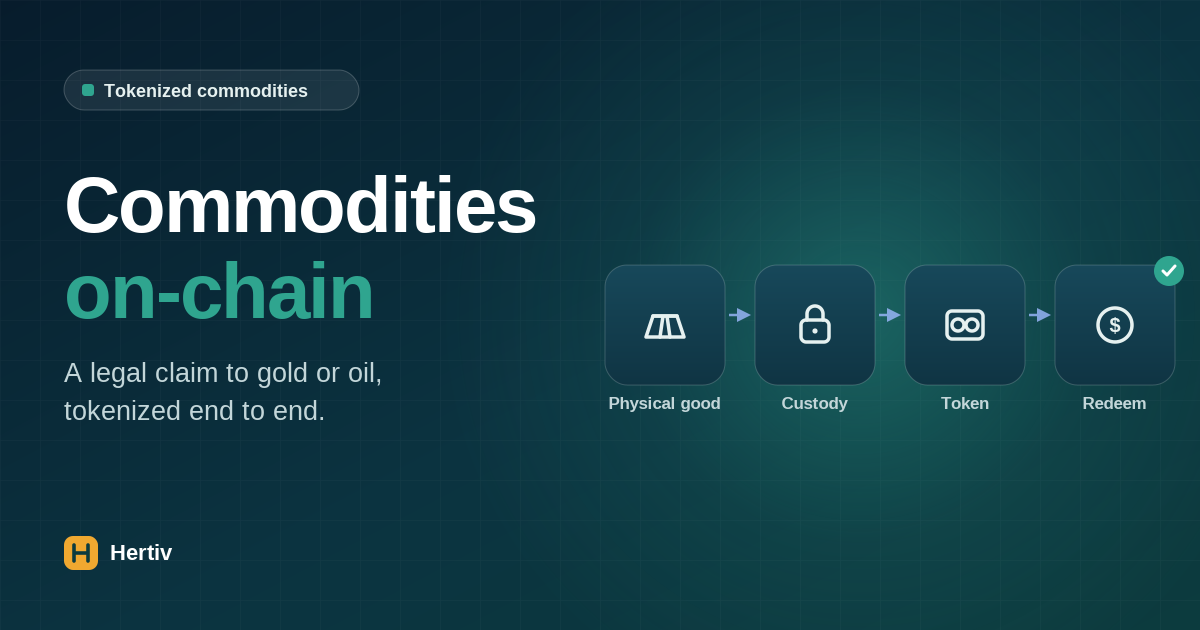
Tokenizing a commodity follows a repeatable sequence: verify the asset, lock it in custody, issue tokens against it, and define how tokens are redeemed or burned. The blockchain is the record layer; most of the work happens off-chain.
- Asset verification. An independent inspector confirms quantity, quality, and location. For gold, this may include assay and serial numbers; for oil or grain, volume and grade.
- Custody agreement. A regulated custodian takes possession under a legal agreement that names the token holder's beneficial interest. Insurance and lien terms are set here.
- Legal wrapper. Counsel drafts the terms that connect the token to the underlying claim, including governing law and transfer restrictions.
- Token issuance. A smart contract mints tokens against the verified asset. Supply is capped to the verified quantity and checked by an oracle or a signed attestation.
- Proof of reserves. A recurring audit or attestation confirms the custody balance matches the on-chain supply. Discrepancies trigger a freeze or burn process.
- Transfer and settlement. Holders move tokens under the rules encoded in the contract, such as allowlists or investor checks.
- Redemption or burn. A holder returns tokens and receives the physical commodity or cash equivalent, and the contract burns the tokens.
Example: suppose a custodian holds 100 kilograms of verified silver and issues 100,000 tokens at 1 gram each. If an audit finds 99 kilograms in custody, the contract should freeze 1,000 tokens until the discrepancy is resolved. The arithmetic must reconcile at every step.
What does the technology stack look like?
The stack has four layers: the chain, the token contract, the data feeds, and the custody integration. Most enterprise deployments combine a permissioned chain for control with public-chain settlement where liquidity matters.
- Chain choice. Ethereum and EVM-compatible networks are common for public settlement. Permissioned networks such as Hyperledger Fabric or a private EVM chain suit closed consortia where counterparties are known.
- Token standard. ERC-20 is used for fungible commodity tokens; ERC-721 or ERC-1155 for lot-specific or batch-specific assets. Enterprise standards add transfer restrictions and role-based controls.
- Oracle and attestation layer. Price feeds and reserve attestations are pushed on-chain by a trusted signer or a multisig. This is the weakest link in most designs, so treat the oracle as a security boundary.
- Custody and ERP integration. Warehouse management, inspection reports, and accounting systems feed the token contract. Without this integration, reconciliation becomes manual and slow.
Our blockchain development services cover contract design, integration, and audit preparation for these builds.
What are the main risks and how are they controlled?
The main risks are custody failure, reserve mismatch, legal ambiguity, and oracle manipulation. Each has a control, and the controls are mostly operational rather than cryptographic.
- Custody risk. The custodian may fail, commingle assets, or lose insurance coverage. Control: regulated custodians, segregated accounts, and regular third-party inspections.
- Reserve mismatch. Tokens may exceed the verified asset. Control: frequent attestations, on-chain supply checks, and an automatic freeze when the ratio diverges.
- Legal risk. The token may not give enforceable ownership under the relevant jurisdiction. Control: a legal opinion and clear redemption terms in the token documentation.
- Oracle and key risk. A compromised signer can mint or release assets incorrectly. Control: multisig approvals, hardware key management, and rate limits on minting.
- Liquidity risk. A token may trade thinly or not at all. Control: realistic expectations and a redemption path that does not depend on a secondary market.
Where do tokenized commodities make sense?
Tokenized commodities make sense where settlement speed, fractional ownership, or transferability across parties creates real value. They make less sense where the physical logistics dominate and the counterparties already trust each other.
Common patterns include:
- Precious metals. Gold and silver tokens allow smaller denominations and faster transfer between accounts. The custody and audit model is well understood, which makes this the most mature category.
- Trade finance. Warehouse receipts and bills of lading can be tokenized to reduce paperwork and finance delays, though legal recognition varies by jurisdiction.
- Energy and carbon-linked assets. Tokens can represent renewable energy certificates or carbon credits, where the registry integration is the hard part. See our work on AI and blockchain for energy and utilities.
- Agricultural and industrial inputs. Batch-level tokens can track quality and provenance, but the value depends on inspection discipline.
In finance, tokenized commodities often sit alongside other tokenized assets in a broader program; our finance and banking practice covers the compliance side.
How do you choose an approach?
Choose an approach by starting from the legal claim and the redemption path, then work back to the technology. Teams that start with the chain usually rebuild later.
- Define the claim. Decide whether the token confers ownership, a beneficial interest, or a contractual right. This determines the legal work and the transfer restrictions.
- Pick the custody model. Allocated custody is simpler to audit; pooled custody is more liquid. Match the model to how holders will actually use the token.
- Choose the chain for the counterparties. Use a permissioned network for closed consortia and a public EVM chain where external liquidity is the goal.
- Design the reserve process first. Define who attests, how often, and what triggers a freeze. Build the contract around that process.
- Plan redemption before launch. A token without a tested redemption path is an unfinished product.
If you are weighing build versus buy, a short blockchain consulting engagement can pressure-test the legal and custody assumptions before any code is written.
Common mistakes
Most failures in tokenized commodities come from treating the token as the product rather than the legal and operational arrangement behind it. These mistakes repeat across projects.
- Skipping the legal opinion. Assuming a token is enforceable because it is on-chain.
- Manual reconciliation. Letting the reserve check depend on a spreadsheet updated by hand.
- Single-signer minting. Allowing one key to issue tokens without multisig or rate limits.
- Ignoring redemption. Launching a token with no tested process for physical delivery.
- Overstating audit coverage. Presenting an attestation as a full audit when the scope is narrower.
- Assuming liquidity. Expecting a secondary market that does not yet exist.
For teams building in this space, the AI and Web3 glossary clarifies the terms used across custody, attestation, and settlement.
Key takeaways
- A token is only as good as the legal claim and custody arrangement behind it.
- Proof of reserves and independent audits are what separate a real token from a paper one.
- Governing law, redemption rights, and insurer terms matter more than the token standard.
- Tokenized commodities can improve settlement speed and transferability but add custody and oracle risk.
- Most enterprise use cases start with a permissioned chain and a small set of trusted counterparties.
Frequently asked questions
Is a tokenized commodity the same as a commodity derivative?
No. A derivative is a contract whose value derives from a commodity price. A tokenized commodity represents a claim on the physical asset itself, held in custody. Some tokens combine both features, which is why the legal documentation matters.
Do you need a regulated custodian to tokenize a commodity?
In most jurisdictions, yes, if the token is offered to the public or to retail investors. A regulated custodian provides segregation, insurance, and audit access. Closed consortium models sometimes use a contractually appointed custodian instead.
How is proof of reserves verified?
An independent auditor or attestor confirms the physical quantity in custody and signs a statement that is published on-chain or linked to the token contract. The frequency and scope vary; the key question is who signs it and what happens when it disagrees with supply.
Can tokenized commodities be redeemed for physical delivery?
They can if the token terms include a redemption right and the custodian supports physical delivery. Many tokens offer cash settlement instead. Check the redemption terms before buying, because they determine the real value of the token.
Which blockchain is best for tokenized commodities?
There is no single best chain. Public EVM chains suit external transfer and liquidity; permissioned networks suit closed consortia with known counterparties. The choice should follow the legal model and the participants, not the other way around.
What is the biggest risk in tokenized commodities?
Custody and reserve mismatch are the biggest risks. If the physical asset is not where the token says it is, or the legal claim is unenforceable, the token loses its value regardless of how well the smart contract is written.


