Tokenized Assets and the Secondary Market: How Trading Works
A secondary market lets investors buy and sell tokenized assets after the first sale. Here is how trades settle, who can trade, and what makes a token easy to exit.
On this page
Short answer
A secondary market for tokenized assets is where investors trade tokens that represent real-world assets after the first sale, with the token changing hands on the blockchain while the asset stays in its legal wrapper. It gives holders an exit and sets a market price, but trading is limited by eligibility rules, lock-ups and how many buyers actually want the token.
What is a secondary market for tokenized assets?
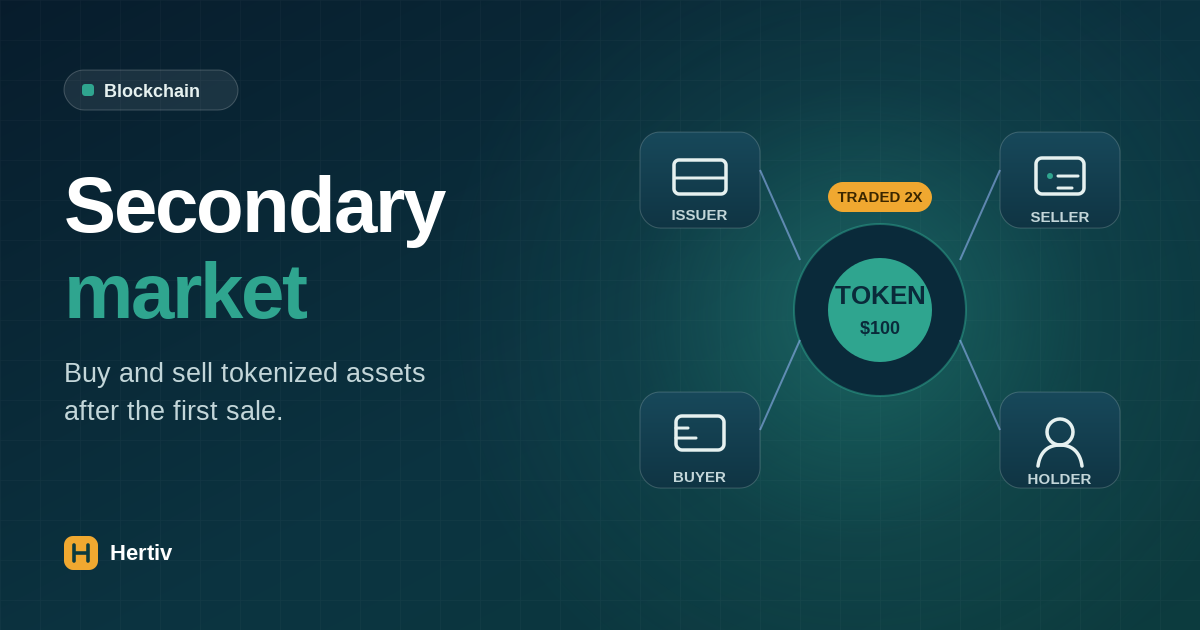
A secondary market for tokenized assets is a place where investors buy and sell tokens that represent real-world assets after the first sale, instead of buying them from the issuer. The first sale is the primary market: the issuer sells the token to the first buyer. Every trade after that happens on the secondary market.
The asset itself does not move. A tokenized bond, fund share or property share stays in its legal wrapper, and only the token changes hands. The buyer gets the rights the token carries, such as interest payments or a share of rent, and the seller gets the sale price.
Secondary trading is what turns a token from a one-off investment into something you can exit. Without it, a token holder who needs cash must find a buyer privately or wait for the asset to pay out. The difference between the two markets is simple:
| Feature | Primary market | Secondary market |
|---|---|---|
| Who sells | The issuer | An existing token holder |
| Price | Set by the issuer | Set by buyers and sellers |
| Money goes to | The issuer or the asset | The selling holder |
| When it happens | At issuance | Any time after issuance |
| Main purpose | Raise capital | Provide an exit and price discovery |
Not every tokenized asset has a secondary market. Some tokens can only be transferred with the issuer's approval, and some cannot be transferred at all. How tokenization works explains the issuance steps that decide what a token can and cannot do.
How does a token change hands after the first sale?
A token changes hands when the seller lists it, a buyer agrees a price, and the transfer is recorded on the blockchain. The smart contract or the platform checks that both sides are allowed to trade, then moves the token and the payment.
- List the token. The seller offers a number of tokens at a price on a trading venue or through a broker, or agrees a price privately with a buyer.
- Check eligibility. The venue or contract checks that the buyer is allowed to hold the token, for example by confirming identity and accreditation status.
- Settle the trade. The buyer pays, usually in a stablecoin or fiat through the venue, and the token moves to the buyer's wallet at the same time.
- Update the records. The transfer is recorded on chain, and the issuer's register is updated so the new holder receives future payments.
- Handle fees and tax records. The venue takes its fee, and both sides get a record of the trade for their books.
Settlement can be fast because the token and the payment move together, but the legal transfer still depends on the wrapper. If the issuer's register does not recognise the new holder, the on-chain transfer alone may not be enough.
Who can buy and sell on a secondary market?
Who can trade depends on the token's rules, which are set at issuance and written into the smart contract and the legal documents. Most tokenized assets are securities, so the rules usually limit trading to investors the regulator allows.
Some venues are open to any verified investor, while others are limited to professional or accredited investors. A token that was sold only to professionals usually cannot be sold to a retail buyer on the secondary market, even if the venue would accept the trade.
Issuers also set lock-up periods. A token may be locked for months after issuance, during which it cannot be sold at all. After the lock-up ends, trading opens under the same eligibility rules.
Before you list or buy, check three things: whether you are eligible to hold the token, whether the venue is licensed where you live, and whether the token has a lock-up or transfer restriction. A real-world asset tokenization platform usually publishes these rules for each token it lists.
What makes a tokenized asset easy or hard to trade?
A tokenized asset is easy to trade when many buyers want it, the rules are clear, and the venue is trusted. It is hard to trade when the asset is unusual, the buyer pool is small, or the rules make each trade slow.
- Size of the buyer pool. A token tied to a well-known fund or bond attracts more buyers than a token tied to a single small property.
- Standard terms. Tokens with standard legal terms and clear payment schedules are easier to price, so buyers need less time to decide.
- Venue quality. A regulated venue with custody, clearing and a visible order book gives buyers confidence that a trade will settle.
- Transfer restrictions. Each eligibility check adds friction. Tokens that anyone verified can buy trade more easily than tokens limited to a short list of investors.
- Price information. If recent trades are visible, buyers can judge a fair price. If no trade has happened in months, pricing is guesswork.
- Minimum ticket size. Small minimums open the market to more buyers, while large minimums keep the pool narrow.
Liquidity is the result of all of these together. A token can be technically transferable and still trade rarely if the buyer pool is small or the price is unclear.
Example (hypothetical): a tokenized bond changes hands twice
Example (hypothetical): a company issues a tokenized bond worth $10,000,000, split into 100,000 tokens at $100 each, paying 6% a year. An investor buys 2,000 tokens for $200,000 at issuance.
Six months later the investor needs cash and sells 1,000 tokens on a secondary venue at $101 each, receiving 1,000 x $101 = $101,000. The buyer takes over the interest on those tokens from the next payment date, so the seller keeps the interest already paid and the buyer gets the rest.
A year later the buyer sells the same 1,000 tokens at $99 each, receiving 1,000 x $99 = $99,000. The buyer lost $2,000 on the price but received a year of interest: 1,000 tokens are 1% of the bond, and 1% of 6% of $10,000,000 is $6,000, so the buyer still came out ahead after fees.
Interest of 6% on $10,000,000 is $600,000 a year. A holder of 1,000 tokens owns 1% of the bond and receives $6,000 a year. The bond itself never changed; only the tokens moved, twice, between three different holders.
What are the risks of secondary trading?
The risks of secondary trading are mostly about price, access and the legal wrapper. A token that trades rarely can lose value fast when a holder needs to sell, and a trade that looks settled on chain may not be recognised off chain.
- Thin trading. Few buyers means wide gaps between buy and sell prices, so a seller may accept a large discount to exit quickly.
- Price swings. A single large sale can move the price of a rarely traded token far more than the same sale would move a listed share.
- Venue risk. A venue can fail, freeze withdrawals or lose its licence. Tokens held in the venue's custody are exposed to that risk.
- Legal mismatch. If the issuer's register does not record the transfer, the buyer may not receive interest or voting rights even though the token is in their wallet.
- Regulatory change. Rules for tokenized securities are still changing in many countries, and a venue or token that is legal today may face new limits later.
- Fraud and mispricing. Without visible trade history, a seller can overstate demand or a buyer can underpay. Check recent trades before agreeing a price.
These risks do not make secondary markets useless, but they do mean you should treat a token's trading history as evidence, not marketing. RWA tokenization use cases shows which asset types have the most active secondary trading.
What are the common mistakes?
The most common mistakes in secondary trading are assuming a token is liquid, skipping the transfer rules, and trading on a venue without checking who holds the tokens. All three come from treating a token like a listed share.
- Assuming you can sell quickly. A token that traded once last quarter is not liquid. Check the trade history and the number of active buyers before you buy.
- Ignoring transfer restrictions. A trade can be blocked or reversed if the buyer is not eligible. Confirm eligibility before you agree a price.
- Trusting the last price. The last trade may be months old or unusually small. A single old price is not a market price.
- Leaving tokens on a venue. Tokens held in a venue's wallet are exposed if the venue fails. Move them to your own wallet after the trade settles.
- Forgetting the fees. Venue fees, custody fees and settlement fees add up, and they can turn a small gain into a loss on a short holding period.
Key takeaways
- The primary market is the first sale by the issuer; the secondary market is every trade after that
- A trade moves the token and the payment together, but the issuer's register must also recognise the new holder
- Most tokenized assets are securities, so eligibility rules and lock-ups decide who can trade
- Liquidity depends on buyer pool, standard terms, venue quality and visible price history
- Thin trading means wide price gaps, so check recent trades before you buy or sell
Frequently asked questions
What is the difference between the primary and secondary market?
In the primary market the issuer sells the token for the first time and the money goes to the issuer or the asset. In the secondary market an existing holder sells to another investor, and the money goes to the seller. The asset itself does not move in either case; only the token changes hands.
Can any tokenized asset be traded on a secondary market?
No. Some tokens cannot be transferred at all, some need the issuer's approval for each transfer, and some are locked for months after issuance. The legal documents and the smart contract decide what is allowed, so read them before assuming you can sell.
Who sets the price on a secondary market?
Buyers and sellers set the price through offers and bids, unlike the primary market where the issuer sets it. When trading is thin, a single sale can move the price a lot, so the last trade price is only a rough guide to what your tokens are worth.
Do I need to be an accredited investor to trade?
It depends on the token. Many tokenized assets are limited to professional or accredited investors, and that limit usually applies to secondary trades too. Check the token's rules and the venue's requirements before you try to buy or list.
What happens to interest or rent when a token is sold?
Future payments go to the new holder from the next payment date, while payments already made stay with the seller. The issuer's register must be updated so the new holder is recorded, otherwise the payment may still go to the old holder.
Is a secondary market the same as a crypto exchange?
Not exactly. A crypto exchange trades native cryptocurrencies that are usually not securities. A secondary market for tokenized assets trades tokens that represent regulated assets, so it usually needs a licence, identity checks and eligibility rules that a crypto exchange does not.


