Tokenization in Manufacturing: What It Changes
Tokenization in manufacturing gives parts, machines and batches a shared digital record. Here is where tokens fit and how to run a pilot.
On this page
Short answer
Tokenization in manufacturing is the use of digital tokens on a blockchain to represent physical things in a factory, such as parts, machines, batches or carbon credits, so each item has a shared, checkable record that follows it from supplier to customer. The token carries the facts that matter, such as origin, production date and quality checks, and all parties work from the same record.
What is tokenization in manufacturing?
Tokenization in manufacturing is the use of digital tokens on a blockchain to represent physical things in a factory, such as parts, machines, batches or carbon credits, so each item has a shared, checkable record that follows it from supplier to customer.
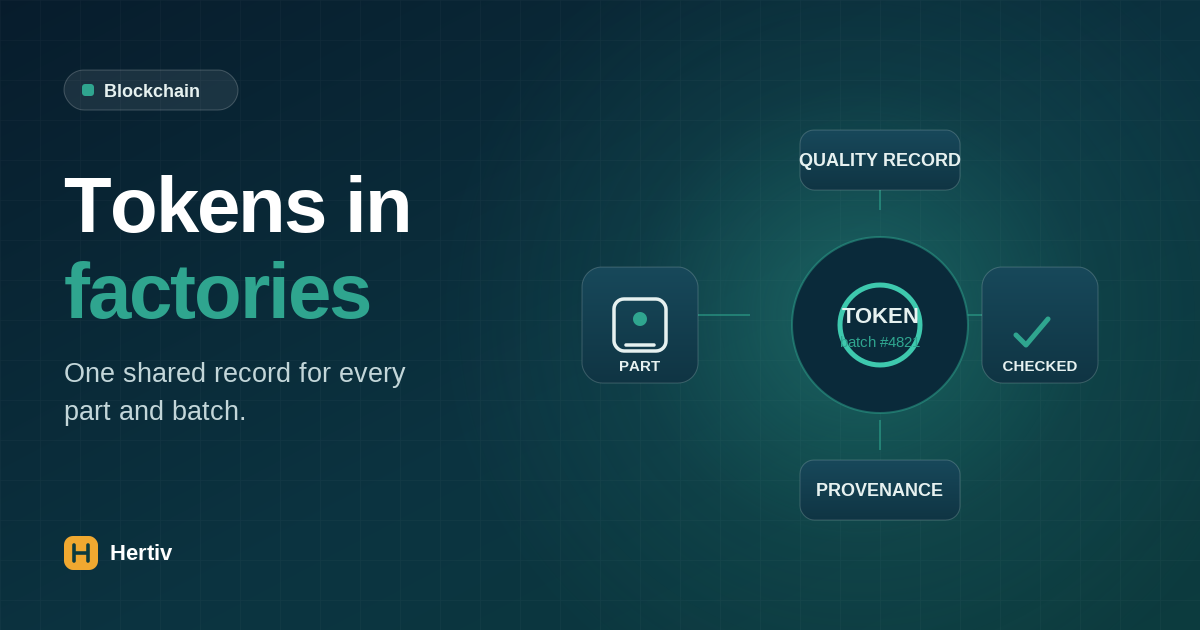
A token stands for one thing: one batch of parts, one machine, or one unit of a credit. The token carries the facts that matter about that thing, such as where it came from, when it was made and which checks it passed. Anyone with permission can read that record and trust it, because it lives on a shared ledger rather than in one company's system.
The point is not the token itself. It is the shared record. Manufacturers, suppliers and buyers currently keep separate records that disagree, and reconciling them costs time and money. A token gives all of them the same record to work from.
This is a form of real-world asset tokenization, where a digital token represents something physical. How to implement tokenization explains the general steps, which this article applies to factory settings.
Where do tokens fit in a factory?
Tokens fit in a factory wherever a physical item needs a record that several companies must trust: parts provenance, equipment ownership, quality records, carbon credits and supply chain finance.
| Use | What the token stands for | Who gains |
|---|---|---|
| Parts provenance | One batch of parts | Buyer and assembler |
| Equipment ownership | One machine or tool | Owner and lender |
| Quality records | One inspection result | Auditor and customer |
| Carbon credits | One unit of avoided emissions | Issuer and buyer |
| Supply chain finance | One invoice or shipment | Supplier and bank |
Parts provenance is the most common starting point, because a wrong or fake part can stop a production line or cause a recall. A token that records where a batch came from and which checks it passed makes that check fast.
Supply chain finance is the use with the clearest money payoff. A supplier that can show a tokenized invoice for goods already delivered can often get paid sooner, because the bank can check the record instead of chasing paper.
How does a tokenized part record work?
A tokenized part record works by issuing a token when a batch is made, updating it as the batch moves through production and shipping, and letting the buyer check the full history before accepting the parts.
When a batch leaves the supplier, the supplier issues a token that records the part type, the batch number, the production date and the quality checks passed. That token is the batch's digital twin for the rest of its journey.
At each step, the party handling the batch adds a record to the token: the assembler logs when the parts arrived and which line used them, and the quality team logs the inspection result. Each entry is signed, so the history shows who added what and when.
The buyer checks the token before accepting the delivery. If the batch number, the quality record and the shipping record all match, the parts are accepted. If any record is missing or does not match, the delivery is held for a manual check. Blockchain in supply chain management covers the wider picture of shared ledgers across suppliers.
How do you run a tokenization pilot in manufacturing?
Run a tokenization pilot by picking one part, one supplier and one buyer, tokenizing that single flow end to end, and measuring whether the shared record actually saves time or catches errors.
- Pick one part. Choose a part where provenance already causes problems, such as a safety-critical component with frequent checks.
- Agree on the record. Supplier, assembler and buyer agree on which facts the token carries and who may add each one.
- Pick the ledger. Use a permissioned chain or a private network, since factory data is usually not public.
- Build the token and the readers. Issue tokens at production, and give each party a simple tool to read and update them.
- Run it alongside the old process. Keep the paper and spreadsheet checks running so nothing is lost if the pilot fails.
- Measure the result. Count the hours saved on checks, the errors caught and the disputes avoided, then decide whether to expand.
The pilot should last one production cycle, long enough for a batch to travel from supplier to buyer and through the quality checks. A shorter pilot proves the technology but not the value.
For the platform side of this work, RWA tokenization covers how real-world assets are represented as tokens, including the custody and registry parts a pilot needs.
What are the limits and risks?
The limits of tokenization in manufacturing are that a token is only as good as the data put into it, that factory systems are hard to connect, and that the legal status of a token is not settled everywhere.
The data problem is the biggest one. A token that says a batch passed inspection is only true if the inspection actually happened and was recorded honestly. The ledger cannot check the physical world, so the token is a record of claims, not a guarantee.
Connecting factory systems is the second limit. Machines, sensors and enterprise software in a factory often use old protocols and formats, and wiring them to a ledger takes real integration work. A pilot that only covers one part avoids this, but a full rollout does not.
The legal question matters for ownership and finance uses. If a token stands for a machine or an invoice, the law must recognise the token as proof of ownership or as a claim on payment. That recognition varies by country, so check it before building a finance use case.
Example (hypothetical): a parts supplier tokens its batches
Example (hypothetical): a parts supplier ships 10,000 brake discs a month to one car maker, in batches of 500. Each batch gets a token recording the batch number, the production date and the inspection result.
Before tokenization, the car maker's receiving team spent 20 minutes per batch checking paper certificates against the delivery, which is 20 batches times 20 minutes, or 400 minutes a month. With tokens, the check takes 5 minutes per batch, which is 20 times 5, or 100 minutes a month, saving 300 minutes, or 5 hours, a month.
In the third month, one batch arrives with a token whose inspection record does not match the delivery note. The batch is held, and the supplier finds that the wrong certificate was attached. Without the token check, the batch would have entered the production line and the error would have surfaced later, at far higher cost.
What are the common mistakes?
The most common mistakes are tokenizing everything at once, trusting the token more than the physical check, and building the ledger before agreeing on what the record should contain.
- Tokenizing every part at once. Start with one part where provenance already causes problems.
- Skipping the physical check. A token records a claim; it cannot confirm the part itself is correct.
- No agreement on the record. If supplier and buyer disagree on which facts matter, the token helps nobody.
- Public chain for private data. Factory data usually belongs on a permissioned network, not a public one.
- Measuring the technology, not the value. Count hours saved and errors caught, not tokens issued.
Key takeaways
- A token stands for one thing: one batch, one machine or one credit
- Parts provenance is the most common starting point
- A token records claims; it cannot check the physical world
- Run a pilot on one part, alongside the old process, for one cycle
- Measure hours saved and errors caught, not tokens issued
Frequently asked questions
What is tokenization in manufacturing?
It is the use of digital tokens on a blockchain to represent physical things in a factory, such as parts, machines, batches or carbon credits, so each item has a shared, checkable record that follows it from supplier to customer.
Which manufacturing use should come first?
Parts provenance, because a wrong or fake part can stop a production line or cause a recall. A token that records origin and quality checks makes that check fast and shared.
Do tokens replace quality inspections?
No. A token records that an inspection happened and what it found. It cannot check the part itself, so the physical inspection still has to happen and be recorded honestly.
Should factory tokens live on a public blockchain?
Usually not. Factory data is normally private, so a permissioned chain or private network fits better. A public chain suits cases where the record is meant to be open to many parties.
How does tokenization help supply chain finance?
A supplier with a tokenized invoice for goods already delivered can show the bank a checkable record instead of paper, which can mean faster payment. The bank still needs to trust the record.
How long should a pilot run?
One full production cycle, long enough for a batch to travel from supplier to buyer and through quality checks. A shorter pilot proves the technology works but not whether it is worth the effort.


