Blockchain in Supply Chain Management: 3 Reasons It Matters
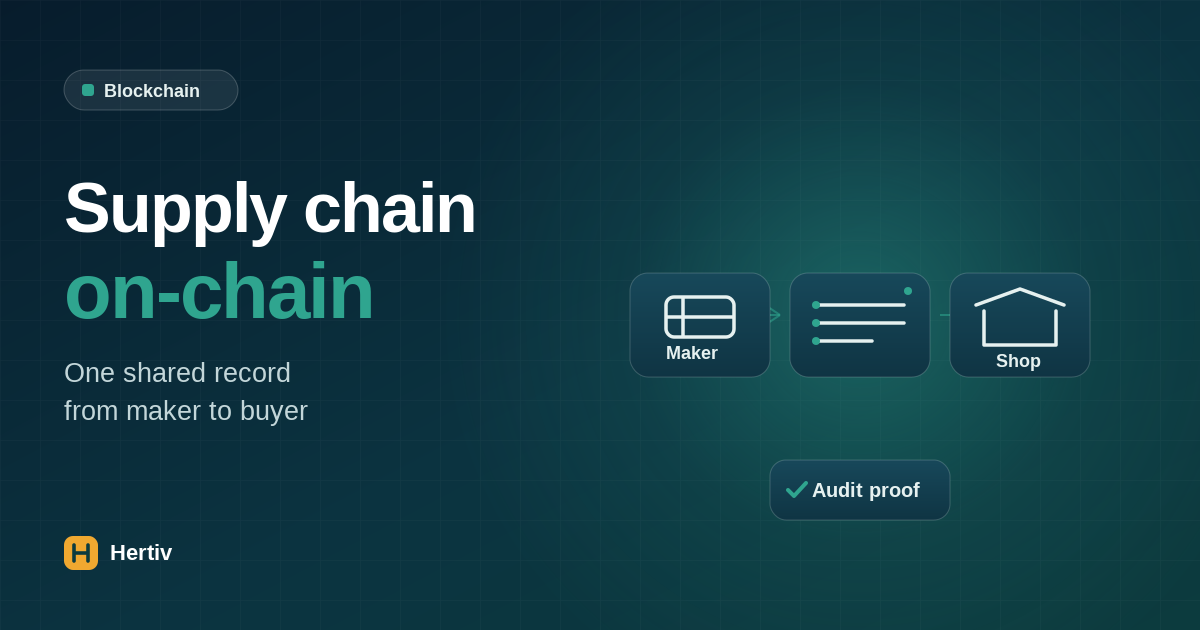
Blockchain gives every company in a supply chain one shared record of where goods are and who handled them. That shared record is why it keeps coming up.
On this page
Short answer
Blockchain in supply chain management is a shared, tamper-resistant record that follows goods from maker to buyer, with each handover written down for every party to see. It matters for three reasons: one record that all parties trust, faster checks at each handover, and proof that survives an audit.
Why does blockchain matter for supply chains?
Blockchain matters for supply chains because no single company owns the whole journey of a product. A shipment passes through makers, shippers, warehouses, customs and shops, and each one keeps its own records. When those records disagree, nobody knows where the goods are or who is at fault.
A blockchain gives all of them one shared record. Each handover is written to the ledger with a time and a signature, and the entry cannot be quietly changed later. That shared record is the point; the technology is only the way to keep it honest.
| Supply chain pain | What usually happens | What blockchain changes |
|---|---|---|
| Lost shipment | Phone calls to five companies | One record shows the last handover |
| Disputed delivery | Conflicting spreadsheets | Both sides read the same entry |
| Fake goods | Paper certificates are copied | Origin entry is signed and checked |
| Slow customs checks | Documents sent by email | Records are already on the ledger |
| Recall tracing | Days of digging through records | Batch history in minutes |
| Missing audit trail | Records edited after the fact | Entries cannot be rewritten |
| Unpaid suppliers | Payment waits on paperwork | Delivery triggers the next step |
| No proof of origin | Buyer trusts a label | Origin is written at the source |
The table shows where the value sits: in the handover, not in the database. If your chain has few parties and everyone already trusts each other, a normal database does the job. The what is blockchain guide explains the shared-ledger idea in plain terms.
1. One shared record that all parties trust
1. One shared record: best for chains with many parties
One shared record is the first reason blockchain matters in supply chains. A product's journey is split across companies that do not fully trust each other, and each one keeps its own copy of the truth. A blockchain replaces those copies with one ledger that every party reads and writes to.
Each entry is signed by the party that made it and linked to the one before it, so changing an old entry would break the chain. That makes the record hard to fake and easy to check, which is what lets a buyer trust a shipment it has never seen.
Pros:
- Every party reads the same record
- Entries are signed and hard to change
- Disputes shrink because the facts are shared
Cons:
- Needs all key parties to join
- Someone must agree the rules first
- Bad data entered is still bad data
2. Faster checks at each handover
2. Faster checks: best for goods that change hands often
Faster checks at each handover are the second reason. When a pallet moves from a warehouse to a truck, the receiving party usually checks paperwork, calls the sender and waits for a system update. With the handover already on the ledger, the check is a lookup instead of a phone call.
That speed matters most for goods that change hands many times: food, medicine and parts that pass through several warehouses. Each party sees the same status, so a delay is visible at once instead of surfacing days later when a customer complains.
Pros:
- Handovers are checked in minutes, not days
- Delays are visible to every party at once
- Less paperwork chasing between companies
Cons:
- Only helps if handovers are recorded on time
- Needs scanners or apps at each stop
- Does not fix slow physical transport
3. Proof that survives an audit
3. Proof that survives an audit: best for regulated goods
Proof that survives an audit is the third reason. Food, medicine and luxury goods face rules about origin, temperature and handling, and a regulator or a buyer may ask for proof months after the shipment. Paper records get lost and spreadsheets get edited, so the proof often fails when it is needed most.
A blockchain keeps the proof in the ledger itself. Each step is time-stamped and signed, so an auditor can follow a batch from source to shelf without asking five companies for their files. That is also why recalls get faster: the affected batch is found in minutes, not days.
Smart contracts can add the next step, releasing a payment or a document when a delivery is confirmed on the ledger. The what is smart contract development guide explains how those automatic steps work.
Pros:
- Full history from source to shelf
- Recalls find the batch in minutes
- Auditors read one record, not five files
Cons:
- Only as good as the data entered
- Setting up the rules takes time
- Small suppliers may lack the tools to join
How to choose a blockchain supply chain pilot
Choose a pilot by picking one product line with a clear pain, not by trying to put the whole chain on a ledger at once. A small pilot proves the value and shows who needs to join.
- Pick one pain. Lost shipments, fake goods or slow recalls each point to a different pilot.
- Map the parties. List every company that touches the goods and check which ones will join.
- Agree the data first. Decide what each handover records before anyone writes code.
- Start with a permissioned network. Most supply chains use a private network where only invited parties read and write.
- Measure the pilot. Compare tracing time, dispute count and check time against the old way before scaling.
Talk to firms that have run a chain pilot before you build. The enterprise blockchain companies for startups list shows what to look for in a partner.
What are the common mistakes?
The most common mistakes are putting the whole chain on a ledger at once, trusting the technology to fix bad data, and leaving suppliers out.
- Starting too big. A whole-chain rollout stalls; one product line and one pain proves the idea.
- Believing the ledger fixes bad data. A blockchain keeps wrong entries safe, so the data entry step needs checks of its own.
- Leaving small suppliers out. If the smallest supplier cannot record a handover, the chain has a gap.
- Skipping the rules. Who can write, who can read and who settles disputes must be agreed before launch.
- Choosing a public chain by default. Most supply chains need privacy, so a permissioned network usually fits better.
Key takeaways
- One shared record replaces conflicting spreadsheets across the chain
- Handovers are checked in minutes because the record is already there
- Audits and recalls are faster because every step is time-stamped and signed
- Start with one product line and one pain, not the whole chain
- A blockchain keeps bad data safe too, so the data entry step needs its own checks
Frequently asked questions
How is blockchain used in supply chain management?
Blockchain is used as a shared ledger that records each handover of goods, from maker to buyer. Every party reads the same record, which cuts disputes, speeds up checks and gives auditors a full history of a batch.
What are the benefits of blockchain in supply chain?
The main benefits are one trusted record across many companies, faster checks at each handover, and proof of origin that survives an audit. Recalls also get faster, because the affected batch is found in minutes rather than days.
Which industries use blockchain in supply chains?
Food, medicine, luxury goods and car parts use it most, because origin, handling and recalls matter there. Any chain where several companies share goods and do not fully trust each other's records can benefit.
Does blockchain stop fake goods?
It helps, but it does not stop them on its own. A signed origin entry makes a fake harder to pass off, yet the physical link between the goods and the entry still needs checks such as tags or scans at each handover.
Is blockchain expensive for supply chains?
A pilot is usually modest in cost, because it covers one product line and a few parties. The larger cost is getting every party to join and agree the rules, so start small and measure the pilot before scaling.
Do small suppliers need to join the blockchain?
Yes, if they handle the goods. A gap at any handover breaks the record, so the pilot must give small suppliers a simple way to record their step, such as a phone app or a scan at the dock.


