6 Types of Startup Funding Worth Knowing
Startup funding comes in six main types, from bootstrapping to venture capital. Learn how each one works, what it costs you, and which fits your stage.
On this page
Short answer
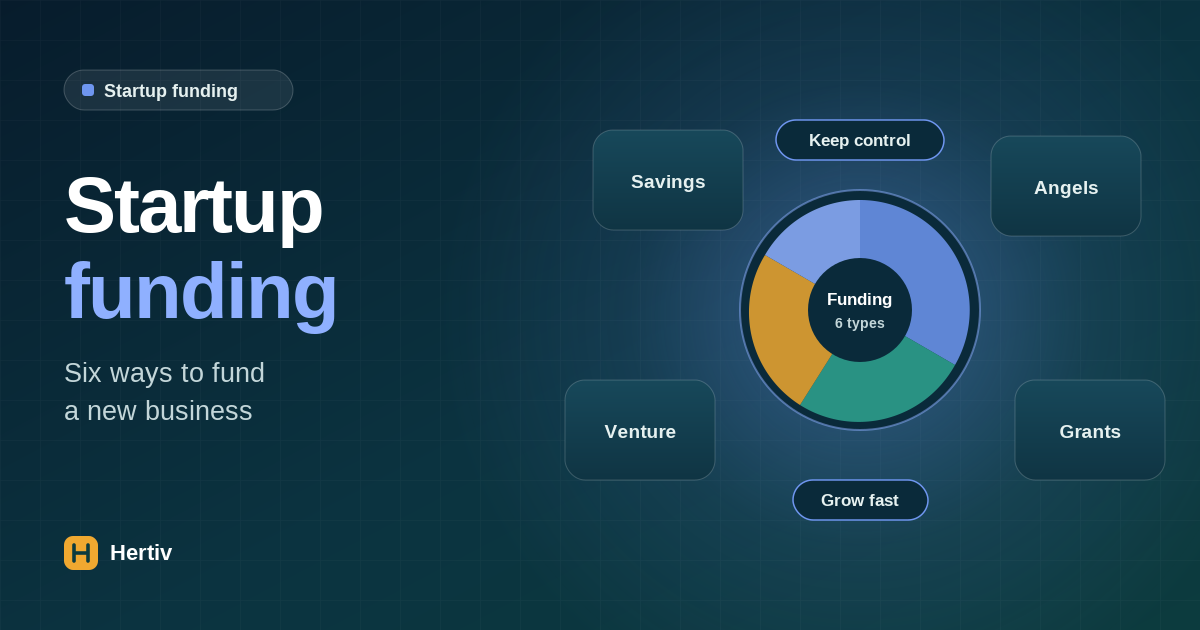
The six main types of startup funding are bootstrapping, friends and family, angel investment, venture capital, crowdfunding and grants. Each one trades money for something different, your own savings, personal trust, equity, control or time, and the right type depends on your stage, your revenue and how much control you want to keep.
Startup funding types at a glance
Every startup needs money before it earns money, and the source of that money shapes the business. Some founders pay from their own savings. Others sell a share of the company to investors, ask the crowd for small amounts, or apply for grants that need no repayment.
| Type | What you give | Typical stage | Speed |
|---|---|---|---|
| Bootstrapping | Your own savings | Day one | Immediate |
| Friends and family | Trust and goodwill | Idea stage | Weeks |
| Angel investment | A small share of equity | Early, pre-revenue | One to three months |
| Venture capital | A larger share of equity | Growth stage | Three to six months |
| Crowdfunding | Rewards or early access | Product ready | One to two months |
| Grants | Time and reporting | Any stage | Months |
No type is best for everyone. A founder with savings and a slow-growing business may never need an investor. A founder building a product that needs a large team before it earns anything will need outside money. Work through the six types below and match one to your stage.
1. Bootstrapping: best for keeping full control
1. Bootstrapping: best for keeping full control
Bootstrapping means funding the startup from your own savings and from the revenue the business earns. You spend only what the business can afford, and you keep every share of the company. Many service businesses, small software tools and niche products start this way.
The trade-off is speed. Growth is limited to what revenue can pay for, so hiring and marketing move slowly. That can be an advantage too: a bootstrapped founder learns which customers pay and which features matter before spending on anything else.
Pros: full control; no debt and no investors to report to; forces a focus on paying customers.
Cons: slow growth; personal savings at risk; hard to compete with funded rivals in fast markets.
2. Friends and family: best for the first small sum
Friends and family funding is money from people who know and trust you, usually a small amount to build the first version of the product. It is often the first outside money a startup takes, and it can come as a loan or as a small share of the company.
The risk is personal, not financial. If the business fails, the money is gone and the relationship can suffer. Put the terms in writing, even with family: how much, what it buys, and what happens if the business closes. Clear terms protect both sides.
Pros: fast and flexible; no formal pitch needed; terms can be simple.
Cons: personal relationships at stake; small amounts only; unclear terms cause conflict later.
3. Angel investment: best for early funding with advice
3. Angel investment: best for early funding with advice
Angel investors are individuals who invest their own money in early startups, usually in exchange for a small share of the company. Many are former founders who also give advice, introductions and help with hiring. The amount is usually smaller than venture capital, but it arrives earlier.
Angels invest in the founder as much as in the idea. They look for a team that understands its customers and can show early signs of demand, such as paying users or a waiting list. In return they expect regular updates and a say in major decisions, though rarely day-to-day control.
Pros: money plus experience and contacts; faster than venture capital; works before revenue.
Cons: you give up equity; investors expect updates and progress; terms vary widely.
4. Venture capital: best for fast, large-scale growth
Venture capital is money from funds that invest in startups with the potential to grow very large, very fast. A venture round is usually larger than an angel round and comes with a board seat, reporting duties and pressure to grow quickly. It fits products that need a big team and big marketing before they earn serious revenue.
Venture capital is not for every startup. Funds look for markets that can support a very large company, and most startups do not fit that shape. Taking venture money also means giving up a large share of control, and the fund will expect the company to aim for a sale or a public listing.
Pros: large amounts for fast growth; strong networks and credibility; follow-on funding possible.
Cons: loss of control; pressure to grow at all costs; only fits very large markets.
5. Crowdfunding: best for testing demand in public
5. Crowdfunding: best for testing demand in public
Crowdfunding raises many small amounts from a large number of people, usually through a platform. Backers may get the product early, a reward, or a small share of the company, depending on the platform. It works best for products people can see and understand, such as hardware, games and consumer apps.
The campaign itself is the test. If strangers pay before the product exists, the idea has real demand. If nobody backs it, the idea needs work. Running a campaign takes weeks of preparation, and delivering to backers on time is a project in itself. For how token-based funding differs, see ICO vs crowdfunding.
Pros: validates demand before building; no equity in reward campaigns; builds an early audience.
Cons: public failure if the campaign flops; delivery duties to backers; platform fees apply.
6. Grants: best for funding without giving up equity
Grants are money given by governments, foundations or programmes to support a specific kind of work, such as research, clean energy or regional development. Grants do not need repayment and do not take equity, which makes them attractive for deep-tech and social ventures.
The catch is time and paperwork. Applications are long, decisions take months, and the money often comes with reporting rules and limits on how it can be spent. Grants rarely fund a whole company, so most founders use them alongside another type of funding.
Pros: no equity and no repayment; good for research and deep tech; adds credibility.
Cons: slow decisions; heavy paperwork; money is restricted to approved uses.
How to choose
Choosing a funding type comes down to your stage, your market and how much control you want to keep. Work through these steps before you take any money.
- Work out how much you need. Price the first version and six months of running costs. For how to size a first version, see what is an MVP.
- Check what the money costs. Bootstrapping costs your savings. Investors cost equity and control. Crowdfunding costs time and delivery. Grants cost paperwork and patience.
- Match the type to your stage. An idea with no product fits friends and family or an angel. A product with users fits angels or venture capital. A finished product fits crowdfunding.
- Talk to founders who took it. Ask what the terms really meant, what surprised them, and what they would do differently. One honest conversation beats ten articles.
- Keep a plan B. Funding rounds fail and campaigns flop. Know how long your savings last and what you will cut if the money does not arrive.
If you are comparing funding with building the product first, MVP app development cost shows what a first version usually costs.
What are the common mistakes?
The most common funding mistakes are raising too much too early, taking money from the wrong people, and spending before the product is proven.
- Raising too much, too early. Extra money feels safe, but it dilutes your share and raises expectations. Raise what the next stage needs, not what you can get.
- Ignoring the terms. A low valuation or a harsh term sheet can cost more than the money is worth. Read every term and get advice before signing.
- Mixing money and family. Taking money from family without written terms puts relationships at risk. Write it down, even when it feels awkward.
- Spending on the wrong things. Funding should buy proof: a working product, paying users, or a clear answer about demand. Office space and branding can wait.
- Chasing venture capital by default. Most startups do not fit the venture model. A funded competitor is not a reason to raise if your market is small and steady.
Key takeaways
- Bootstrapping and friends and family are the usual first money, because they are fast and keep control
- Angel investors add money plus advice, while venture capital adds large money plus pressure to grow fast
- Crowdfunding tests demand in public; grants fund specific work without taking equity
- The cost of money is not only cash: it is equity, control, time or personal risk
- Raise what the next stage needs, and read every term before you sign
Frequently asked questions
How much money should a startup raise first?
Raise enough to build the first version and run for six months, plus a small reserve for surprises. Raising far more than that dilutes your share and raises expectations before you have proof the product works.
Is bootstrapping better than taking investment?
It depends on the market. Bootstrapping fits businesses that earn revenue early and grow steadily. Investment fits products that need a large team before they earn anything. Neither is better in general.
What is the difference between an angel and a venture capitalist?
An angel invests personal money, usually early and in smaller amounts, and often helps with advice. A venture capitalist invests a fund's money, usually later and in larger amounts, and expects fast growth and a board seat.
Can I crowdfund a software startup?
Yes, but it works best when backers can see and use the product early. Software with a clear demo, a beta or early access tends to do better than a back-end tool that backers cannot try.
Do grants need to be repaid?
No, grants do not need repayment and do not take equity. They do come with rules on how the money can be spent and what you must report, and decisions often take months.
When should a startup talk to investors?
When you can show something real: a working product, paying users, or clear evidence that people want what you are building. Talking earlier usually means talking with nothing to show.


