8 Startup Business Ideas in Australia Worth Building
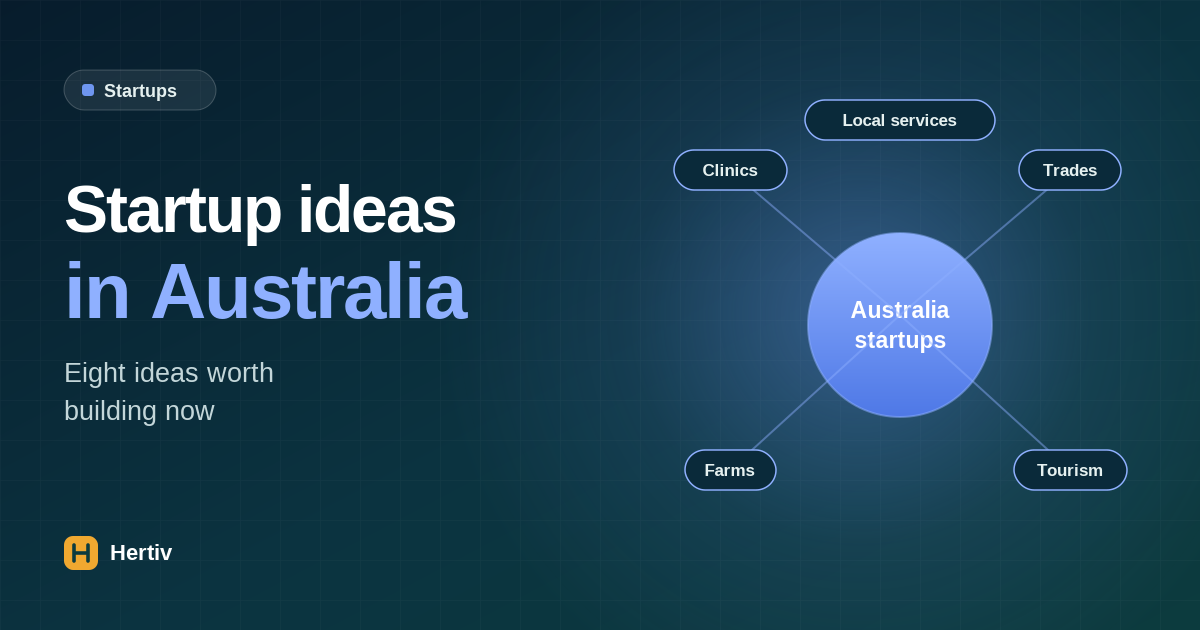
Eight startup ideas fit Australia well: clinic booking, trades quoting, farm data, tutoring, delivery tracking, finance, tourism and local services.
On this page
Short answer
Startup business ideas in Australia work best when they fit local life: big distances, small towns, strict rules and industries like health, farming and tourism. The eight ideas below are all software businesses a small team can start, and each one solves a problem Australian businesses already pay to fix.
Which startup ideas fit Australia best?
The best startup ideas in Australia start from a local problem, not a global trend. A clinic in a country town, a plumber covering a whole region, or a farm hours from the nearest city all have the same pain: distance, paperwork and waiting. Software that cuts the waiting is worth paying for.
The eight ideas below cover health, trades, farming, learning, delivery, finance, tourism and local services. Each one can start small in one city or region and grow without a huge team. For the planning basics, read what an MVP is before you pick an idea.
| Idea | Who pays | Why it fits Australia |
|---|---|---|
| Clinic booking software | Clinics and patients | Long waits and far distances |
| Trades quoting tool | Plumbers, electricians | Big regions, small teams |
| Farm data dashboard | Farmers and agronomists | Remote land, big decisions |
| Tutoring marketplace | Parents and students | After-hours learning demand |
| Delivery tracking | Shops and couriers | Wide delivery areas |
| Small business finance app | Small firms | Cash flow is the top worry |
| Tourism booking tool | Tour operators | Seasonal visitors, many channels |
| Local services marketplace | Homeowners | Trust matters most |
<h3>1. Clinic booking software: best for health startups</h3>
Clinics in Australia juggle phone bookings, reminders and no-shows across long days. A booking tool that handles online booking, reminders and a simple waitlist cuts the phone queue and fills empty slots. The clinic pays because every filled slot is income.
The hard part is health data: Australian privacy rules are strict, and a booking tool must handle patient details with care. A team that builds privacy in from the start, and keeps the tool simple for older patients, has a real edge. Start with one clinic, learn its day, then grow.
- Pros: clinics pay for filled slots; the problem is the same in every town.
- Cons: health privacy rules are strict; older patients need a simple design.
2. Trades quoting tool: best for small trade firms
Plumbers and electricians lose hours writing quotes after a long day on site. A tool that turns a site visit into a quote in minutes, with photos and a price the customer can accept on the spot, wins the job before a rival replies. The trade firm pays because quotes turn into work.
The tool must work on a phone, on site, with poor signal. A quoting app that needs an office computer will not be used. Keep the quote simple: job, price, date, accept button. The rest can wait.
- Pros: fast quotes win jobs; the tool is used every day on site.
- Cons: must work offline on a phone; trade firms are slow to change tools.
<h3>3. Farm data dashboard: best for agtech founders</h3>
Australian farms are large, remote and data-rich: soil, rain, machines and markets all produce numbers. A dashboard that pulls those numbers into one clear view helps a farmer decide what to plant, when to water and when to sell. The farmer pays because one good decision covers the cost.
The challenge is connection: many farms have poor internet, so the dashboard must work with data that arrives late. A team that designs for offline-first, with a simple view a farmer can read in the ute, will beat a fancy dashboard that needs fast broadband.
- Pros: one good decision pays for the tool; farms are large and underserved.
- Cons: poor rural internet; farmers trust people, not dashboards, at first.
4. Tutoring marketplace: best for education founders
Parents across Australia pay for tutoring, and good tutors are hard to find outside the big cities. A marketplace that matches students with tutors by subject, level and time zone, with video lessons built in, opens tutoring to families in small towns. Parents pay because the tutor is one click away.
Trust is the whole product here: verified tutors, clear pricing and a simple way to report a bad lesson. A marketplace that checks its tutors and handles payment cleanly will beat a free listings page every time.
- Pros: demand exists in every town; video lessons remove the distance problem.
- Cons: trust must be earned tutor by tutor; quality varies widely.
<h3>5. Delivery tracking: best for retail and courier teams</h3>
Australian shops deliver across wide areas, and customers want to know where their order is. A tracking tool that gives the customer a live map, a delivery window and a message when the driver is near cuts support calls and missed deliveries. The shop pays because fewer calls mean less staff time.
The tool must handle the long tail: rural addresses, gated properties and drivers who cover huge routes. A simple map with honest time windows beats a precise tracker that breaks on a country road.
- Pros: fewer support calls; works for any shop that delivers.
- Cons: rural addresses are messy; drivers need a simple app.
6. Small business finance app: best for cash flow pain
Cash flow is the top worry for Australian small businesses: invoices paid late, tax due at the wrong time, and no clear view of the month ahead. A finance app that shows money in, money out and tax set aside, in plain words, helps owners act before a problem hits. Owners pay because it stops surprises.
The app must connect to Australian banks and accounting tools, and it must speak plain English, not accounting jargon. A tool that shows one clear number, such as cash available after tax, is worth more than ten charts.
- Pros: cash flow pain is universal; owners pay for peace of mind.
- Cons: bank connections are fiddly; accounting jargon scares users off.
<h3>7. Tourism booking tool: best for seasonal operators</h3>
Tour operators in Australia sell through many channels: their own site, agents, hotels and marketplaces. A booking tool that keeps availability in one place, so a seat is never sold twice, saves the operator from angry customers and lost income. The operator pays because double bookings cost real money.
Seasonality is the challenge: a tool that earns its keep in a busy summer must still be worth paying for in a quiet winter. Keep pricing tied to bookings, not a flat fee, so the operator pays most when the tool earns most.
- Pros: stops double bookings; operators feel the pain directly.
- Cons: income is seasonal; many channels must stay in sync.
8. Local services marketplace: best for trust-first teams
Homeowners need cleaners, gardeners and handymen, and they choose on trust. A marketplace that verifies workers, shows real reviews and handles payment and disputes gives homeowners the confidence to book. The worker pays a fee because the marketplace brings the jobs.
The hard part is supply: without enough good workers, the marketplace has nothing to sell. Start in one suburb, sign up twenty great workers, and grow street by street. A marketplace that works in one suburb will work in the next one too.
- Pros: trust is a real edge; every suburb needs the same service.
- Cons: supply must come first; bad workers damage trust fast.
How to choose an idea
Pick the idea where you already know the customer. If you worked in a clinic, build the clinic tool. If your family runs a trade firm, build the quoting tool. Knowing the customer beats knowing the technology, because the customer tells you what to build.
Then test the idea with ten real customers before you build much. Ask if they would pay, how much, and what they use today. If ten people will not pay, a hundred will not either. Read how to build an MVP to keep the first version small.
Also check what an MVP costs before you plan the budget, so the first version fits what you can afford.
- Pick the idea where you already know the customer well.
- Talk to ten real customers and ask what they pay for today.
- Build the smallest version that solves one clear problem.
- Charge from the start, so you learn if it is worth paying for.
- Grow one city or region at a time, not the whole country at once.
Common mistakes
The most common mistake is building for the whole country on day one. Australia is big and varied, and a product that works in Sydney may fail in a country town. Start in one place, learn it well, then expand.
Another mistake is copying a US startup without checking the rules. Australian privacy, tax and employment rules differ, and a product built for another market can break on local law. Check the rules early.
A third mistake is building before talking to customers. A team can spend six months on a beautiful product nobody wants. Ten customer conversations cost a week and can save six months.
Finally, do not undercharge. Australian small businesses will pay for a tool that saves real time or money, and a price that is too low signals a tool that is not serious. Charge what the problem is worth.
Key takeaways
- Pick an idea where you already know the customer
- Start in one city or region, not the whole country
- Talk to ten real customers before building much
- Charge from the start so you learn if it is worth paying for
- Australian rules differ from US rules, so check them early
Frequently asked questions
Which startup idea is best for Australia?
The best idea is the one where you already know the customer. Health, trades, farming and tourism all have real pain in Australia, and a founder who knows the customer can build a tool that fits local life.
Do I need a lot of money to start?
No. Most of these ideas can start as a small tool for one city or one industry. A small version that solves one problem for ten paying customers is a better start than a big product with no customers.
How do Australian rules affect a startup?
Privacy, tax and employment rules in Australia differ from other markets. A product built for another country can break on local law, so teams check the rules for their industry early.
Should I build for the whole country at once?
No. Start in one city or region, learn what customers there need, and expand once the product works. A product that works in one place will work in the next one too.
How do I test an idea cheaply?
Talk to ten real customers and ask what they pay for today. If they will not pay for a small version, they will not pay for a big one, and the conversation costs far less than building.
What makes Australian customers different?
Distance and trust matter more. Customers are spread out, often in small towns, and they buy from people they trust. A product that works offline and earns trust will beat a flashy one.


