Stablecoins in Ecommerce: Checkout, Refunds and Payouts
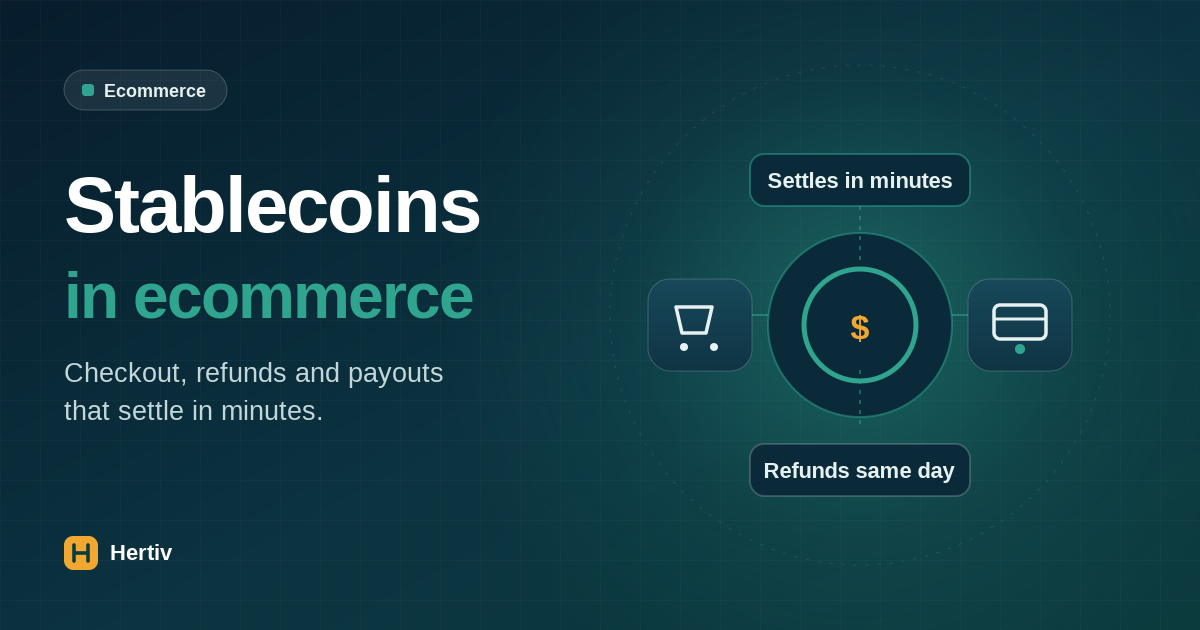
Stablecoins give online shops a payment option that settles in minutes and works across borders. Here is where they help at checkout, and where they do not.
On this page
Short answer
Stablecoins in ecommerce are dollar-pegged digital tokens that online shops accept at checkout, use to pay suppliers and marketplaces, and hold as balances for refunds and payouts. They settle in minutes rather than days and work across borders without card networks. They help most with cross-border sales, marketplace payouts and refunds, and least with ordinary domestic card sales where cards already work well.
What are stablecoins in ecommerce?
Stablecoins in ecommerce are digital tokens pegged to a currency, usually the US dollar, that an online shop accepts as payment or uses to move money. A customer pays with a stablecoin from a wallet, the shop receives tokens, and the shop can hold them, convert them to local currency, or spend them on suppliers.
They differ from ordinary crypto payments because the value does not swing with the market. A shop that prices a product at 50 dollars receives 50 dollars' worth of stablecoins, not an amount that could be worth 45 or 55 dollars by the time the payment clears. That stability is what makes them usable for everyday online sales.
For the basics of what a stablecoin is and how the peg works, what is a stablecoin explains the main types and how each one holds its value.
How does a stablecoin checkout work?
A stablecoin checkout works like a card checkout with a different final step. The customer picks the stablecoin at payment, the shop shows a price in that token, and the customer approves the payment from a wallet. The payment settles on a blockchain in minutes, and the shop sees the funds without waiting for a card network to clear them.
Most shops do not handle the blockchain directly. A payment gateway or processor takes the stablecoin, confirms the payment, and either passes the tokens to the shop or converts them to local currency. The shop's order system sees a normal paid order, and the customer gets the usual confirmation email.
The table shows where stablecoins fit in an online shop, and where cards still win.
| Use | Stablecoins help when | Cards still win when |
|---|---|---|
| Checkout | Buyer is abroad or unbanked | Buyer is local and carded |
| Cross-border sales | Fees and delays are high | Market already has local rails |
| Refunds | Refund must be instant | Buyer expects a card refund |
| Marketplace payouts | Sellers are in many countries | Sellers all use one bank |
| Subscriptions | Buyer prefers wallet billing | Buyer expects card billing |
| Loyalty balances | Points should move across shops | Points stay inside one shop |
Where do online shops actually use stablecoins?
Online shops use stablecoins in a few places where the old payment rails are slow or expensive. The first is cross-border sales: a shop selling to customers in several countries can accept one token instead of setting up local payment methods in each market.
The second is marketplace payouts. A marketplace with sellers in many countries can pay them in stablecoins in minutes, instead of running bank transfers that take days and cost a fee each. The third is refunds: a stablecoin refund reaches the customer the same day, which matters when the customer is waiting to buy a replacement.
A fourth use is supplier payments. A shop that buys stock from overseas suppliers can pay in stablecoins and skip the bank's conversion fee and delay. The supplier receives the same value, and the shop keeps a clear record of each payment on the chain.
What do stablecoins cost an online shop?
Stablecoins cost an online shop in three places: the gateway or processor fee, the network fee for each payment, and the cost of converting tokens to local currency. Gateway fees vary by provider and by volume, so ask for a written quote; see the vendor site for current figures.
Network fees depend on the chain. Some chains charge a fraction of a cent per payment, others charge more when the network is busy. Choosing the chain is therefore a cost decision as well as a technical one, and many shops accept stablecoins on one low-fee chain only.
Conversion is the hidden cost. If the shop converts every payment to local currency at once, it pays a spread on each conversion. Holding a balance in stablecoins and converting in larger batches usually costs less, but it leaves the shop holding tokens it must account for.
What are the risks and compliance duties?
The risks of stablecoins in ecommerce are price stability, regulation and customer support. A stablecoin can lose its peg, a regulator can change the rules for accepting them, and a customer who sends payment to the wrong address has no card company to call.
Compliance duties depend on where the shop and its customers are. Some places treat stablecoin payments like any other payment, others require licences or reporting, and a few restrict them. A shop should check the rules for each market it sells into before turning the option on, and keep records of every payment, refund and conversion.
Customer support needs a plan too. Staff should know how to check a payment on the chain, how to handle a payment sent to the wrong address, and when to escalate to the gateway provider. A shop that cannot answer those questions will struggle the first time a customer reports a missing payment.
Example (hypothetical): a shop adds stablecoin checkout
Example (hypothetical): an online shop sells phone accessories to customers in 12 countries. About 300 orders a month come from abroad, and card payments for those orders take 3 days to settle and cost about 4% in fees and conversion.
The shop adds stablecoin checkout for orders over 40 dollars. In the first month, 60 of the 300 cross-border orders are paid in stablecoins. Each one settles in about 10 minutes instead of 3 days, and the fee is about 1% instead of 4%.
On those 60 orders, the average order value is 60 dollars, so the shop saves about 3% of 3,600 dollars, or about 108 dollars in the month, and the money arrives days earlier. Refunds are faster too: a stablecoin refund reaches the customer the same day, while a card refund took up to 5 days.
What are the common mistakes?
The most common mistakes are turning stablecoins on for every order at once, and treating them as free money. Both create work that a small pilot would have caught.
- Offering stablecoins to everyone on day one. Start with cross-border orders, where the benefit is clear, and learn from a small group.
- Ignoring conversion costs. A low gateway fee means little if converting to local currency eats the saving.
- No plan for wrong-address payments. Decide in advance what happens when a customer sends funds to the wrong address.
- Forgetting tax and accounting. Stablecoin sales, refunds and conversions all need records; set the process up before launch.
- Accepting too many chains. One or two low-fee chains are easier to support than five.
Start with one chain, one customer group and a clear refund process, then expand only when the pilot works. For the wider retail picture, stablecoins in retail covers how physical shops use the same tokens.
Key takeaways
- Stablecoins suit cross-border checkout, marketplace payouts and fast refunds
- A stablecoin payment settles in minutes; the shop can hold tokens or convert them
- Gateway, network and conversion fees together decide whether it pays off
- Rules differ by market, so check compliance before turning the option on
- Start with one chain and one customer group, not with every order at once
Frequently asked questions
Do customers actually pay with stablecoins?
Some do, mainly for cross-border orders and in places where card payments are slow or expensive. Most domestic customers still prefer cards, so stablecoins work best as an extra option at checkout rather than a replacement for cards.
Which stablecoin should a shop accept?
Shops usually start with a widely held dollar-pegged stablecoin on a low-fee chain, since that is what most wallet users hold. The choice depends on what your customers already use, so check your audience before picking a token or a chain.
Are stablecoin payments reversible?
No, in the usual sense. A blockchain payment cannot be recalled once it settles, so refunds are new payments sent back to the customer. Shops need a clear refund process and a way to verify the customer's wallet address before sending funds.
Do stablecoins save money on fees?
They can, mainly on cross-border orders where card fees and conversion add up. The saving depends on the gateway fee, the network fee and the conversion spread, so compare the full cost against your current card costs before deciding.
What happens if a stablecoin loses its peg?
The token can trade below its target value until confidence returns, which means a shop holding it can lose money. Shops reduce this risk by converting payments to local currency quickly and by accepting only well-established stablecoins.
Do I need a licence to accept stablecoins?
It depends on where your shop and your customers are. Some places treat accepting stablecoins like any other payment, others require licences or reporting. Check the rules for each market you sell into, and keep records of every payment and refund.


